
Fall Wallpaper for iPhone: Cozy Autumn Lock Screen Ideas

Updated August 2026 · Practical autumn wallpaper ideas for iPhone Lock and Home Screens

Fall backgrounds for iPhone are vertical autumn images chosen and cropped for the Lock or Home Screen. They work best when the scene leaves room for the real interface: use a calm clock zone, move the main subject away from notifications, and preview it with the widgets you actually use. Even a cozy picture can look beautiful in a gallery and still feel crowded on a Lock Screen.

The fast answer

For a Lock Screen: use a detailed fall scene with open space behind the clock and room below for notifications.

For a Home Screen: use the same palette with fewer edges behind app icons and widgets.

Before saving: check the active screen, dimmed screen, clock style, widgets, and a sample notification. The configured phone is the decision surface.

This guide gives you 12 composition ideas, a mood-to-screen-fit table, current iPhone setup steps, and a practical way to reject a wallpaper before it becomes annoying. These are design ideas rather than promises that all 12 files already exist in iScreen. For ready-to-use choices, you can browse iPhone wallpapers.

The Clock-First Crop: A First-Pass Fall Wallpaper Check
The Clock-First Crop: A First-Pass Fall Wallpaper Check — iScreen

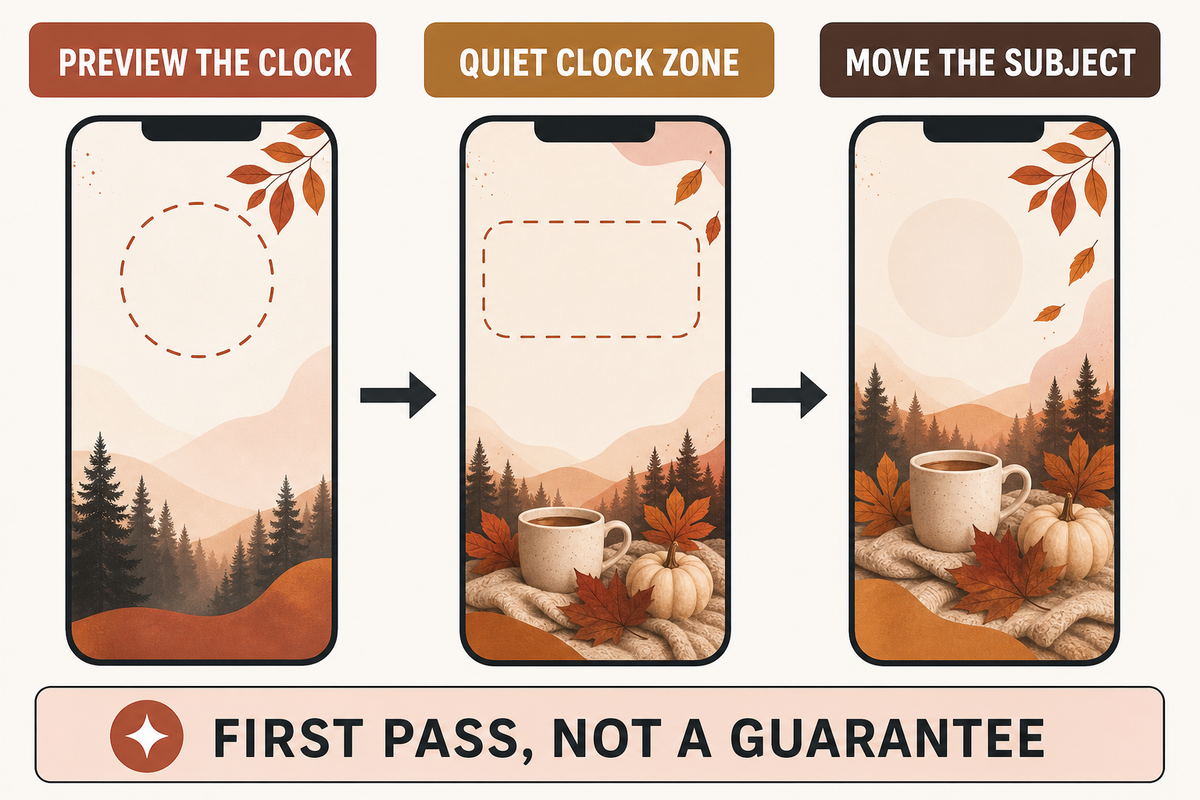
The Clock-First Crop is a quick first-pass check: preview the clock before judging the art, keep its immediate background relatively quiet, and move the main object away from the notification stack. It does not guarantee readability. Brightness, color, visual clutter, room lighting, widgets, notifications, and your chosen clock treatment can all change the final result.

That screen-fit problem is why mood comes before placement, not instead of it. A rusty forest path can carry more edge detail than a cream flat lay, but the path’s vanishing point should not disappear under the time. Pink pumpkins can preserve a soft fall aesthetic if their strongest shapes sit in the lower half. The goal is not to make every iPhone background empty. It is to give the interface somewhere to live.

Choose a fall mood by focal placement and screen tolerance
Mood Palette Best focal placement Widget tolerance Home Screen companion
Warm and cozy Amber, cream, walnut Lamp, mug, or book below center Medium Cream-to-amber blur
Colorful leaves Rust, gold, red Canopy at edges; open sky above Low to medium One enlarged leaf
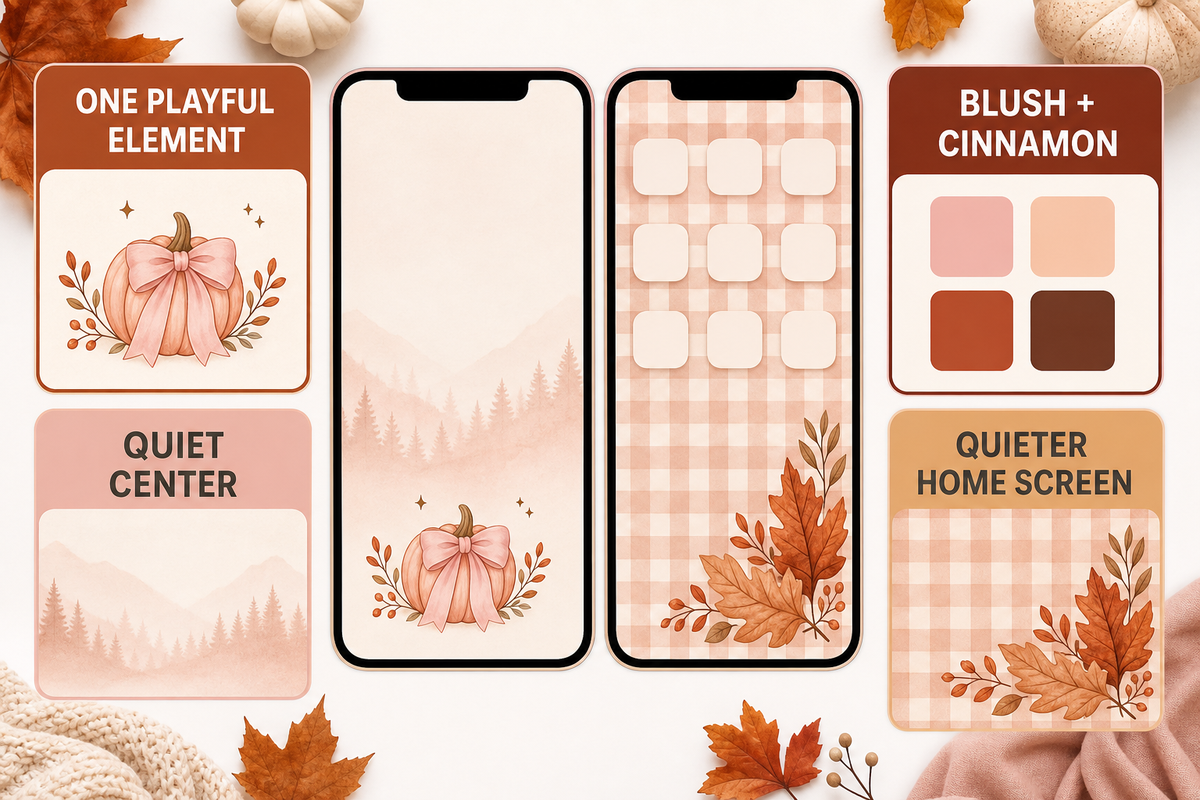
Soft and cute Blush, peach, cinnamon One doodle group in lower third High Wide gingham or tiny corner motif
Dark and moody Charcoal, brown, muted orange Porch or moon below the clock Medium Low-detail charcoal gradient
Pumpkin harvest Pumpkin, oat, olive Still life across the bottom Medium Single pumpkin silhouette
Minimal neutral Oat, cocoa, black Small line art off center High Paper texture or flat color

Current search demand helped allocate space among cozy, cute, aesthetic, leaves, and holiday variations, but it does not prove a universal taste hierarchy. Use the table as a screen-fit decision, not a rule about which autumn style is “best.”

12 Cozy Fall Wallpaper Ideas for iPhone
12 Cozy Fall Wallpaper Ideas for iPhone — iScreen

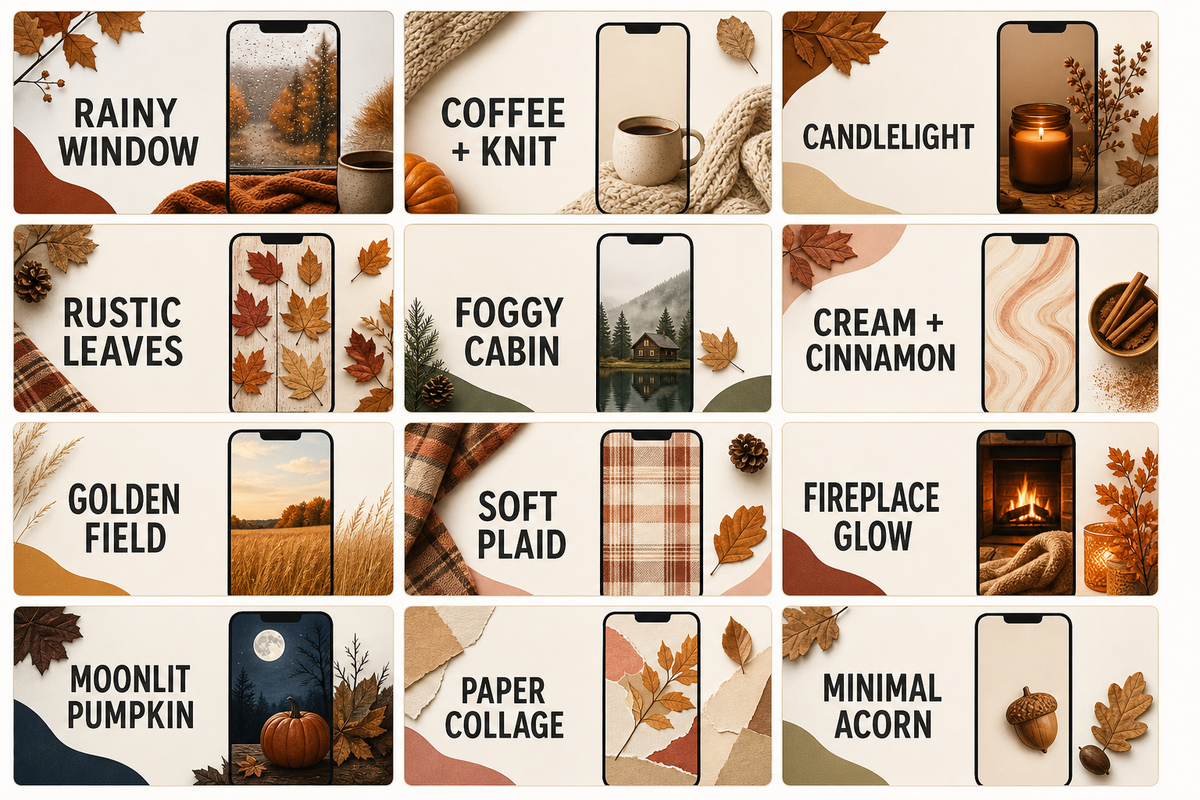
The 12 fall wallpaper ideas cover indoor warmth, outdoor color, texture, and minimal art. Each includes a clock-zone direction and a Home Screen pairing, so you can compare daily usability instead of choosing from mood alone. Keep the art original and generic: no copied commercial illustration, protected character, celebrity, team mark, or branded object is needed to make autumn recognizable.

12-Idea Screen-Fit Table
Idea category Clock zone Widget tolerance Home Screen pair
1. Rainy window and warm lamp Keep the lamp low; use the dim window above. Medium Amber rain blur
2. Coffee, knit blanket, and book Place the flat lay below the clock. Low Close crop of cream knit
3. Amber candlelight still life Move flame away from the digits. Medium Brown-to-amber gradient
4. Rustic wood and dried leaves Leave a bare wood panel at top. High Wood grain with one corner leaf
5. Foggy cabin morning Use fog for time; cabin sits low. High Fog and pine color field
6. Cream and cinnamon flat lay Push spices to lower corners. High Warm cream paper texture
7. Golden-hour field Put the horizon below center. High Soft gold sky crop
8. Soft plaid texture Lower contrast behind the time. Medium Enlarged, quieter plaid
9. Fireplace glow Frame the fire below notifications. Low Charcoal wall with soft glow
10. Moonlit pumpkin porch Separate the moon from the clock. Medium Midnight blue with one leaf
11. Brown-paper autumn collage Build the collage around blank center space. Medium Plain kraft paper grain
12. Minimal acorn and leaf line art Place one motif below the time. High Matching micro-motif at one edge

Autumn Leaves and Forest Backgrounds

Autumn Leaves and Forest Backgrounds — iScreen

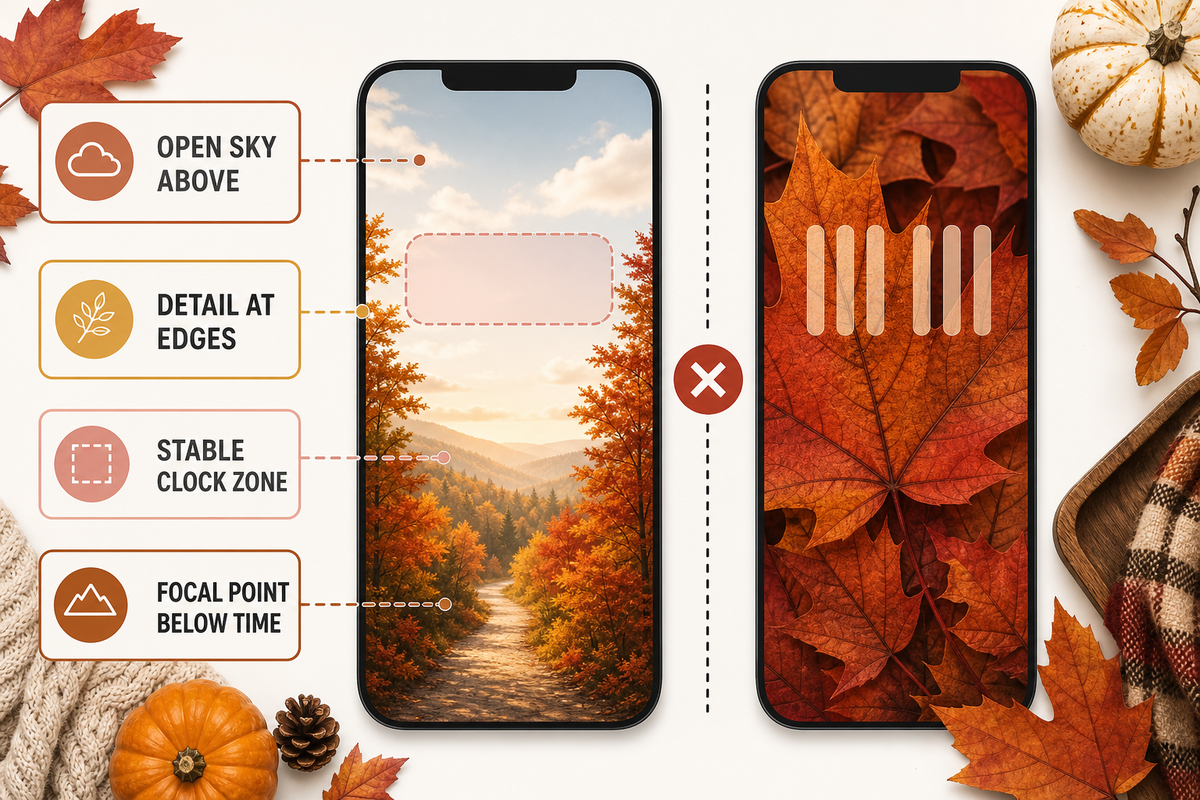
For leaf and forest fall backgrounds for iPhone, choose a composition with one stable region rather than equal detail everywhere. An open sky above red maples, fog above a golden aspen path, or dark water above a reflection gives the clock a usable field while keeping the scene unmistakably autumnal.

A leaf close-up can work if the main vein runs beside the clock instead of through it. A falling-leaf pattern is more forgiving at the edges than in the center. Yellow autumn backgrounds—or iPhone wallpapers featuring autumn leaves—still need a stable clock zone. For a forest trail, place the brightest vanishing point below the time; otherwise the clock and path compete for the same focal role. Misty evergreens suit more widgets because fog reduces local edge detail, while a crisp red canopy needs a cleaner crop.

The useful distinction is not “photo versus illustration.” It is edge distribution. Fine detail around the perimeter can frame the interface. Fine detail directly under digits and small widget text makes the phone harder to scan.

Cute, Pink, and Soft Fall Backgrounds
Cute, Pink, and Soft Fall Backgrounds — iScreen

Cute fall wallpaper stays readable when one playful element gets priority. Try blush pumpkins below the clock, cream-and-peach leaf doodles around the border, a warm gingham field with one large bow, or a soft digital graphic of tiny acorns spaced widely around the edges. Keep the center quieter than the corners.

Pink does not have to mean low contrast. A deep cinnamon clock over pale blush can be clearer than white digits over a busy orange photograph. Soft styles also adapt well to a matching Home Screen: enlarge the gingham, remove most doodles, or isolate one peach leaf in a corner. If the Lock Screen already has widgets, skip decorative phrases and let shape and color carry the theme.

Pumpkin, Halloween, and Thanksgiving Styles
Pumpkin, Halloween, and Thanksgiving Styles — iScreen

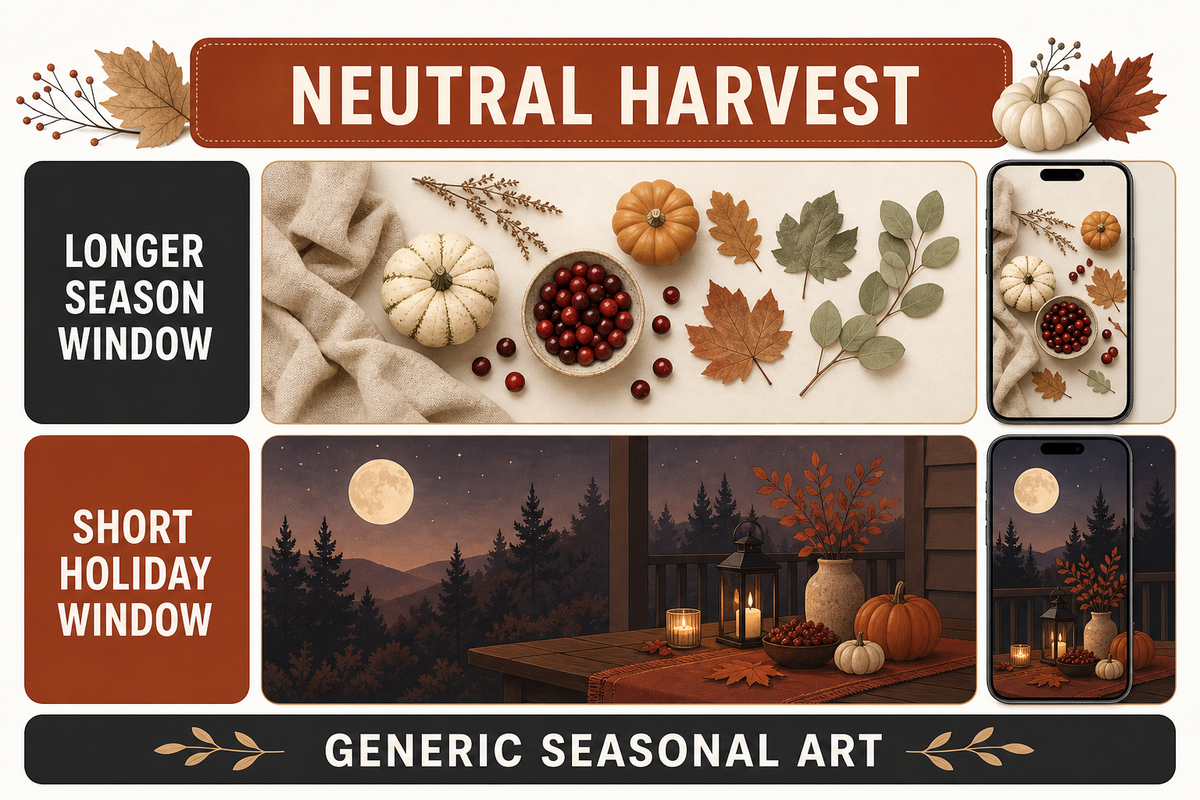
Holiday-specific fall wallpaper works best when you decide how long it should stay on the phone. Neutral pumpkins, cranberries, dried leaves, harvest linen, and a late-autumn sky can run from September through November. Jack-o’-lantern faces, bats, or a dinner-table message create a shorter Halloween or Thanksgiving window.

Build a curated shortlist of neutral harvest images and shorter-window holiday styles before saving one. For a versatile pumpkin Lock Screen, use three or fewer large forms across the bottom and leave the upper wall, sky, or paper field open. Pumpkin iPhone wallpapers can stay on your phone into November, while an early Christmas motif changes the seasonal message. For subtle spooky mood, try a moonlit porch, bare branch silhouette, or black cat-shaped shadow created as original art. A harvest table should be cropped low enough that dishes do not sit under notification banners. For a Home Screen companion, reduce the scene to one pumpkin or a broad linen texture so icons stay easy to find. Avoid copying protected characters or franchise-specific artwork; generic seasonal objects provide more freedom to coordinate the rest of the screen.

Keep the Clock and Widgets Readable
Keep the Clock and Widgets Readable — iScreen

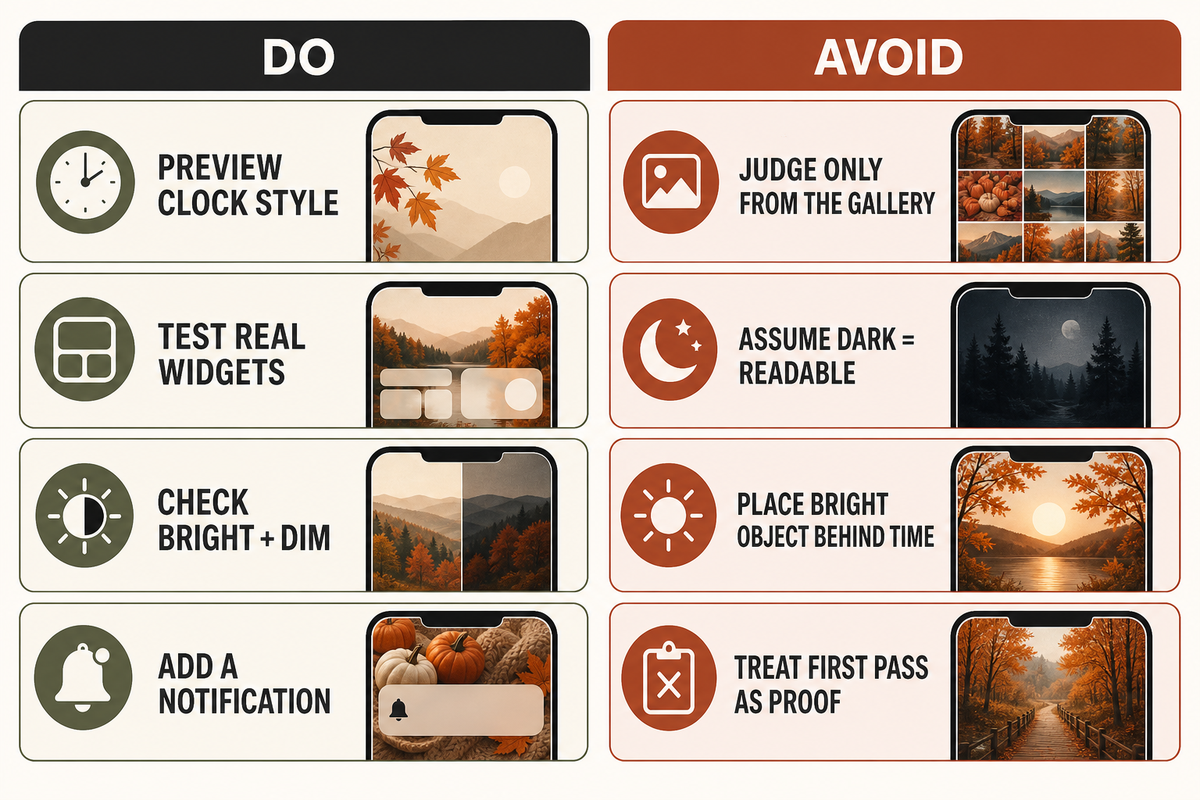
A readable fall Lock Screen needs local separation behind every foreground element, not merely a “light” or “dark” wallpaper label. Check the clock, each widget, the notification area, the focal subject, the active screen, and the dimmed screen. Recheck after changing clock color or widget load, because the same source image can behave differently in another configuration.

W3C Technique G18 supports the general principle that text must remain distinguishable over solid, varying, and patterned backgrounds. Here, that principle is a practical design lens, not a claim that your iPhone wallpaper must meet a particular web-compliance ratio.

Apple’s system editor is why The Clock-First Crop starts with the interface. Apple’s current Lock Screen guide documents photo repositioning, clock appearance, and widgets.

“You can personalize your Lock Screen by choosing a wallpaper, showcasing a favorite photo, changing the font of the time.”

Those controls mean a gallery thumbnail cannot prove final readability.

Do

  • Preview the actual clock color and font.
  • Test with the widgets you really keep.
  • Wake the screen in bright and dim surroundings.
  • Recheck after a notification appears.

Don’t

  • Judge only from the uncropped gallery image.
  • Assume dark automatically means readable.
  • Place the brightest object behind the time.
  • Treat The Clock-First Crop as a guarantee.

How to Set and Crop a Fall Wallpaper on iPhone
How to Set and Crop a Fall Wallpaper on iPhone — iScreen

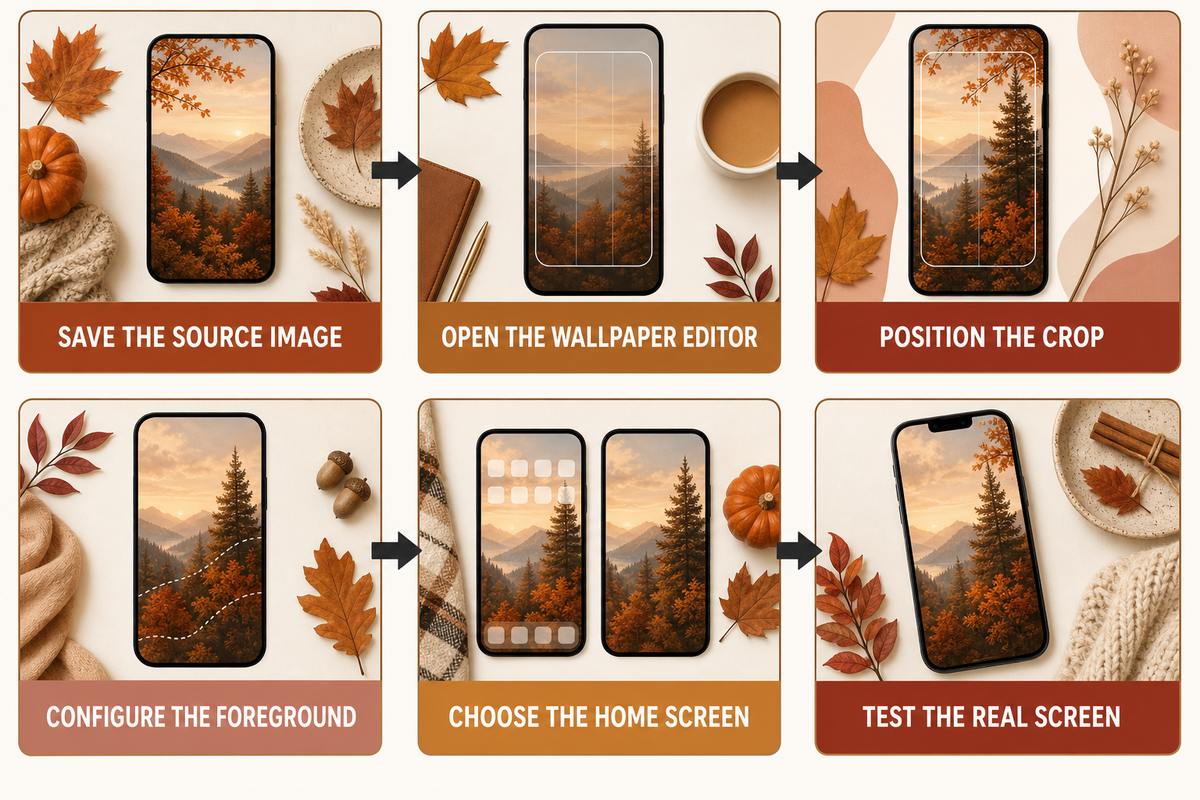
Save an original or properly licensed vertical image, open the iPhone wallpaper editor, position the subject around the clock and widgets, then choose whether the Home Screen uses the same image or a quieter companion. iScreen can help you discover wallpapers and coordinated themes; iOS controls the final system wallpaper setting.

  1. Save the source image — use the largest clean vertical version the creator or license legitimately offers.
  2. Open the wallpaper editor — use Settings > Wallpaper > Add New Wallpaper, or touch and hold the Lock Screen and choose the add control.
  3. Position the crop — pinch and drag until the subject clears the clock, widgets, and expected notification area.
  4. Configure the foreground — choose the clock treatment and add only widgets you will use.
  5. Choose the Home Screen — set a pair or select a separate, lower-detail companion.
  6. Test the real screen — wake the phone, check active and dimmed states, then revise the crop if scanning feels slow.

Apple Support documents the current Settings path, photo selection, Wallpaper Pair option, and separate Home Screen customization. Menu wording and available effects can vary by system version, model, and selected image, so use the controls you see on your phone.

There is no single pixel-perfect size for every iPhone. Apple lists the iPhone 16 Pro Max display at 2868 × 1320 pixels, while the iPhone 15 Pro Max is listed at 2796 × 1290 pixels; both are 460 ppi, but the resolutions differ. Files labeled HD may still crop poorly, and an Android-oriented crop may place its subject in the wrong zone. Use a high-resolution vertical image with room around its subject, then let the on-device crop settle the final composition.

When a Beautiful Fall Wallpaper Fails on a Real Screen
When a Beautiful Fall Wallpaper Fails on a Real Screen — iScreen

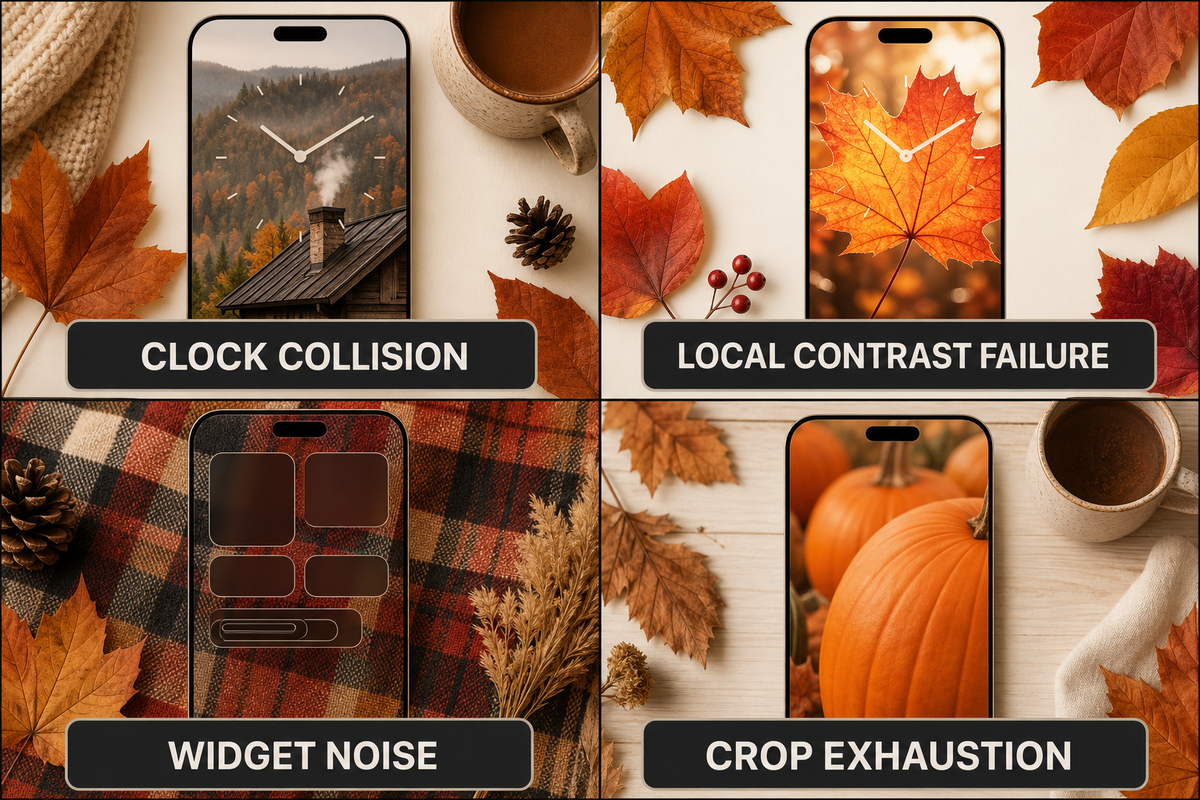
A beautiful image fails as fall wallpaper when the focal subject collides with the clock, the brightest edge breaks through the digits, fine detail sits behind widgets, or a landscape photograph needs an extreme vertical crop. Reverse-test those four failures before you keep the wallpaper for a full day.

  1. Clock collision: the cabin roof, leaf vein, lamp, or moon sits directly behind the time.
  2. Local contrast failure: most of the image is dark, but one bright patch cuts through two digits.
  3. Widget noise: plaid, twigs, or tiny leaves make small foreground labels slow to read.
  4. Crop exhaustion: there is no spare scenery around the subject, so every zoom cuts off something important.

A 2022 Apple Community report described a Lock Screen whose time and date looked acceptable in preview but became difficult to read after application. That is one person’s experience, not current Apple policy, yet it illustrates the reason to test the configured screen rather than rely on the source image alone.

Rights can fail too. “Free to download” does not automatically mean free to republish, sell, or edit. Search labels such as “free fall iPhone wallpapers” or “download free” are not licenses. Pinterest pins can help with visual discovery, but follow them to the original creator and terms before saving a file. The U.S. Copyright Office explains that permission is generally obtained from the owner and that changing another person’s work does not by itself create ownership. Creative Commons recommends identifying the creator, source, and license when attribution is required. Check the exact source terms; this is general information, not legal advice.

Pair a Fall Lock Screen With a Quieter Home Screen
Pair a Fall Lock Screen With a Quieter Home Screen — iScreen

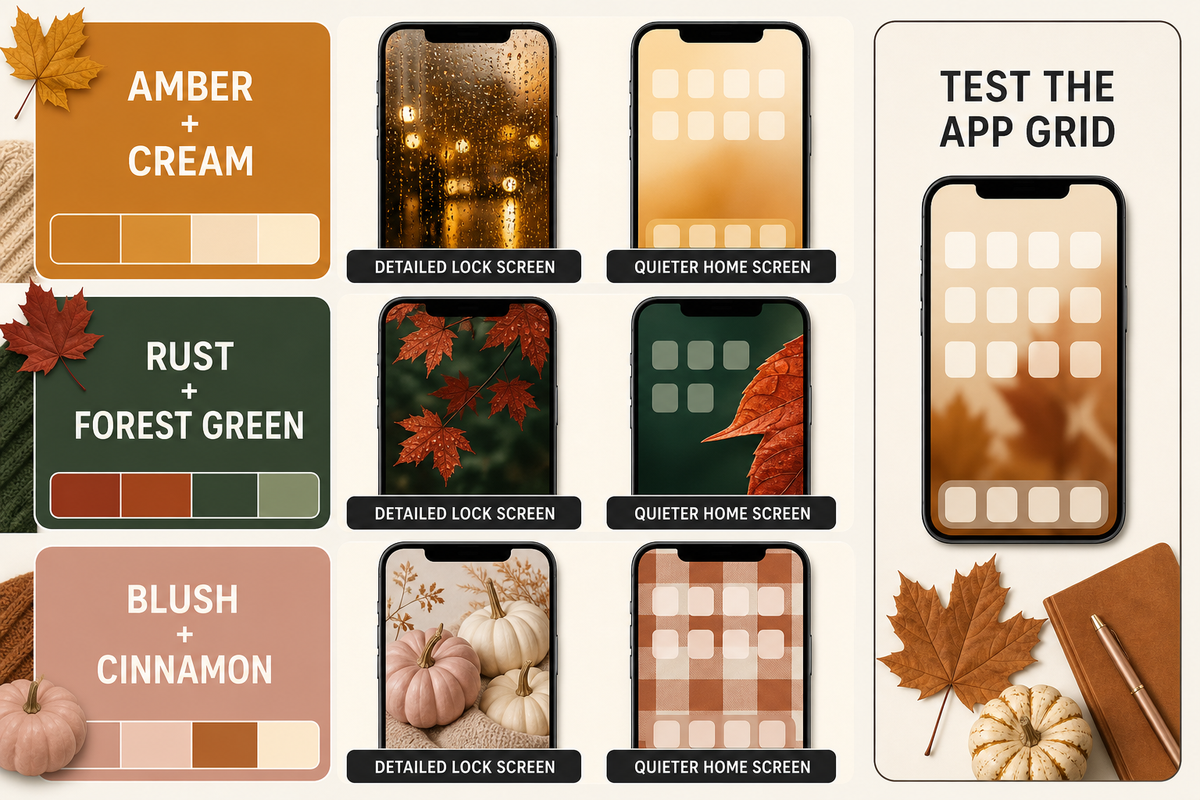
Use the same palette on both screens, then reduce Home Screen detail until icons and widgets are easy to find. “Quieter” is a starting direction, not proof of usability: open the real app grid, locate three everyday apps, scan two widget labels, and check whether the wallpaper pulls your eye away from them.

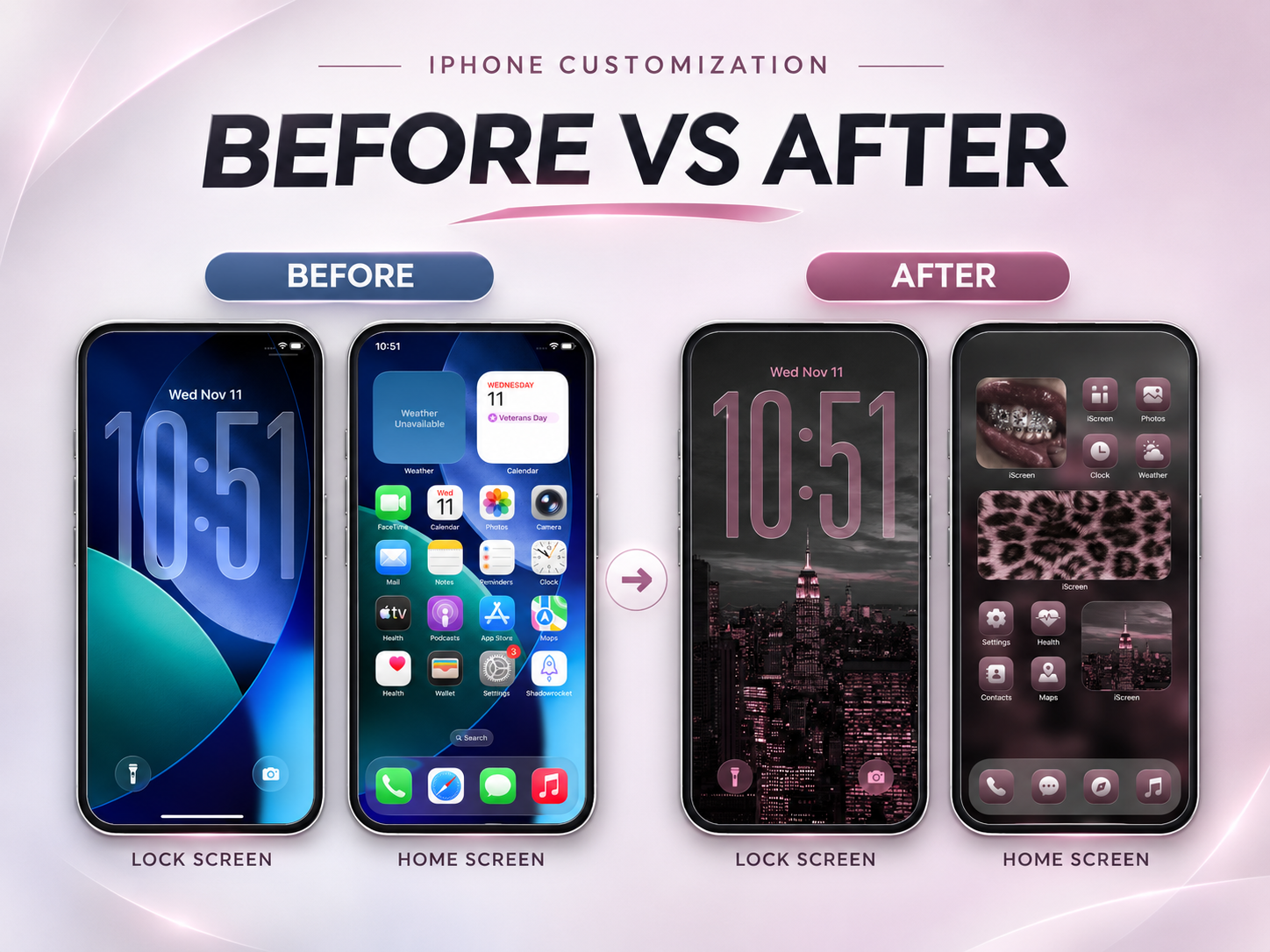
Three dependable pair recipes are amber and cream, rust and forest green, and blush and cinnamon. Pair a rainy amber Lock Screen with a cream-to-amber blur. Pair red leaves over forest green with one enlarged leaf along the Home Screen edge. Pair blush pumpkins with a cinnamon gingham that is broader and lower in contrast.

Apple allows a separate Home Screen wallpaper, so the pair does not need to be the exact same crop. If you want a full coordinated look, explore matching iPhone themes and compare them with these iPhone Home Screen ideas. Keep this article’s role clear: it helps choose a fall image and make it fit; the gallery and theme pages own browsing.

Browse More Fall Wallpapers in iScreen
Browse More Fall Wallpapers in iScreen — iScreen

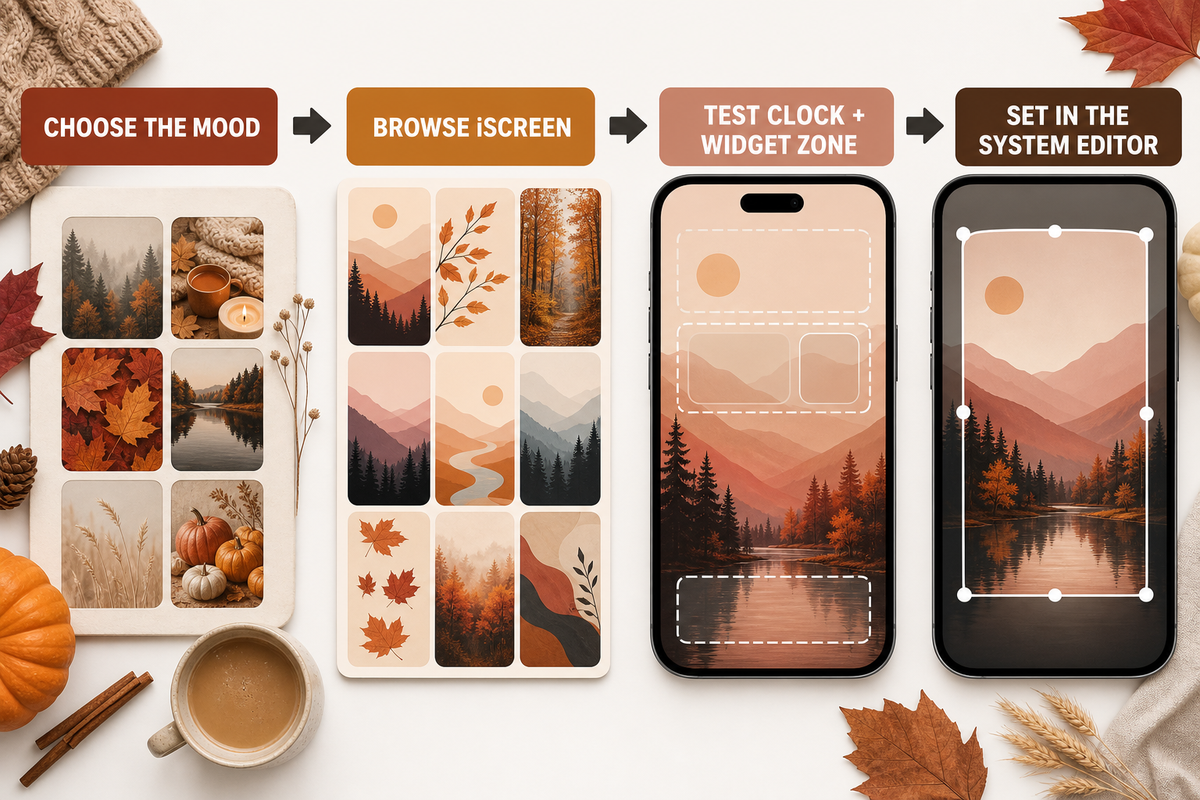
When you know the mood and screen fit you want, move from inspiration to selection. Browse iScreen’s wallpaper library, compare each phone wallpaper on your own Lock Screen, and use the clock, widget, and notification checks above before settling on the crop.

A warm latte scene or cozy iPhone background still needs the same test. The goal is an autumn-themed iPhone that remains usable; iScreen is the discovery route, and the system editor completes the setup.

For a broader visual baseline, compare this fall palette with the examples in our guide to aesthetic iPhone wallpaper, then return to the autumn-specific clock and crop checks here.

Key takeaway

Choose fall backgrounds for iPhone with one calm clock zone, one clear focal subject, and enough crop reserve to test the actual clock, widgets, notifications, and dimmed screen.

Browse iPhone wallpapers in iScreen

Frequently Asked Questions

What are some good wallpapers for autumn?

Good autumn wallpapers include cozy indoor scenes, colorful leaves and forests, and minimal harvest palettes, provided the main subject does not compete with the clock.
Try a rainy window with a lamp below the time, a red-maple canopy with open sky above, or one pumpkin on a warm cream field. For a Lock Screen, protect the clock and notification area. For a Home Screen, reduce edge detail behind icons. The best choice is the one that keeps its mood after the real interface is applied.

Where can I find free fall wallpaper images?

Look for creator-owned collections, app-owned artwork, or stock images with a clear license, then verify on the original source page what “free” allows before downloading.
A free personal download is not automatically permission to republish the image, sell it, or edit it into another product. Check the original creator, source page, and license conditions; include attribution when the license requires it. Anonymous repost boards and cropped search previews are weak ownership evidence. iScreen’s wallpaper library is a practical browsing route when you want ready-to-use choices.

How do I make fall wallpaper readable on my iPhone Lock Screen?

Use The Clock-First Crop as a first pass: protect a calm area behind the time, move the subject away from notifications, and preview the configured Lock Screen.
Choose the clock style and color you intend to keep, add your actual widgets, then check the active and dimmed screen. Let one sample notification appear. If digits cross a bright leaf, lamp, moon, or roof edge, move the crop or choose a quieter image. Repeat the test after changing widgets because the source image alone cannot predict every foreground configuration.

What size should a fall iPhone wallpaper be?

Use a high-resolution vertical image at least as large as your device display, but do not rely on one universal iPhone wallpaper size or exact crop.
Current iPhone models have different display resolutions, and iOS can reposition or crop the image. Extra room around the focal subject matters more than matching one published number perfectly. Download the largest clean version legitimately available and use the on-device preview to set the final crop.

Is a dark fall wallpaper better for iPhone?

A dark fall wallpaper is better only when it supports your mood and keeps the clock, widgets, and icons distinct; darkness alone does not guarantee readability.
A charcoal porch or moonlit forest can give pale clock digits a stable field, but one bright moon or lamp behind the time can still break up individual digits. Dark leaf texture may hide dark widget labels, while saturated orange objects can pull attention away from notifications. Test the local patch behind the clock in a bright room, a dim room, and the display state you normally use. Then scan every widget and find three common apps on the paired Home Screen. Choose a dark wallpaper for mood and separation, not for an unsupported battery-saving promise; display type, brightness, screen activity, and the rest of the interface all affect power use.

Should my fall Lock Screen and Home Screen use the same image?

Usually, a complementary pair works better: keep the same colors and texture, then use a quieter crop or companion image behind Home Screen icons and widgets.
The exact same image is fine when it has both a clock-safe upper area and a low-detail icon field. Otherwise, keep the detailed cabin, leaves, or pumpkin scene on the Lock Screen and use a gradient, enlarged texture, or isolated motif on the Home Screen. Check icon and widget recognition on the real app grid before deciding.

About This Guide

This guide combines current Apple wallpaper controls, two model-specific Apple display specifications, general foreground-background readability guidance, current fall-gallery format research, and image-rights sources. The 12 ideas and The Clock-First Crop are editorial tools used in this guide, not a claim that every composition has been device-tested or is already available in the iScreen library.

最近の記事

How to Turn a Video into a Live Photo on iPhone

How to Turn a Video into a Live Photo on iPhone

2026/11/13 19:12
To turn video into a Live Photo on iPhone, import a video clip into a Live Photo converter, trim the moment you want, and save it to Photos. Open the saved picture, then press and hold to play it. If you want to keep the original sound quality, listen to the result before removing the video or sharing it. For a moving Lock Screen, choose a converter’s wallpaper export route. IntoLive has a dedicated Live Wallpaper option, and Apple provides a different wallpaper route. Saving a moving picture and setting an animated background are different things. Video to Live Photo conversion turns a selected video moment into a photo with motion. Save the result to Photos first. For wallpaper, use a wallpaper export and enable the play control when setting your Lock Screen. Start with the original video and keep it until you’ve checked the saved result. Choose an output that preserves sound if you want to keep a spoken moment. Use the converter’s wallpaper option when your goal is Lock Screen animation. Compare the saving step and payment terms before editing a long clip. This tutorial follows Apple’s instructions and the developers’ own guides. The conversion routes haven’t been tested on a physical iPhone for this article. Turn your video into a Live Photo Can I make a live picture from a video? Yes. A video to Live Photo converter can transform a selected moment into a picture with motion. To convert video to Live Photo format, start with the original recording. Pick a video from your library. Trim the part you want, choose a still frame where the tool allows it, and export to photos. Play that saved item before moving on to wallpaper setup or sharing. V2LP’s developer explains how to use an app to create Live Photos by choosing a video, trimming it, selecting a cover photo and saving it to Photos. Editing controls include an audio toggle. Leave the sound on if you want to keep the voice or background audio of your favorite video moments. For wallpaper, follow intoLive’s creation guide: Open intoLive and tap Live Wallpaper. Import your media and trim the section you want. Finish the edit, then tap the Share icon. Choose the option to save as a Live Photo. Next, launch Photos. The Apple Live Photos instructions state that saved Live Photos appear in the Collections > Media Types > Live Photos section. Open the item and press and hold the screen to preview its cover image and motion. Inspect the cover and playback, then listen if sound is required. A thumbnail in the camera roll alone doesn’t say much about the moving part. Keep the original in your library. It’s a good starting point if your crop takes off too much, if the moment captured is too short, or if you want to make another version of the video. When using apps like these, make sure to use the same original video so that changes are easier to spot in the output. Before comparing apps, identify the type of result you need: Result type What you have What to do next Camera Live Photo Captured directly with the iPhone camera. Play it in Photos; this is not a conversion of an older movie. Converted Live Photo A moment selected from an existing video. Check both the chosen still image and the motion. Silent Live Photo Motion saved without the original audio. Suitable when sound is unimportant; keep the video for speech. Live wallpaper export A converter’s output intended for the Lock Screen. Apply it in Wallpaper settings and check playback on wake. GIF input An animated source accepted by some converters. Import it through the tool before saving a Live Photo. Standalone video A movie that can be shared separately. Keep the original video for the full scene. To export a Live Photo as a short movie, use Apple’s Save as Video command. Still image A photo without playable motion. Use it as a static background; it is not a moving export. Download package Files bundled for a provider-specific import. Follow that provider’s import instructions before checking Photos. Choose a clip that works as wallpaper For Live Photo wallpapers, select short clips with smooth motion, a clear subject and not too many scene changes. intoLive recommends minimal movement and transitions for its wallpaper exports. A person turning and facing the camera would be a better starting point than a montage of different unrelated scenes. In its duration guide, intoLive says that wallpaper exports should be between 1-2 seconds. Consider that if you need to pick a segment of action for the background. The Clip-to-Lock-Screen Check below will allow you to pinpoint the stage of the unwanted change. For browser conversions, do the paired import and then check the saved item. Complete the other checks provided below. Work through the relevant checks below; app users can disregard the browser import row. Stage What to inspect What to change first Original action The selected moment contains the action you want. Move the trim points before editing the cover. Original framing The subject stays inside the crop. Choose a wider source or adjust the crop. Saved cover The still image shows the expression you chose. Change the cover or key photo where available. Saved motion Pressing and holding plays the saved item in Photos. Return to the converter if only a still image was saved. Saved sound Speech remains when you need it. Check the mute option; choose another route for silent-only output. Browser import Both parts are saved by the provider’s paired import route. Repeat Save 2 Items for LivePhotoNow rather than saving only the picture. Wallpaper preview The subject fits around the clock and the play control is available. Review the wallpaper export route, framing and play setting. Lock Screen wake The selected wallpaper animates when the phone wakes. Inspect the play control and developer troubleshooting guidance. A high-quality still frame matters too. Pause on a frame of the video with your preferred expression and composition before making any cropping adjustments. For the surrounding layout, the iPhone wallpaper Size Guide can assist you in planning a portrait composition before you crop away part of your subject. Set the Live Photo as your Lock Screen wallpaper Can you add video as wallpaper on an iPhone? You can use a converted Live Photo as an animated Lock Screen wallpaper via Apple’s wallpaper controls. Use a saved Live Photo rather than a raw movie for the wallpaper. Apple details this method on iOS 17 or later, where the animation is played when the device is woken. Follow Apple’s Lock Screen setup instructions once you’ve saved your conversion: Open Settings → Wallpaper → Add New Wallpaper. Tap Photos, then Live Photo. Select your saved image. Customize the preview. Tap Add, then choose Set as Wallpaper Pair or Customize Home Screen. Apple describes the animation as playing “whenever you wake up your device.” Apple, Set a Live Photo as your Lock Screen wallpaper on your iPhone, 2025. Lock and wake the phone to test the result. Pressing and holding a Live Photo in Photos tests its playback in the library. Choose Customize Home Screen if you want a different static background image behind your app icons. For more on Lock Screen customization, see this guide. Convert without installing another app Yes, a browser converter can offer a route that doesn’t require installing another app. LivePhotoNow describes importing an MP4, MOV or WebM clip, selecting the moment, and using Save to Photos → Save 2 Items on iPhone. Follow that paired saving step, rather than saving only the still picture. The service states its conversion runs in the browser and its output is silent. It pairs a still image with a motion file using matching metadata. So the audio choice is to use a different route when the person’s voice is the reason you’re saving the clip. Other online tools use different imports. LivePhotoTools, for example, describes a package and an iPhone import route involving a Live Photo app. Downloading a package isn’t the same step as creating a recognized item in Photos. Before using a private video, read the service’s upload and handling information. Don’t use a shortcut tutorial that promises a native Photos conversion button without showing its actual saving route. Check free export before paying for an app V2LP’s developer lists basic conversion, trimming, cover selection and saving as free, with advertisements. Removing advertisements and gaining editing tools is available via an in-app purchase. Route Saving step Decision before editing V2LP Save the edited result to Photos. Basic saving is listed as free with ads; Pro is optional. intoLive wallpaper route Live Wallpaper → edit → Share → save as Live Photo. Use the dedicated wallpaper route and inspect the current purchase screen. LivePhotoNow browser route Save to Photos → Save 2 Items. The developer describes free, silent output and browser processing. LivePhotoTools browser route Download its package, then follow its import instructions. Its iPhone instructions involve another application. V2LP lists no watermark, no subscription and an optional one-time Pro purchase. When comparing apps, distinguish an optional in-app purchase from a renewing subscription or trial. On the App Store, read App Privacy. A developer can describe conversion that’s done locally while the listing can separately disclose tracking, as V2LP does. Local processing and the app’s broader data collection are different questions. Fix motion that is not supported as wallpaper If the saved item moves in Photos but stays still as wallpaper, check the wallpaper export and play control first. intoLive’s troubleshooting guide states that both converted Live Photos and Live Photos captured using the camera may not work perfectly as wallpaper. For this Lock Screen feature, Apple states iOS 17 or higher. Buying another converter isn’t the first check. No moving item in Photos: return to the export step. Make sure you saved a Live Photo rather than a GIF, video or still image. intoLive wallpaper fails: create the final export through Live Wallpaper. Its guide distinguishes that route from New Project. Motion control is missing: intoLive recommends turning off Low Power Mode and checking again. A busy clip is rejected: choose a simpler moment with less movement and fewer transitions, following the developer’s advice. There’s an exception to the New Project distinction: intoLive describes using the video acceleration feature to increase a video’s speed, saving that edit, and then importing it again using the Live Wallpaper. Therefore, you don’t need to discard a useful pre-edit just because it was done in a different part of the application. In an Apple Support Community discussion, a user said that system-suggested pictures worked. However, when using manually selected pictures, it didn’t work. Another user said he/she got different results. Don’t reset your whole phone just because one user in a forum said to do it. After altering the export settings, save a new version and apply that version in Wallpaper settings. Otherwise, you may be looking at a previously saved background while evaluating a newer conversion. The guide to iPhone wallpaper changing by itself addresses a different situation where the image changes unexpectedly. Keep the still image useful between animations Cover pictures work best when they leave space for notifications and the clock. You can evaluate video details by checking whether individual faces are recognizable. Use the preview to check for blur at the edge of your crop. The animation can end on a calm screen with a readable subject. A tight crop that cuts off a face will still be distracting when nothing moves. Select a coordinated Home Screen and Lock Screen from Apple’s settings, and then check the wallpaper preview. If you want a better static composition, return to the converter. Design ideas can be found in iScreen wallpapers or in the iPhone wallpaper Aesthetic Guide. Choose the background design after the conversion works so that you can judge the saved still image alongside the motion. Frequently asked questions What is a Live Photo? A Live Photo is a photo with a short moving moment that you can play in Photos. Apple’s camera records what happens 1.5 seconds before and after the shutter. You can choose a key photo, apply a Photos effect, and share the result. That camera timing describes capture on the device. A converter starts from an existing movie and applies its own trimming and export settings; for example, intoLive’s wallpaper guide describes a 1–2-second result. Can I convert a long video into a Live Photo? Yes, by selecting a shorter moment from the original video. Trim to the part you want before saving. For intoLive’s wallpaper route, its developer describes a 1–2-second result, so choose the action that fits that output rather than expecting the entire recording to play. Keep the original movie for the full scene, longer audio or a later edit. A Live Photo is useful for a selected moment, not as the only copy of a long recording. How do you loop a Live Photo? Open it in Photos, tap the Live Photo control near the top, and select Loop. Apple also lists Bounce and Long Exposure in that menu. Choose the effect you want for viewing the photo in your library. Loop replays the action, while Bounce reverses it back and forth. Preview the effect on the actual subject: a wave can read differently from a person walking out of frame. Keep an original copy before experimenting with an additional editor, since Apple warns that third-party editing can remove applied effects. How do I turn a Live Photo into a video on iPhone? Open the Live Photo, tap More, and choose Save as Video. Apple’s reverse-conversion instructions say the new video appears in Recently Saved and the original remains in Live Photos. Use this shareable video copy when you want to send a standalone movie. Why does my Live Photo stay still on another phone? The sharing method may have sent a still image, or the receiving application may show only the photo. Apple says Mail sends a Live Photo as a still image. If the recipient needs motion, save a video copy and send that instead. Keep the original Live Photo as well; the video copy is a separate output for sharing. Can a GIF be used instead of a video? Yes, when the converter supports GIF input. Choose a GIF or video that contains the moment you want to keep. V2LP and LivePhotoNow both describe that option. Import the GIF through the selected tool and save the result into Photos, then use the same playback and wallpaper checks as for a video conversion. Live Photo vs video: what is the difference? A Live Photo opens as a picture with motion available to play; a video is a standalone moving recording. Choose a Live Photo for a selected still image and its brief action. Keep a video when you need the full scene or a movie to send. For a personal moment with speech, include sound retention in the decision: some conversion routes save motion without the original audio. References & Sources Take and edit Live Photos, Apple Support. Set a Live Photo as your Lock Screen wallpaper on your iPhone, Apple Support. How to turn a Live Photo into a video on your iPhone, Apple Support. Related articles Animated wallpaper on iPhone iPhone Home Screen wallpaper ideas iPhone wallpaper size and framing Customize your iPhone Lock Screen
2026/11/13 19:12
How to Customize Your iPhone Home Screen with Widgets and App Icons

How to Customize Your iPhone Home Screen with Widgets and App Icons

2026/11/13 17:20
Your iPhone Home Screen is more than just a place to launch apps — it’s a reflection of your personal style. With custom widgets, app icons, and wallpapers, you can turn a standard Home Screen into a look that feels uniquely yours. Whether you prefer a clean minimalist layout, a soft pastel look, or a bold retro theme, iScreen makes it easy to create a Home Screen you love. Here’s how to do it with iScreen.   1. Why Customize Your iPhone Home Screen? There are several reasons to give your iPhone Home Screen a makeover. Express Your Personal Style: Choose colors, icons, and wallpapers that reflect your personality and favorite aesthetic. Make Your Phone More Functional: Widgets let you check useful information, such as the weather, calendar events, and battery levels, without opening individual apps. Create a More Organized Look: Matching app icons and carefully arranged widgets can make your Home Screen look cleaner and more visually appealing. A well-designed Home Screen combines both style and functionality, making your everyday iPhone experience more enjoyable.   2. How to Customize Your iPhone Home Screen Before exploring third-party customization apps, you can start with the built-in features on your iPhone. Here are two simple ways to personalize your Home Screen. 2.1 Add Widgets to Your iPhone Home Screen Widgets display useful information directly on your Home Screen while adding a personal touch to your layout. Follow these steps to add a widget: Touch and hold an empty area of your Home Screen until the apps start to jiggle. Tap the Edit button or the + button, depending on your iOS version. Browse the available widgets and select the one you want. Choose your preferred widget size. Tap Add Widget, then drag it to your desired position. Tap Done to save your layout. You can experiment with different widget sizes and arrangements to create a layout that works for you.   2.2 How to Change App Icons on Your iPhone Custom app icons are another great way to transform your iPhone’s appearance. You can use the Shortcuts app to replace the standard app icons with your own images. Here’s how: Open the Shortcuts app on your iPhone. Tap the + button to create a new shortcut. Select Add Action, search for Open App, and choose it. Tap App and select the app you want to customize. Open the shortcut’s details menu and choose Add to Home Screen. Tap the icon preview and select Choose Photo to upload your custom icon. Enter a name and tap Add. Repeat these steps for other apps to create a consistent icon style across your Home Screen.   3. How to Customize Your iPhone Home Screen with iScreen Want more creative options beyond the built-in iPhone settings? iScreen makes it easier to explore different widget designs, custom app icons, and wallpapers in one place. 3.1 Explore More Widget Styles With iScreen, you can discover a variety of aesthetic iPhone widgets to match your personal style. From minimalist calendars and photo widgets to cute interactive designs, there’s something for different tastes. You can also personalize available widget options, such as colors, backgrounds, and photos, to create a look that fits your Home Screen. Mix different widget styles and sizes to build a layout that’s both attractive and practical. 3.2 Explore Ready-to-Use Theme Setups For a more cohesive Home Screen design, iScreen offers a curated collection of ready-made theme setups, bringing together matching widgets, app icons, and wallpapers in a unified aesthetic. Explore a range of styles, from playful and colorful designs to minimalist, retro, and dark themes. Each collection features coordinated visual elements, making it easy to create a polished iPhone Home Screen with a consistent look and feel. With thoughtfully paired designs, iScreen helps transform individual customization elements into a complete, visually harmonious setup.   3.3 Bring Everything Together Now it’s time to combine your favorite widgets, custom app icons, and wallpapers into one personalized setup. Try a minimalist theme for a clean look, a pastel theme for a softer aesthetic, or a retro-inspired design for a nostalgic vibe. Don’t be afraid to experiment with different colors and layouts until you find your favorite combination.   Final Thoughts Customizing your iPhone Home Screen doesn’t have to be complicated. With the right combination of widgets, app icons, and wallpapers, you can create a phone setup that reflects your personality while keeping everything easy to access. Ready to give your iPhone a fresh new look? Explore more customization possibilities with iScreen and create a Home Screen that’s truly yours! Media Contact iScreen Official Team Email: iscreenofficial@gmail.com Official Website:iScreen – Phone Style, iScreen it! iOS Download Link:‎‎iScreen – Widgets & Wallpaper Android Download Link:‎‎iScreen – Widgets & Wallpaper
2026/11/13 17:20
OLED Wallpapers for iPhone: Black Backgrounds That Work

OLED Wallpapers for iPhone: Black Backgrounds That Work

2026/11/13 14:36
/* Article-only alignment with the confirmed iScreen Home Screen guide. */ #iscreen-oled-article{font-family:Arial,sans-serif;font-size:inherit;line-height:1.75;color:#242735;} #iscreen-oled-article h2{margin:0 0 8px;padding:0;border:0;} #iscreen-oled-article figure{margin:12px 0!important;} #iscreen-oled-article .faq-item{margin:0 0 24px!important;padding:0!important;border:0!important;border-radius:0!important;} #iscreen-oled-article table{width:100%;border-collapse:collapse;margin:24px 0;font-size:15px;line-height:1.6;letter-spacing:normal;border:1px solid #e0e0e0;color:#2d2d2d;font-variant-numeric:tabular-nums;} #iscreen-oled-article table tr{border:none!important;} #iscreen-oled-article table th{background:#2d2d2d!important;color:#fff!important;font-weight:600;text-align:left;padding:12px 16px!important;border:none!important;vertical-align:top;} #iscreen-oled-article table td{padding:11px 16px!important;border:none!important;border-top:1px solid #e0e0e0!important;background:#fff;vertical-align:top;text-align:left;} #iscreen-oled-article table tbody tr:nth-child(even) td{background:#f5f5f5;} #iscreen-oled-article table tbody td:first-child{font-weight:600;} #iscreen-oled-article caption{caption-side:top;text-align:left;} @media(max-width:767px){#iscreen-oled-article table{font-size:14px;}#iscreen-oled-article table th,#iscreen-oled-article table td{padding:10px 12px!important;}} Updated November 2026 Choose an OLED wallpaper iPhone users can read at a glance: a black background with a small subject clear of the clock. Pure black has the quietest look; a thin moon or a dark gradient adds interest. Use the picture you like, and check its fit. Your screen type changes the battery advantage. An iPhone 13 uses OLED, while the standard iPhone 11 uses an LCD. Both can display the same dark image, but only the OLED panel lights its pixels individually. Browse iScreen wallpapers and backgrounds for designs, and use the checks below to choose a usable file. Six OLED wallpaper styles for your iPhone Pure black, a small moon, a thin outline, and a monochrome silhouette are a few starting points. A lower edge glow and a few scattered stars are a couple more. For a busy Home Screen, a pure black background is a good choice. For the Lock Screen, a small, bright subject is good. Choose a style for the screen you use Style Best starting place What to watch Pure black Home Screen with many apps No picture detail; the icons become the main color Small moon Lock Screen with empty upper space Keep the moon away from the time Thin outline Minimal abstract setup A line through a letter can distract Monochrome silhouette Lock Screen with a recognizable subject Fine edges can disappear in a tight crop Lower-edge glow Lock Screen with a dark upper half The glow is colored light, not pure black Sparse stars Night-sky theme Bright dots behind text can make it busy A calmer mobile layout has the favorite artwork on the Lock Screen and simpler backgrounds behind apps. Apple’s wallpaper instructions allow for these choices. A small touch of color often gives an inky black design enough character without filling the display. The iPhone wallpaper aesthetic guide has broader choices if you prefer. True black versus dark gray: check the image True black in an RGB image is #000000, or red 0, green 0, blue 0. For a wallpaper, those background pixels should also be opaque. Dark gray contains nonzero color values. Both can look dark on OLED screens, and darker gray can use less display power than a lighter image. How do I know whether a wallpaper is truly black? Open the original file in an image editor and use the color sampler to check colors in several background areas. Look for full opacity and an RGB value of (0, 0, 0). The W3C PNG specification differentiates transparency from color: a transparent pixel can reveal the background beneath it. A dark thumbnail is a poor test. Black-Pixel Evidence Ladder The Black-Pixel Evidence Ladder separates what a file contains, how a wallpaper looks after it’s installed, and how a phone uses power. Match the question to the check Check type What to inspect Next action File: original Full image rather than a thumbnail or phone mockup Open the individual download File: black values RGB at several empty background points Look for red 0, green 0, blue 0 File: opacity Transparency at those same points Use an opaque background for predictable black Appearance: crop Portrait preview and the subject’s edges Reposition without cutting off important detail Appearance: clock Bright shapes immediately behind the time Move the subject away from the digits Appearance: apps Stars or lines crossing app labels Choose a simpler Home Screen image Energy: display type Exact model’s OLED or LCD specification Use the model table below Energy: visible content Time spent on wallpaper versus app screens Consider app Dark Mode separately Energy: measured saving Same device, brightness and comparable use Only attach a percentage to an actual measurement Apple also describes slight changes in color or blur when scrolling next to black at reduced brightness as normal OLED behavior. A color sampler measures the file; it doesn’t diagnose the display. Check your iPhone screen before expecting savings OLED wallpapers for iPhone X work as images on LCD phones as well. With OLED iPhone wallpapers, the display technology changes how black is produced, not whether the picture can be installed. Check the specific model of a series using Apple’s specs: the standard iPhone 11 and iPhone SE examples below are different from the iPhone 11 Pro and 13. Screen-type decision table: verified model examples Apple device Display Reason to choose black iPhone X, iPhone XS and XS Max OLED Deep black appearance and darker-content power benefit iPhone 11 6.1-inch LCD Appearance and a quieter background iPhone 11 Pro models OLED Individually lit pixels, unlike standard 11 iPhone SE, third generation 4.7-inch LCD Simple composition behind apps iPhone 13 6.1-inch OLED Dark-content display-power advantage Apple lists the iPhone 11 LCD, SE third-generation display and iPhone 13 OLED specifications separately. The technology behind Super Retina explains the differences: “And with no backlight, OLED emits light through each pixel, allowing for a thinner display.” Apple, About the Super Retina display, 2026 How much battery can a black wallpaper save? A black wallpaper can reduce OLED display power compared to a brighter image. The daily battery saving with a black wallpaper varies with screen brightness and how long the wallpaper remains visible. When an opaque app fills the screen, the app’s displayed content becomes the relevant color choice. Apple’s 2022 power consumption presentation mentions that darker content uses less power on OLED panels. Therefore, system and app Dark Mode impact more than just the wallpaper. A black Home Screen doesn’t turn a bright webpage black. Consider the scope of Purdue’s 2021 dark-mode study. Purdue found that switching from light mode to dark mode at 100% brightness saved an average of 39%-47% battery power on the tested OLED smartphones. Researchers examined six Android apps, including Google Maps and YouTube, using 60-second activities on Pixel 2, Moto Z3, Pixel 4 and Pixel 5 phones. They altered the app’s appearance, considered screen brightness, and evaluated battery usage. Changing an iPhone background is a different adjustment. The wallpaper appears on the Home or Lock Screen, and the rest of your day consists of app interfaces, video and other workloads. No physical iPhone battery test was done for this post; therefore no daily savings percentage is assigned to your wallpaper. Download a sharp wallpaper from the original file Save the original HD or 4K portrait, rather than a gallery thumbnail or a screenshot of a phone mockup. Image quality starts with the original file. Its aspect ratio and the final crop determine how the subject is positioned. What is the correct way to download an iPhone wallpaper? Open the individual design from the black wallpaper collection, use its available download option, and keep the original file in Photos. Preview it in Wallpaper settings before committing. If the design has a border, pay attention to every edge while you adjust the crop. For example, suppose you are choosing a portrait image for an iPhone 13. Apple lists its display at 2532 by 1170 pixels, so the corresponding portrait orientation is 1170 pixels wide by 2532 pixels tall. A wide desktop composition places its subject differently even when the file has plenty of pixels. Choose a portrait version with open space near the clock first, then adjust the preview without cropping the subject. Increasing the dimensions of an image can’t restore details missing from the original. The iPhone wallpaper size guide covers model-specific sizing when you want a different fit. Set the Lock Screen and Home Screen separately Use Customize Home Screen to keep an illustration on the Lock Screen and a quieter image behind your apps. The built-in iOS Wallpaper controls handle this without a separate wallpaper app. Save your chosen image first, then follow the native sequence and choose whether you want a pair or two different backgrounds. Open Wallpaper. Go to Settings, then Wallpaper. Add your image. Tap Add New Wallpaper, then Photos, and select the saved picture. Adjust the composition. Preview the subject alongside the clock and any widgets, then tap Add. Choose the Home Screen. Tap Customize Home Screen for a separate look, or Set as Wallpaper Pair to use your selection on both. The Apple wallpaper guide also offers a color, another photo or Blur for the Home Screen. Keep blur off if you want to preserve background details. For a background with no subject, see the solid-color wallpaper guide. On supported models, Always-On has a separate Show Wallpaper toggle under Settings, Display & Brightness, Always On Display. For information on Always-On display, see Apple’s Always-On display guide. Keep bright details clear of your clock and apps Please keep the brightest detail away from the clock and the app labels you read most. In general, contrast right behind each letter is better than darkness. A mostly black image can still be difficult to read when a white star, outline or moon crosses the text. W3C’s background-image contrast examples show why local placement matters: black lines crossing black lettering can make one letter resemble another, and dark gray behind black text can make it unreadable. Apply that principle to your wallpaper preview. For a light clock, move a bright moon away from the digits or choose a darker patch behind them. If stars overlap several app labels, use a plain Home Screen instead of shrinking everything until the image loses its character. The picture doesn’t have to match on both screens. More layout ideas can be found in our Home Screen wallpaper guide. As an alternative to using a completely black background, consider a softer iPhone gradient wallpaper. Choose the black background you will keep Pure black works well behind a busy app layout, as does a small moon or outline if you want a subject that’s noticeably in the foreground. Keep the original download, preview both screens, and retain the version that makes your clock and apps easy to read. The simplest image is a useful starting point, but is by no means a requirement. Before you replace it Keep the uncropped original in Photos so you can readjust the framing when your clock or widget layout changes. Take a look at the iScreen collection above and save your favorite wallpapers. Also, as Apple suggests, use a shorter Auto-Lock time if you don’t need the display to stay on. Frequently asked questions Is OLED wallpaper a special file type? No. OLED wallpaper describes an image’s intended look on an OLED screen, not a separate image format. A PNG or JPEG can contain a black background, a gray gradient or a bright subject. An OLED-optimized label usually points to the design. For pure black, examine the original background values and opacity. Choose the file for its composition and dimensions rather than expecting the label to change how your screen works. Does a black wallpaper work on an iPhone 11? Yes. A black wallpaper works on the standard iPhone 11, although its LCD doesn’t use the same individually lit pixels as an OLED display. The image can still give your phone a minimal appearance and leave a quiet background behind apps. Choose it for those visual reasons. Keep the model distinction clear when reading recommendations: iPhone 11 Pro models use OLED, while the standard iPhone 11 uses LCD. Do I need to pay for an OLED wallpaper app? No. Setting an image you already have uses the iPhone’s built-in Wallpaper controls. Image access is a separate choice. A creator can offer a free download or sell a collection, while an app can charge for additional designs or features. Check the terms attached to the particular file you want. Once the image is saved, use Photos in Add New Wallpaper to select it. Is a dark gradient the same as true black? No. A gradient contains changing color values. It can include pure-black areas, but the colored glow remains part of the image. Choose it when that extra depth suits your design. Can one image look good on both screens? Yes, especially when the image has a small subject and plenty of empty space. Preview the clock and your app layout separately. A composition that frames one can overlap the other. References & Sources Apple: Change your iPhone wallpaper W3C: PNG Specification, Third Edition, 2025 Apple: iPhone 11 technical specifications Apple: iPhone SE, third generation, technical specifications Apple: iPhone 13 technical specifications Apple: Super Retina and Super Retina XDR displays Apple Developer: Power down, improve battery consumption, 2022 Purdue University: Dark mode and phone battery life, 2021 Apple: Change the wallpaper on iPhone Apple: Keep the iPhone display on longer W3C: Background-image contrast failure F83
2026/11/13 14:36
トップに戻る