iPhone Home Screen Layout Ideas: 30+ Aesthetic Setups to Copy

You’ve heard it before: your iphone home screen layout is used more frequently than anything else you own. (More than 80 times a day on average, give or take). What the heck?

So it pays to invest a little time. The gap between a jumbled grid and an iOS configuration you truly covet the creative layout idea, is enormous. Here: 30+ aesthetic layout ideas to try, the new iOS 26 customization interfaces Apple introduced last fall, and what not to do.

All that you see below is based around Apple’s launch and shipment with the iOS 26 Liquid Glass design language and also a test run against r/iOSsetups community patterns through out 2025 and 2026.

Quick Stats — iPhone Home Screen Customization 2026

iOS 26 release window Fall 2025 (previewed June 9, 2025)
New customization layer Liquid Glass design system
Icon style options 4 modes (Default / Dark / Tinted / Clear — Clear is new)
Apple Smart Stack widget limit Up to 10 widgets per stack
iPhone home screen grid 6 rows × 4 columns + 4-slot Dock
Top 5 widget apps install rate (US) ~15% of iPhones (Sensor Tower)
Widget-driven battery impact ~15% of total battery use (typical)
Apple HIG icon assets resolution 180×180 px @3x (60×60 pt logical)
Style families in this guide 6 (Minimalist / Pastel / Dark / Glassy / Cottagecore / Vibrant)
Last updated 2026-05-26

What Makes a Great iPhone Home Screen Layout in 2026?
What Makes a Great iPhone Home Screen Layout in 2026?

You don’t just come up with the ultimate iphone home screen layout once – you figure out four levels of layered decisions and then bring it all into sync with itself. Once you see the pile, you’ll get rid of the urge to wrestle with your phone and begin shaping it.

The 4-Layer Layout Stack

  1. wallpaper layer- the most base visual layer. Controls tone and feel of the artwork as a whole, including color scheme.
  2. widget layer – informational layer. Time, weather, calendar, activity – everything you see it without opening application
  3. This is the official stock icon set icons used for some apps and iOS 26 introduced the official visual cohesion with 4 styles plus tinting.
  4. Folder & page logic – navigation tier. Dock, first page, additional pages, App Library overflow.

The layout’s iPhone home screen: each one is a rigid 6-by-4 grid and a 4-cell dock, using 180180 p× icon images at 3×. You can’t drag icon where you please – in fact, every layout decision is an answer to which one of those 28 places to fill. Which sounds like an annoyance – but is actually a feature: it keeps people from defaulting to “more apps”.

The most powerful layout signal is opening your phone and seeing that what’s on screen aligns perfectly with why you’re picking it up. Open calendar widget six times day, it should be in page 1. Open App Store twice a month and no way it should be in the dock.

Bad layouts aren’t ugly, they’re mistaken about what the user really cares about.

The iOS 26 Customization Revolution — What’s New in Liquid Glass
The iOS 26 Customization Revolution — What's New in Liquid Glass

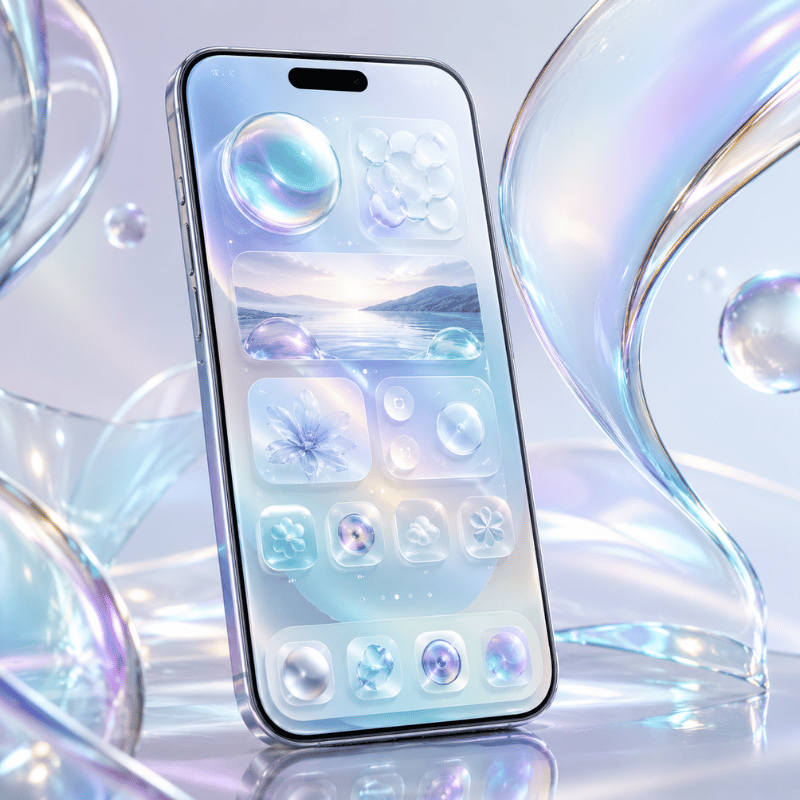
iOS 26, previewed by Apple on June 9, 2025 and released as a free update for iPhone 11 and later in fall 2025, is the biggest home screen customization shift since iOS 14 introduced widgets. The headline change is a new visual material called Liquid Glass — a translucent layer that reflects and refracts whatever sits behind it. Apple describes it as the design system extending across iOS 26, iPadOS 26, macOS Tahoe 26, watchOS 26, and tvOS 26.

In particular, four things about the home screen are different, so far as those trying to design any layout might be concerned.

  • The fourth icon type — Clear. With the recent iOS 26, Clear was introduced to the bunch of Default, Dark and Tinted icon styles. The Clear icon is a fully transparent version which takes on the color from your wallpaper while the white text and shapes remains visible.The four styles were photographed by MacRumors inside the customization panel.
  • Tinted icons took on a totally new dimension In iOS 18, a tinted icon was a black background with coloured graphic details. In iOS 26, the colour icon matches the color you picked with white details in Light Mode, or a more obscure nuance of that same color in Dark Mode. It’s the same setting that looks very different indeed.
  • Set icons match a given color. The all-new feature can set icons automatically match their physical iphone color. Case-users with dark blue iPhones17 Pros will be able to choose for all of their icon set colors to be changed automatically to the color of their physical iphone
  • Place on widget bottom or edit on wallpaper. The clocks can hold Widgets under it now, and I placed them there. Placing them on the widget bottom is a new feature.Or make the editing direct on the wallpaper through the home screen with no need for any more sisfug’s

There’s also a new “Always” and “Auto” toggle in the new customization settings to allow for a constant Light or Dark mode, or the automatic switching based on time and the old Small/Large icon sized buttons now appear in the upper right corner of the interface. Apple themselves stated in June 2025 this was a series of “new customization options to app icons and widgets, including a stunning clear look.”

“The new design extends across iOS 26, iPadOS 26, macOS Tahoe 26, watchOS 26 and tvOS 26 — crafted with a new material called Liquid Glass that reflects and refracts its surroundings, while dynamically transforming to help bring greater focus to content.”

— Apple Newsroom, June 9, 2025

layout implication: If you’re using iOS 26, most of the aesthetic designs listed here will appear very different (many of them improved!) compared to how the identical design appears in iOS 18, solely because the icon framework is entirely new. On iOS 18, ‘Clear’ or ‘Matched’ setting in each of the steps will automatically revert to the Default or Tinted – we point these out in the customization walkthrough below.

30+ Aesthetic Home Screen Setups — 6 Style Families to Copy
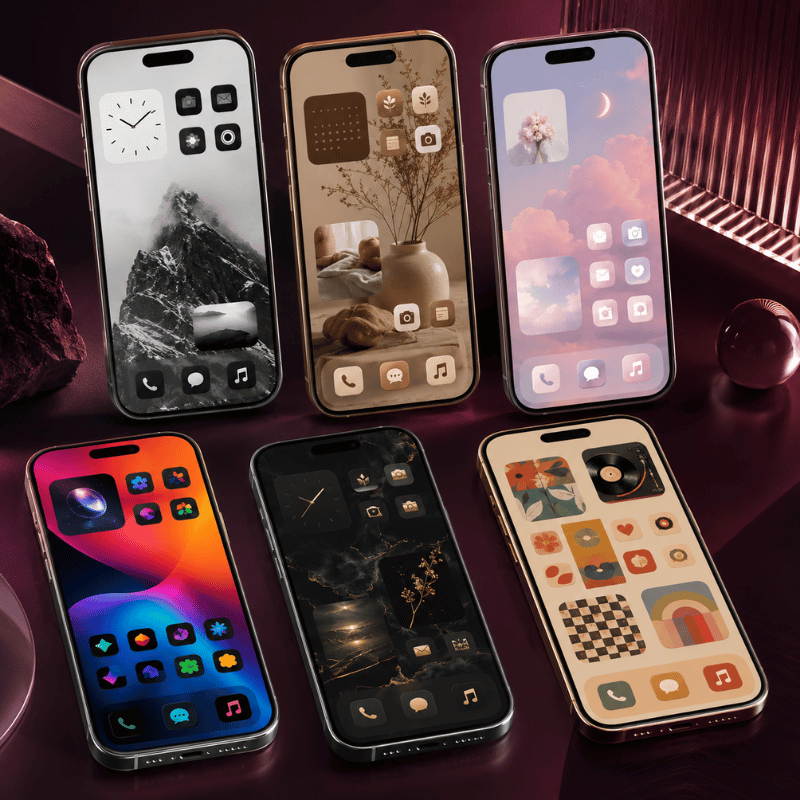
30+ Aesthetic Home Screen Setups — 6 Style Families to Copy

Instead of a list of 30 non-sequitur examples, I’ve organized the 31 creative ios home screen ideas into 6 style families. First select the family of your preference, then borrow any one of the 5 starting point setup variation. In the beginning, I show every setup setup listing the wallpaper feel, the widget count, icon style, and the vibe, just one line for copying: Each iphone wallpaper selected was the element of the group, though an alternate can be inserted for your own personal photo if the atmosphere corresponds.

Family 1 — Minimalist & Clean

Restraint as the design decision. One-pager, mono or near-monochrome, breathing room over density. At its best, really, when you have and *use* fewer than 15 apps and want to feel more zen in your pocket.

  1. One Page-dock of four essentials, one home screen for 8-10 apps I open frequently, other stuff handled by App Library. Off white/warm gray wallpaper.Default icons.
  2. The Dark Void – pure black wallpaper, Dark icon mode, 6-8 often used apps, no widgets. Made with OLED battery life in mind on iphone 12 Pro and later.
  3. The Margin Master – Center-aligned single column of icons, plenty of negative space, and an abstract gradient wallpaper to ground the visual elements. Use a single time widget if desired.
  4. The Two-Row Wonder – Only the top two rows of icons are used; the bottom part of the grid is left empty to reveal the wallpaper below. Abstract or photographic wallpapers add significant visual impact.
  5. The Subtle Tint – default icons paired with colors sampled from the wallpaper using iOS 26’seyedropper Tool ( Tinted Mode ). Minimal deviation from defaults, subtle uniformity without going for all out Clear .

Family 2 — Pastel & Soft

Low-saturation, warm color palettes that evoke a sense of calm rather than being strictly sterile. iOS 26’sTinted Mode is key here to apply a unifying color to all icons within the same scheme. Works best with one or two small widgets; an excess breaks the peaceful atmosphere.

  1. Lavender Dream – Lavender gradient wallpaper, all icons tinted the same lavender color, and a single, small calendar widget in matching hues. Cream Dock background created with a crop of the same wallpaper design.
  2. Peach Sunrise – Gradient shifting from peach to cream colors, with Tinted peach icons. Include a two-widget stack (weather information overlaying time) in similar colors.
  3. Sage Botanical – A soft sage green wallpaper, complemented by a botanical or illustrated leaf variant and sage-tinted icons. Display a favorite plant photo within a widget for personalization.
  4. Mint Modern – Primarily mint green, featuring Clear (iOS 26 only) icons that reveal the underlying mint green, with a restricted number of frequently used apps.
  5. Cream & Coffee – Cream wallpaper, Tinted icons in warm brown, and a single weather widget in complementary shades, giving off a journal-like aesthetic.

Family 3 — Dark Mode & OLED

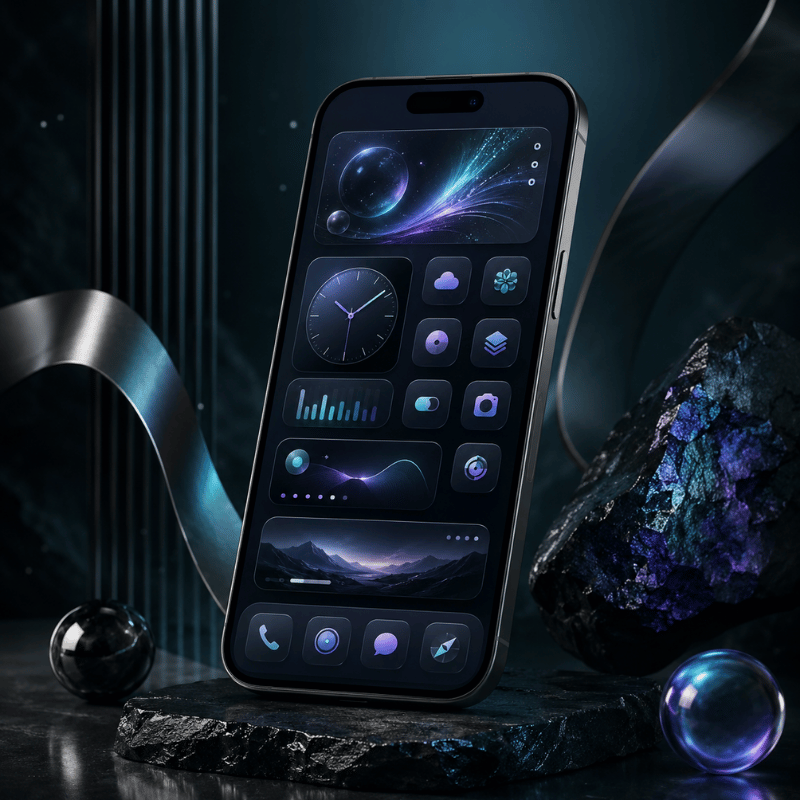
Beneficial for OLED devices (e.g., iphone X and subsequent models), as perfectly black pixels are switched off, saving energy. Using a single accent color against black provides sufficient visual interest without being overly vibrant, which can appear overwhelming against dark backgrounds.

  1. Pure Black OLED – Pure black wallpaper, Dark icon style, and one single tinted widget. Offers the best battery efficiency and highest contrast.
  2. Cyber Neon – A black wallpaper highlighted by a single neon color accent (such as electric pink or purple). Tinted icons should match the accent color, and use two glow-effect widgets for dynamic flair.
  3. Carbon Fiber – Dark gray wallpaper with a carbon pattern pattern, gray Tinted icons, and monochrome widgets, delivering an industrial look without clichés.
  4. Midnight Blue – Deep navy wallpaper, blue Tinted icons (adjusted to match your wallpaper via Match Wallpaper), and one weather widget, striking a balance between formality and accessibility.
  5. Matrix Green – Black wallpaper with a faint green coding rain texture, Tinted green icons using the predefined iOS 26 palette. A niche yet decidedly iconic choice.

Family 4 — Glassy & Liquid Glass (iOS 26 only)

Introducing the new aesthetic family, only available in iOS 26. Clear icons allow your wallpaper to shine through, turning the layout into a single layered image. This works best with photographic or gradient wallpapers, as solid colors don’t offer much refraction for Clear icons.

  1. Clear Cascade – Utilizing a cherished photo wallpaper and Clear icons, augmented with three translucent widgets that adopt the wallpaper’s color tones. The result is a unified image across the screen, with icons appearing to float on top.
  2. Frosted Pane – A wallpaper with a subtle gradient effect (such as a deep teal to navy gradient), paired with Clear icons and a single glass-like weather widget, resembling frosted window glass.
  3. Aurora Glass – Aurora photograph wallpaper, Clear icons, a single Smart Stack widget cycling through info. The aurora colors show through every icon.
  4. Matched Glass – Wallpaper-matched Tinted icons via the Auto option, so icons automatically pull from the dominant wallpaper hue. Re-sets when you change wallpaper.
  5. Pure Translucent – Single solid color wallpaper (deep emerald or burgundy), Clear icons, no widgets. Severe but striking.

Family 5 — Cottagecore & Earthy

Warm naturalistic palettes – paper, wood, soil, plants. Pair with sepia or warm-tinted icons. Resists the cold tech feel that pure dark or pure pastel layouts can have.

Reads as cozy.

  1. Forest Floor – Forest floor photograph wallpaper, warm earth-tinted icons, brown weather widget.Smells like petrichor.
  2. Vintage Paper – Aged paper texture wallpaper, sepia widgets, default icons (the contrast works).Reads like an old journal.
  3. Garden Path – Garden or wildflower photograph wallpaper, soft botanical illustration variants for widgets, light green tinted icons.
  4. Cabin Coziness – Wood grain texture wallpaper, warm amber Tinted icons, a single calendar widget styled with handwritten font apps if possible.
  5. Botanical Library – Plant illustration wallpaper from a vintage botanical print, brown widget stack. Folders named for plant types (Succulents, Ferns) instead of generic categories.

Family 6 — Vibrant & Maximalist

For people who actually want a busy phone. Every-corner-used, multiple widgets, photo or illustration wallpapers with full saturation. The “lots of apps and I like seeing them” approach.

Works best when you actually open most of what’s on screen.

  1. Color Explosion – Bright multi-color gradient wallpaper, Default icons in full color, four widgets across two rows.Loud, alive.
  2. Sunset Pop – Sunset photograph wallpaper (warm pink-orange-yellow), warm Tinted icons, three widgets at the bottom (a Liquid Glass placement).
  3. Tropical Burst – Tropical leaf or beach wallpaper, Default icons for full color punch, five-plus widgets spanning the layout.
  4. Retro 80s – Synthwave grid wallpaper, pink-and-purple Tinted icons, two widgets styled in the same neon palette. Big “Stranger Things” energy.
  5. Bookshelf Maximalist – Bookshelf or library wallpaper, folders named like book genres, multiple widgets stacked like decorations.
  6. Mood Board – Photo collage wallpaper showing personal photos, a large Photos widget centerpiece, two Smart Stacks at the bottom.The phone as scrapbook.
💡 Pro Tip

Save your finished layout as a screenshot before experimenting with the next one.

If you decide to go back, having the photo means you can rebuild the original layout in 5 minutes instead of half an hour of trial-and-error.

How to Choose Your Layout Style — The 3-Question Style Picker
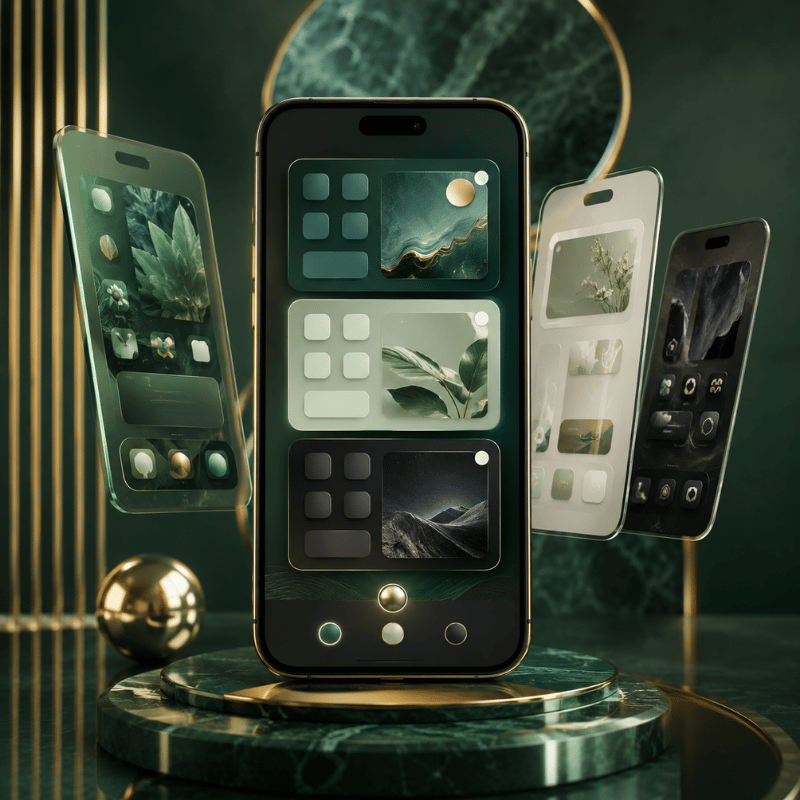
How to Choose Your Layout Style — The 3-Question Style Picker

Looking at 30+ setups is fun for inspiration but useless for actually deciding.

This three-question filter narrows down to one or two families based on how you use your phone, not which screenshot you liked. Answer honestly – the picker is only useful if the answers are about your actual habits, not your aspirational ones.

Question Answer A Answer B Answer C
Q1. Apps you open daily? Fewer than 12 12 to 25 More than 25
Q2. Color preference? Muted / neutral Warm / earthy High contrast / vivid
Q3. How do you use your phone? Focused, one task at a time Browse and graze Multitask all the time

Now match your three answers to the recommended family:

  • A A A Minimalist & clean (Family 1). Few apps, muted, focused – restraint is the entire point.
  • A B A Pastel & Soft (Family 2). Few apps, warm palette, focused – soft minimalism with warmth.
  • A C A Dark Mode & OLED (Family 3). Few apps, high-contrast, focused – accent-on-black discipline.
  • B A B or B A C Glassy & Liquid Glass (Family 4, iOS 26 only). Moderate apps, muted, multi-tasking – Clear icons let the photo show through.
  • B B B Cottagecore & Earthy (Family 5). Moderate apps, warm earthy, browse pattern – cozy without clutter.
  • C C C Vibrant & Maximalist (Family 6). Many apps, vivid, multitask – embrace the busy.

If your answers cross categories (A-B-C), pick the family that matches Q1 (app count) – that constraint matters most. Color preference and usage pattern adjust the variant within the family.

How to Customize Your iPhone Home Screen — Step-by-Step (iOS 26 + iOS 18 Fallback)
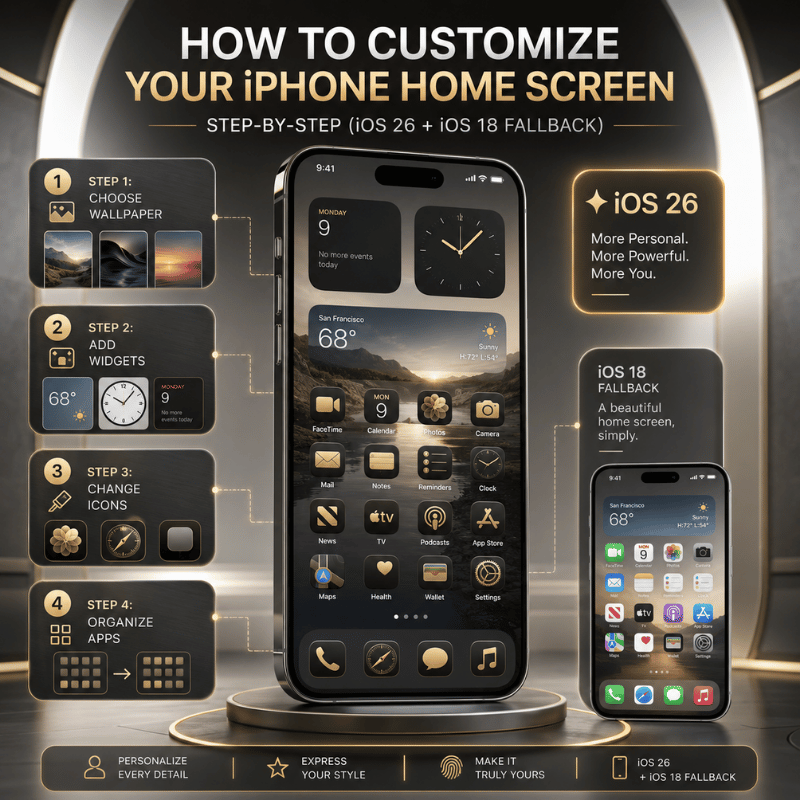
How to Customize Your iPhone Home Screen — Step-by-Step (iOS 26 + iOS 18 Fallback)

There are exactly four layers to touch, in this order: wallpaper, widgets, icons, folders. Doing them out of order is why most attempts end up cluttered – you cannot pick an icon tint until you know what color your wallpaper actually is, and you cannot decide widget placement until you know what apps are landing on the first page. Allow about 15 minutes start to finish.

Step 1: Set the wallpaper (the foundation layer)

  1. iOS 26: Long-press an empty area of the home screen tap the wallpaper picker icon. (New: you no longer have to go through settings.)
  2. iOS 18 fallback: settings wallpaper Add New Wallpaper.
  3. Pick from Photos, Apple’s built-in collections, or a solid color. For Family 4 (Liquid Glass), avoid pure solid colors – they leave Clear icons nothing to refract.
  4. Apply to home screen specifically (not just Lock Screen). Many “messy looking” layouts are caused by accidentally only changing the lock screen.

Step 2: Place widgets (the information layer)

  1. Long-press the home screen until icons jiggle tap Edit in the upper left Add widget.
  2. Pick widgets first by what you actually check often (calendar, weather, activity rings, time), then by what they look like. Function before form.
  3. Stack related widgets: drag one widget on top of another to create a stack. Apple supports up to 10 widgets per stack per Apple Support’s widget documentation, with Smart Stack rotating automatically based on time and usage.
  4. iOS 26 new placement: widgets are no longer locked to the top of the screen. Drag a widget to the bottom rows if you prefer a Liquid Glass look with information closer to your thumb.

Step 3: Theme the icons (the cohesion layer)

  1. Long-press an empty area tap customize in the lower right (iOS 26) or use settings Display & Brightness (iOS 18 partial fallback).
  2. iOS 26 shows four icon styles – Default, Dark, Tinted, Clear. Pick one. If you choose Tinted, you also choose a color: preset palette, eyedropper from wallpaper, or Auto (matches device case color).
  3. The Small / Large size buttons are now in the upper right of the customization panel (relocated from iOS 18). Large icons remove labels and expand each icon to fill more of the grid – cleaner look, easier to tap.
  4. Toggle Always / Auto for permanent style versus time-based switching.

Step 4: Arrange folders and pages (the navigation layer)

  1. Drag any icon on top of another to make a folder. To rename the folder, tap the name field once.
  2. If you need to reduce clutter, then you can hide pages you don’t use much. Long-press an empty spot on the page, tap the group of small page dots at the bottom, and uncheck the pages you want to hide. They’re not deleted; they just move to the App Library (located beyond your last home page on the left).
  3. Consider using App Library for anything you touch less than once a week. You don’t want more than 3 folders on your actual home screen anyway.
  4. More than 3 folders means the folders themselves become a new kind of visual clutter, which is exactly what we’re trying to avoid with the folder system.

Q: How do I get my iPhone home screen back to normal?

If you feel you’ve gone too far and want to start over, Apple provides a couple of options: settings General Transfer OR Reset iphone Reset Reset home screen layout. Both will reset your screen to Apple’s original state for page 1, moving all other apps into the App Library. wallpapers, widgets, focus modes, and icon tinting are not affected by these resets; undo these changes individually. This process does not delete any applications or data, it simply reverts their placement. Afterward, you may wish to rebuild your home screen from one of the 31 configurations outlined above.

App Icon Themes — iOS 26 Native Tint vs Custom Shortcuts Method
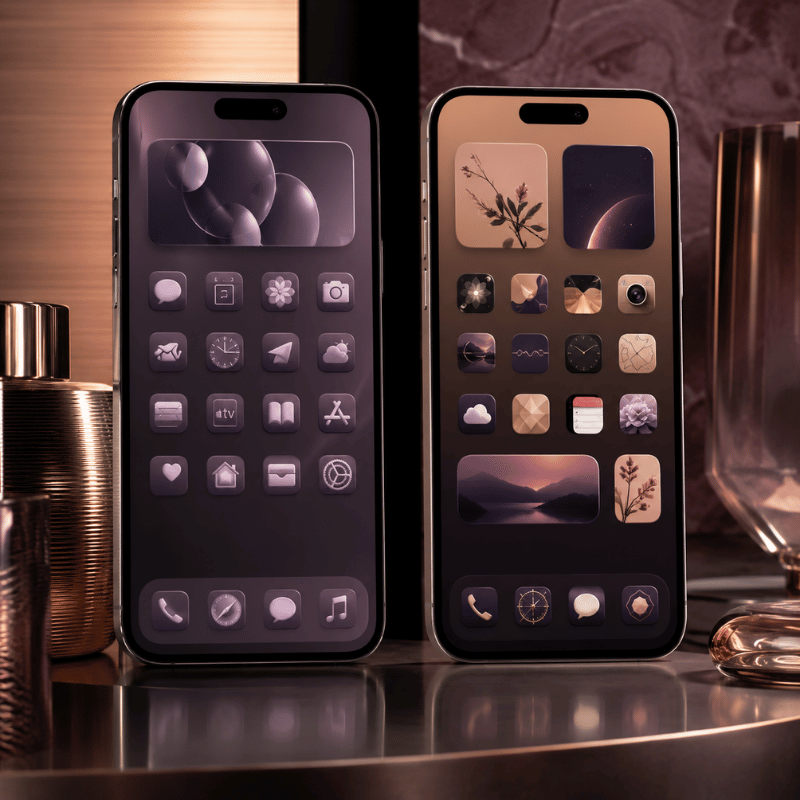
App Icon Themes — iOS 26 Native Tint vs Custom Shortcuts Method

By 2026, there are really two paths toward a themed home screen and they serve distinct purposes: the native iOS 26 Tint or Clear option applies a system-wide visual style across all of your icons, while the Shortcuts trick replaces individual icons with your own custom images. Which route you choose depends on whether you’re aiming for a consistent atmosphere or per-app custom icons.

Method iOS 26 Native Tint / Clear Shortcuts Custom Icons
Visual scope All app icons system-wide Per-icon, one at a time
Setup time Under a minute 2-3 minutes per icon
iOS version iOS 26 only (Clear); Tinted available iOS 18+ but behaves differently iOS 14 onwards
Loading behavior Opens app directly Brief Shortcuts flash before app loads (annoying for daily-use apps)
Original app icon Recolored / transparent but recognizable Hidden — original goes to App Library
Best for Whole-screen aesthetic shifts A handful of feature icons in a curated theme pack

The Tint route: Go to your home screen, long-press an empty spot to enter the Jiggle mode, then long-press on the icon of your choice to make it highlightable. Or long-press and then tap “iconize”. From there, tap Tinted, select from one of the preset palettes, use the eyedropper for custom colors, or enable Auto for a color balance based on your device’s wallpaper. For a visual guide to all tint settings, refer to MacObserver’s complete guide.

Q: What app are you using for the icons?

While an iOS 26 native tint option exists, most people will probably skip it. If you still want a unified color palette across all of your icons on your iOS device and aren’t using Shortcuts, the native Tint feature is the way to go. For custom images per application (or full theme packs for cottagecore icons, minimal line icons, and so on), Apple Shortcuts are the primary method in 2026, supplemented by Widgetsmith for matching widgets and specialized icon apps like iScreen or Widgetable for curator icon packs.

⚠️ Important

It’s important to note that using Shorts-as custom icons is technically-will break Spotlight search image recognition on many occasions, so you won’t see the custom icon in search results, which could be confusing with an abstract theme. Therefore, this setup is not ideal if your primary way of launching apps is through Search.

The Core 6 Widget Stack — Which Widgets Actually Earn Their Spot
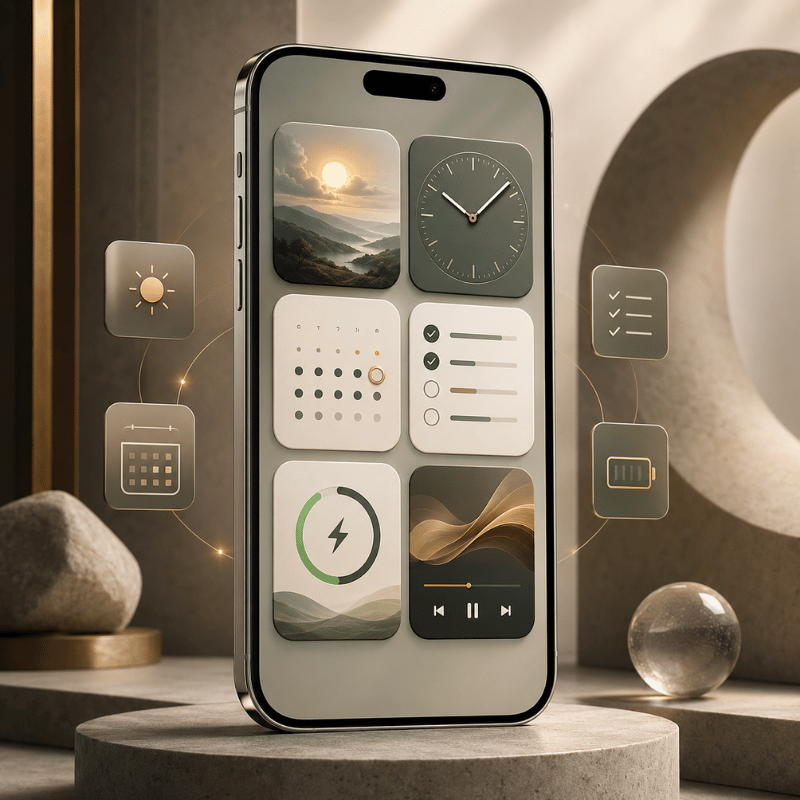
The Core 6 Widget Stack — Which Widgets Actually Earn Their Spot

The reality ofaddWidget-ing is way less widespread than you probably imagine. A 2024 TidBITS reader survey of iphone-users revealed nearly 50 percent never cracked open widgets and a lot of other users just had a few widgets they barely used. Widget tracker Sensor Tower says top-5 widget apps barely make it to 15% of iPhones in the US. In short, most people who installed any widgets, installed too many widgets and never actually glanced at them until they grew to resent them as visual clutter.

Widget-adoption in the wild.

A better widget strategy involves starting with a six-widget “core” and only moving up from there if the seventh widget would reduce your overall daily app opens by at least one.

What to include in your widget core, Part 1.

Widget Recommended size Why it earns its spot
1. Time / clock Small (2×2) Glanceable, replaces lock-screen check
2. Weather Small (2×2) High check frequency, low cognitive cost
3. Calendar (next event) Medium (4×2) Reduces app-opens to check “what’s next”
4. Activity rings / fitness Small (2×2) Behavior nudge — visible goal = more motion
5. Notes (pinned) Medium (4×2) Quick capture without app load
6. Smart Stack (rotating) Large (4×4) or Medium Replaces 3-4 single widgets in one slot

Smart Stack is our Workhorse for the Core 6 widgets because it swallows up widgets that don’t merit a devoted chunk of real estate. You can cram as many as 10 widgets into a Smart Stack, and the system intelligently rotates between them based on time, location and usage. (Maybe the calendar at morning; at afternoon exercise; at evening weather, for example.) Many field reports fromr/iOSsetupsand analyses of widget-impacton battery life have arrived at the same conclusion: two or three Smart Stacks with carefully selected content inside work better than 6 stand-alone widgets cluttered up your iPhone home screen.

What to include in your widget core, Part 2.

Q: What is this calendar widget?

The default Apple Calendar (Up Next, Day, List) is your top choice if you can spare no energy beyond simply enabling a widget because the default widget automatically syncs with your Apple Calendar entries without any further configuration. Third-party Calendar widgets, such as Fantastical and Structured, or widgets for specific date types from Widgetsmith, exist too. One reason for its nearly constant presence in ‘best customization widget‘ screenshotsm is that your calendar is one of the most information-rich data you view on your iphone, since this datum dictates your next action.

Smart Augments and Batter Life

💡 Battery Pro Tip

Widgets use about 15% of a iphone’s battery throughout a normal day, and that percentage can grow much more quickly once you start using live-data customization widgets (weather updates by location, dynamic exercise tracking, stock prices in real time, for example). If battery usage is a primary consideration for you, give static customization widgets or less frequently refreshing customization widgets the nod over live data-or just put the less time-critical widgets inside Smart Stacks to space them out through time, instead of laying them all out to get the iphone charged every second.

Third-party tools Augments and apps.

Best Apps for Home Screen Customization — Compared (Honest Trade-offs)
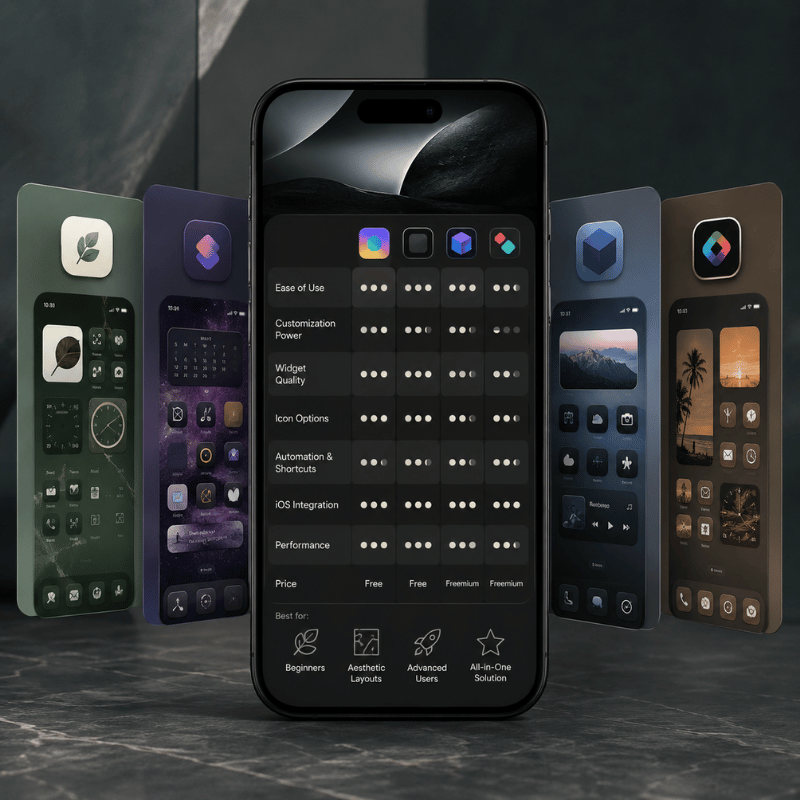
Best Apps for Home Screen Customization — Compared (Honest Trade-offs)

iOS 26 built in a good deal of what previous generations of customization third-party apps helped you accomplish-built-in Tint and Clear tools allow you to eliminate individual apps just to change icon colors. customization still has room for some non-system apps when you need preset icon bundles, interactive elements, lock-screen widgets or icon pack libraries you would not otherwise be able to access.

Anhonest widget’-ing approach.

App Core strength Limitation to know
Widgetsmith Deepest widget customization library, mature iOS 26 support, Focus Mode scheduling Widget-focused — does not theme icons themselves
Color Widgets Pre-made theme packs (apply look + matching widgets in one tap) Less granular control if you want to tweak individual elements
Widgy “Photoshop for widgets” — layers, transparency, data sources, live info Steep learning curve; overkill unless you actually design widgets
Apple Shortcuts Free, built-in, full control over custom-icon replacement Brief Shortcuts flash when opening apps; breaks Spotlight visual recognition
Widgetable Interactive sharing widgets, lock-screen tools, anniversary/birthday reminders Social-feature focus narrows utility for solo users
iScreen All-in-one aesthetic ecosystem (wallpaper + widgets + icon packs together); currently the #1 ranked app in Apple’s App Store Graphics & Design category for iOS 26 Single-app ecosystem — best if you want curated cohesion, less flexible if you mix multiple sources

The honest take: if you only want to change icon color, use the iOS 26 native Tint or Clear option and stop there. If you want a cohesive curated aesthetic where wallpaper, widgets, and icon pack come pre-matched, an ecosystem app like iScreen saves the hours you’d otherwise spend hunting matching assets across separate apps. If you enjoy the design process itself and want maximum control, Widgy is the deep end and Widgetsmith is the comfortable middle. Pick based on whether you value the result or the process.

How to Reset or Restore Your iPhone Home Screen
How to Reset or Restore Your iPhone Home Screen

If your layout experiment went badly, the easiest cure is the built-in Apple reset “Reset home screen Layout”-which shoves apps to App Library while re-arranging the originals to the first screen. Your data and apps are saved-but some things change:

  1. Open Settings.
  2. Tap GeneralTransfer or Reset iPhone.
  3. Tap Reset.
  4. Choose Reset Home Screen Layout.
  5. Click “Confirm” now to revert to default Apple screen; your third-party apps go onto new screens in alphabetical order or App Library.
⚠️ What Reset Does NOT Touch

The icon tints and style, the widgets, wallpapers and custom Shortcuts replaced-app icons, and the folder name “ custom “ are left untouched by layout. Reclaim a clear slate by individually reverting those; plan 5-10 minutes after the main part to finish up.

Q: How do I get my home screen layout back to normal?

Use Reset Home Screen to revert to defaults for icons and then-manually-select “wallpapers” from the list (hold down the home screen icon and choose “wallpaper”). To select the defaults “Default for icon” for icon’s styling, hold “Default”. Swipe individual widgets to “Remove”. Total time for reset including clean up: 5-10 minutes; no data lost.

7 Common Home Screen Layout Mistakes That Make Your Phone Look Cluttered
7 Common Home Screen Layout Mistakes That Make Your Phone Look Cluttered

You’ll spot all of these common mistakes on r/iOSsetups and in battery impact reports; these issues aren’t personal -they’re simply those traps anyone running into customization runs into.

  1. 1. Mismatched widget colors fighting the wallpaper.
    To put it plainly: don’t pick the two most visual elements on your screen (a widget and wallpaper) in warring colors. If your widget and wallpaper conflict, your choice either drowns in “visual noise”; or pick gray widgets to contrast sharply with photos. Luckily iOS 26 automates matching wallpaper and widget colors: “Auto-tint” in settings for the selected wallpaper changes the widget tint in sync with the wallpaper’s chosen tone.
  2. 2. More than three folders on the home screen.
    When you tap folders twice or thrice, just to locate the app within, you start to avoid even those apps you most often need-better yet keep only essential apps visible and rely on App Library for everything else.
  3. 3. Smart Stacks with conflicting categories.
    A Smart Stack could seem efficient if filled with calendar, weather forecasts and stock prices – but in this case, items randomly come to the surface because they are irrelevant to each other. Group items that seem to make sense together, e.g. “Morning routine”: Weather, Calendar, activity summary; “ evening routine ” : screen time , Notes , reminders .
  4. 4. Themed icons that break Spotlight search.
    themed icons take place of the default app identity for Spotlight. This disorients for results when searching in Spotlight by tapping in your keywords. themed icons are for when you open apps manually instead.
  5. 5. Wallpapers that hide the dock.
    Avoid placing busy or very dark wallpaper behind your Dock. As Apple’s own layout guidelines suggest- “ The area of interaction needs to be more contrasty in respect to elements of background .” -a Dock should therefore always be distinguishable from the backdrop.
  6. 6. Designing for landscape when you use portrait.
    iphone home screens appear vertically. If you set landscape photo as wallpaper, the image’s visual focus will often end up in the far corners – your sunset is now clouds only, cropped into portrait orientation; pick wallpapers with composition well-suited for portrait .
  7. 7. Notification badges every where.
    The red dot stands out on any color; five and the whole layout looks like the wailing of alarms. For the notifications that are not critical, turn them off (settings > Notifications > Allow Notifications > Badges off, per app).

FAQ

Q: How do I change my iPhone home screen layout?

View Answer
You work in four layers: first wallpaper, then widgets, icon style, and finally arrange them within folders and on pages. iOS 26 offers many options from within home screen (long press anywhere, then the wallpaper picker, customize menu, and widget editor come up). A first run-through takes about 15 minutes. The most frequent issue that causes problems: You chose a icon tint that looked right for wallpaper #1 and not wallpaper #2.

Q: Can you change the font on an iPhone home screen?

View Answer

Apple restricts access to system-level fonts on the home screen without jailbreak. You can alter text size overall (Settings > Display & Brightness > Text Size) and the lock screen (settings > wallpaper > customize > lock screen > tap clock), but system default type, including icon label style, remains unchangeable through OS means alone.

However, individual widget apps might support font-selection for content within the widget itself.

Q: What app are you using for the icons?

View Answer

In iOS 26, most icon style changes occur through Apple’s native customize menus long-press on an empty space on home screen and pick the desired setting (Default, Dark, Tinted, Clear).

custom images replace individual icons using Apple Shortcuts. Apps such as iScreen (pre-paired themes), widgetsmith (customization depth), and widgetable (social interaction focus) offers bundles where elements come together as coordinated units, varying greatly in how each treats components. Choose depending on speed or your desired depth.

Q: Can you have multiple home screen wallpapers on an iPhone?

View Answer

Yes. Focus modes (introduced in iOS 16) let you assign a different wallpaper to each Focus, so your home screen changes automatically when you switch between Work, Personal, Sleep, or any custom Focus you create.

Find it under Settings → Focus → tap a Focus → Customize Screens. This is the cleanest way to swap home screens for different contexts without doing any reset work.

Q: How do I reset my iPhone home screen?

View Answer

Go to settings > General > Transfer or Reset > Reset > Reset home screen layout. This reestablishes the native placement of apps on page 1 of your home screen, shunting everything else to either the App Library or to subsequent alphabetical pages. Rest assured, no applications or data are removed; it is purely a reorganization.

This action, however, does not alter the appearance of your wallpapers, widgets, icon tint settings, or Focus Modes, which must be managed individually should you wish to achieve a fully clean setup.

Q: What is the best iPhone home screen layout?

View Answer

Your ideal layout comes down to a combination of your app count, stylistic leanings, and usage habits, all addressed by the 3-Question Style Picker in this guide.

There’s no universal ‘best’, only the appropriate family for your distinct patterns.

Q: How do I get my home screen back to its default Apple layout?

View Answer
Two steps. The first step is settings General Transfer or Reset iphone Reset Reset Home Screen layout – this will return your home screen to its default Apple layout and file all other apps into the App Library. The second is to then restore all of your wallpaper, widget, icon tinting, and Shortcuts custom-icon changes manually, because those will carry over with the reset. The most reliable approach is to do a home screen-longpress-and-wallpaper Picker ( Default Apple),customize and do Default for icon style, then longpress individual widgets and choose Remove, and manually delete any of your Shortcut-based custom icons from your Shortcuts App list. Rebuilding from scratch to a true, out-of-box experience takes 5-10 mins and there is zero data loss.

About This Guide

This iphone home screen layout guide is constructed using customization’s iOS 26 Liquid Glass Design System, Apple Support documentation, Apple Human Interface Guidelines, and 2025-2026 r/iOSsetups community patterns. Six style families and 31 setups are presented alongside six widget recommendations, based on real-world builds rather than theoretical hypotheticals. Last updated: 2026-05-26.

Related Articles

  • More iScreen iOS 26 customization guides coming soon
Recent articles

12 Best Widgets for iPhone in 2026: Aesthetic, Productive & Fun

12 Best Widgets for iPhone in 2026: Aesthetic, Productive & Fun

2026/6/12 17:07
The best widgets for iPhone do more than fill empty space on your Home Screen, they put the one thing you’d normally unlock your phone and dig through an app to find right where you can glance at it. What matters isn’t piling on as many as possible. It’s choosing a few that earn their spot, then placing each one where it actually helps: the Lock Screen, the Home Screen, or StandBy. This guide is organized by what you want a widget to docheck the weather, see your day, watch a battery level, count down to a date, and then by the apps that do each job well. You’ll get 17 picks across seven categories, a quick way to decide where each widget belongs, and a plain answer to the question everyone asks: do widgets wreck your battery? (Short version: mostly no, with one real exception.) Quick Setup: iPhone Widgets at a Glance Where widgets go Home Screen · Lock Screen · StandBy · Today View Sizes Small · Medium · Large · Extra-Large (iPad) Add one Tap and hold the Home Screen → tap Edit → Add Widget → search → choose size → Add Widget Version needed Home Screen widgets (iOS 14) · Lock Screen widgets (iOS 16) · StandBy (iOS 17) · Liquid Glass look (iOS 26) How iPhone Widgets Actually Work, and How to Add One A widget is a small, glanceable view of an app that live outside the app itself. Tap it and it opens the app; left alone, it quietly shows the information you care about. Since iOS 14 you can place them on the Home Screen, since iOS 16 on the Lock Screen, and since iOS 17 inside StandBy, the full-screen view that appears when your iPhone is charging on its side. Each surface show a different size and amount of detail, which is why the same widget can feel essential in one spot and pointless in another. Apple gives you four sizes on the Home Screen, Small, Medium, Large, and (on iPad) Extra-Large. A Small weather widget shows the current temperature; a Large one shows an hourly and daily forecast. Worth knowing too is the Smart Stack: a stack of widgets you swipe through, which can also rotate automatically to surface the right one, your alarm in the morning, your commute later, based on time and routine. How do I add a widget to my iPhone? It takes about ten seconds, and the steps are the same whether you’re on iOS 18 or iOS 26: Touch and hold an empty area of the Home Screen until the apps jiggle. Tap Edit in the top-left corner, then tap Add Widget. Search or scroll to the app, swipe to pick a size, then tap Add Widget. Drag it where you want it and tap Done. To build a Smart Stack, drag one widget on top of another of the same size. For the Lock Screen, touch and hold the Lock Screen, tap Customize, choose Lock Screen, then tap the box below the time to add widgets there. Apple’s official guide to adding widgets walks through every surface if you get stuck. 💡 Key takeaway Pick the widget size to match the surface: small, single-number widgets shine on the Lock Screen; larger, detailed ones belong on the Home Screen or in StandBy. How We Chose: The Glance Test There are thousands of widgets in the App Store, and most of them are decorative. To cut the list down, every pick here had to pass one rule we call the Glance Test: a widget earns a spot on your Home Screen only if it shows you something you’d otherwise unlock your phone and open an app to check. If you still end up tapping in to get the real answer, it isn’t a widget you need, it’s an app, and it belongs in your App Library. That single question quietly solves the clutter problem. A weather widget passes because the temperature and rain chance are the whole answer. A “motivational quote” widget usually fails, it’s nice to look at, but it didn’t save you a tap. One first-time user described adding a single stack widget and suddenly feeling like the phone was a “mini command center” rather than a wall of icons . That shift, from launching apps to glancing at answers, is the entire point. “A widget’s job is to surface a small amount of timely, personally relevant information, glanceability is the whole design goal, not feature density.” Apple Human Interface Guidelines, WidgetKit Best Weather Widgets Weather is the widget almost everyone keeps, because the answer, what’s it doing outside, and when will it change, is pure glance value. Two picks cover most people. Apple Weather (free, built in) is better than it used to be. The Large widget shows current conditions plus an hourly and ten-day forecast, and the Lock Screen version can show sunrise, sunset, and precipitation chance in a single line. For most people it’s all the weather widget they need, and it costs nothing. Carrot Weather (free tier, with a paid upgrade as of 2026) is the pick for people who want more: highly configurable layouts, multiple data sources, and notoriously snarky commentary. A power user on a popular setups forum summed up the split well, native widgets are “decent,” but a dedicated weather app gives you layers you can actually tune . If you only care about the forecast on your Lock Screen, start with Apple Weather and turn on precise location only if you need rain-by-the-minute. For a deeper look at the options, see our guide to the best weather widget for iPhone. Best Calendar & Productivity Widgets If your day lives in a calendar, a widget that show your next few events without opening an app is the single biggest time-saver here. Fantastical is the standout: its Medium and Large widgets show an agenda view that’s easier to read at a glance than the stock app, and you can point it at a specific calendar set. It’s repeatedly the app people name when asked which has the best calendar widget . Apple Calendar and Apple Reminders are free and worth stacking together, your next meeting and your next task, side by side. On the productivity side, the Google app’s search-bar widget is a quiet favorite: one tap drop you straight into search or voice search, which is faster than opening Safari and typing. Stack a calendar, a reminders list, and a search bar and you’ve rebuilt the most useful third of your phone into a screen you never have to dig through. 💡 Pro Tip Build a single “today” Smart Stack — calendar on top, reminders and weather beneath — and let it auto-rotate. You get three answers in one widget slot. Best Battery Widgets (and the Battery Myth) If you carry an iPhone, AirPods, and an Apple Watch, the free Apple Batteries widget is the one to add: a single Medium widget shows the charge level of every connected device at once, so you find out your AirPods are at 9% before a call, not during it. Third-party battery widgets add ring-style graphics and per-device history if you want them, but the built-in option cover the core job for free. Do widgets drain your iPhone battery? This is the most common worry about widgets, and the honest answer is: mostly no, with one real exception. Widgets don’t run constantly. iOS gives each one a refresh budget through WidgetKit and updates it on a schedule, and as users on Apple’s own forums point out, a widget largely sips power only when you’re actually looking at the Home Screen . One exception stands outlocation-based widgets such as weather, maps, and anything tracking your position, which can drain noticeably because of continuous Location Services, not because they’re widgets. Outlets like CNET flag Lock Screen weather widgets as a battery cost for exactly this reason. So the fix isn’t “use fewer widgets” — it’s to set location to “While Using” (not “Always”) for your weather widget and skip live, location-tracking widgets you don’t read. A claim floating around, that widgets cut battery by 20% — doesn’t hold up; it’s the location access behind a couple of them that matters. ⚠️ Common mistake Setting a weather widget’s location to “Always” is the real battery drain — not the widget count. Switch it to “While Using the App” and the cost mostly disappears. Best Time, Countdown & Clock Widgets Time widgets are about anticipation, how long until something, or what time it’s somewhere else. A countdown widget that shows the days left to a trip, a birthday, or a deadline is one of the most-used widget types on iPhone, and it’s pure glance value: the number is the whole answer. The Apple Clock app’s World Clock widget is the free pick for anyone juggling time zones, showing two or four cities at once so you’re not doing math before a call. For people who plan around daylight, a sun-and-daylight widget (such as Lumy) shows sunrise, sunset, and golden hour at a glance. Countdowns are popular enough to deserve their own setup, including how to put one on the Lock Screen and in StandBy, we cover that in our guide to the best countdown widget for iPhone. Best Photo & Aesthetic Widgets Not every widget has to be useful, some just make the screen feel like yours. The free Apple Photos widget rotates through your library or a chosen album, so a favorite picture quietly cycles on your Home Screen. Beyond that, aesthetic widgetscustom fonts, colors, themed clocks, and photo frames that match your wallpaper, are where customization apps come in. iScreen, for example, offers themed widget packs you can color-match to a wallpaper, which is handy when you’re building a coordinated look rather than a random grid. If a matching, styled Home Screen is the goal, the widgets are only half of it, the wallpaper and icons have to agree too. Our walkthrough on building an aesthetic iPhone Home Screen shows how to make all three line up. Best All-in-One Widget Apps: Widgetsmith vs Widgetable vs iScreen If you’d rather get a whole kit of customizable widgets from one place instead of installing a separate app per category, an all-in-one widget app is the move. These let you design widgets, pick the data, the font, the color, the background, and place them anywhere. Here’s how the most popular options compare as of 2026. App Best for Free tier Standout Widgetsmith Broad, flexible customization Yes (most features free) Home + Lock Screen, huge style range Widgetable Playful, social & “pet” widgets Yes (in-app purchases) Shared widgets with friends iScreen Themed, color-matched looks Yes (premium upgrade) Coordinated widget + wallpaper + icon themes What is the best free widget app for iPhone? Most people will land on Widgetsmith. It remains the default recommendation when someone wants broad, flexible customization, it works on both the Home and Lock Screen, and the bulk of its features are free . If your goal is a themed look where widgets, wallpaper, and icons all match, a customization app like iScreen is built around that coordination instead. You can see iScreen’s widget options on the custom iPhone widgets page. ✔ Advantages of all-in-one apps One app, dozens of widget styles Match colors and fonts across your screen Most offer a usable free tier ⚠ Limitations to know Deep features often need a subscription Custom widgets can show ads or refresh slower For live data (calendar, weather) the native app’s own widget is often better Lock Screen vs Home Screen vs StandBy: Where Each Widget Belongs Picking good widgets is only half the job; the other half is putting each one on the right surface. That same battery widget feels essential on the Home Screen and wasted on the Lock Screen. Here’s a simple way to decide, based on how each surface is built and what Apple designed it for. Surface Best for Put here Lock Screen One-line, time-sensitive info you check without unlocking Temperature, next event, battery, countdown Home Screen Daily-use widgets and Smart Stacks you interact with Calendar, reminders, photos, multi-device battery StandBy Nightstand / desk view while charging on its side Clock, weather, large photo, world clock Today View Overflow — useful but not daily News, sports, screen-time, anything secondary Rule of thumb: if the answer is a single number or line and you want it without unlocking, it goes on the Lock Screen; if you tap or swipe it during the day, it belongs in a Smart Stack on the Home Screen; if it’s something you watch while the phone charges by your bed, set it up in StandBy. Apple’s notes on using StandBy and customizing the Lock Screen cover the setup for each. To arrange it all into a screen that work, our iPhone Home Screen ideas are a good next step. What iOS 26 Changes for Widgets in 2026 Right now, the biggest shift for widgets is visual. With iOS 26, released in September 2025, Apple introduced Liquid Glassa translucent design that flows across the system and give widgets a glassy, see-through background that morphs with what’s behind it. Widgets with a transparent background now pick up that layered, refractive look, which is why a lot of the “best 2026 setups” people are sharing lean into matching wallpapers that show through. Apple’s own iOS 26 feature list describes Liquid Glass surfaces that “fluidly morph” as you use them. Two practical things follow from this. First, if you want the glassy effect, choose widgets that support a transparent or tinted background and pair them with a wallpaper that has some contrast, and know that turning on Settings → Accessibility → Display & Text Size → Reduce Transparency will flatten the look if you find it distracting. Second, the surfaces keep expanding: StandBy and CarPlay widgets have grown across iOS 17 through 26, and Apple’s WidgetKit documentation shows interactive and Live Activity widgets becoming more capable. If you’re refreshing your setup in 2026, it’s worth redoing your widgets after you settle on a wallpaper, not before, the Liquid Glass look only pays off when the layer behind the glass is one you actually like. Search interest in iPhone widgets jumped sharply around the iOS 26 launch, so this is the moment a lot of people are rebuilding their screens. Build a Home Screen worth glancing at Mix the free built-in widgets above with a themed set, match them to your wallpaper, and you’ve got a screen that earns its space. Explore iScreen widgets → FAQ: Best Widgets for iPhone Q: What are the most useful iPhone widgets? View Answer The widgets people keep longest are weather, calendar, reminders, and a multi-device battery widget — each one answers a question you’d otherwise unlock your phone and dig through an app to check. Start with those four, give each its own surface, and you’ve covered the daily essentials. From there, add a countdown, a world clock, or a photo widget only when it earns the space by passing the same glance test. Quality beats quantity every single time. Q: How do I get cool widgets on my iPhone? View Answer Install a customization app such as Widgetsmith or iScreen, design a widget with your chosen font, color, and background, then add it from the widget gallery like any other. For a coordinated look, match the widget colors to your wallpaper. Q: What apps have the coolest widgets? View Answer Function-first picks are Fantastical for calendars, Carrot Weather for forecasts, and the Apple Batteries widget. Style-first picks are Widgetsmith, Widgetable, and iScreen. Q: What is the best all-in-one widget? View Answer A Smart Stack — several widgets in one slot that rotates to show the right one automatically. Q: Are iPhone widgets worth it, or do they slow your phone down? View Answer Yes, they’re worth it, and no, a sensible set won’t slow your phone down. Widgets update on a refresh budget through WidgetKit rather than running every second, so a handful of them costs almost nothing in performance. The only real drain comes from location-based widgets like weather and maps — and you fix that by setting their location access to “While Using” instead of “Always,” which most people never think to change. Q: How many widgets can you add to an iPhone? View Answer There’s no fixed limit. You can fill several Home Screen pages and bundle widgets into Smart Stacks. But more isn’t better — a handful that each pass the glance test will serve you far better than a screen crammed with widgets you never actually look at. About This Roundup We chose these iPhone widgets against one rule, the glance test, and checked the how-to and battery details against Apple’s own documentation rather than app-store marketing. App pricing and free-tier notes reflect what was available as of 2026 and can change; the Liquid Glass behavior described is from Apple’s iOS 26 feature list. References & Sources Add widgets on iPhoneApple iPhone User Guide Use StandBy on iPhoneApple iPhone User Guide Customize the Lock Screen on iPhoneApple iPhone User Guide New features available with iOS 26 (September 2025)Apple WidgetKit documentationApple Developer iOS features to turn off to save batteryCNET Related Articles Best weather widget for iPhone, picks and setup How to add a countdown widget to your iPhone How to build an aesthetic iPhone Home Screen iPhone Home Screen ideas to copy Custom iPhone widgets from iScreen
2026/6/12 17:07
Lock Screen Widgets Guide: Best Widgets for Your iPhone Lock Screen

Lock Screen Widgets Guide: Best Widgets for Your iPhone Lock Screen

2026/6/5 16:56
Lock screen widgets turn the screen you glance at most into a quick dashboard for weather, your calendar, battery levels, and more, without unlocking your iPhone. They’ve been part of iOS since iOS 16, and they’re easily one of the most useful customization features Apple has shipped. Yet most people add two or three widgets, never touch them again, and miss what these tiny tiles can actually do. This guide covers what lock screen widgets are, how to add and edit them on iPhone, which ones earn a spot, the apps that unlock custom design, and what changed in iOS 26. We’ll also share a simple rule for deciding what to keep, because the lock screen give you far fewer slots than you think. Quick Facts Lock screen widgets require iOS 16 or later. You get a small inline slot above the clock plus one widget row that holds up to four small widgets (fewer if you pick larger ones). They’re glance-first: tap one and it open the app, they aren’t the tap-to-toggle interactive widgets you may know from the Home Screen. iOS 26 lets you place widgets at the top or bottom of the screen and redesigns the clock with Liquid Glass. What Are Lock Screen Widgets? Lock screen widgets are small, glanceable tiles that sit on your iPhone’s Lock Screen and show timely information from your apps, temperature, air quality, battery level, upcoming calendar events, and similar at-a-glance data. Apple introduced them with iOS 16 in 2022, and they live in the strip directly below the clock, plus a single inline slot in the date line above it. It helps to separate three things people lump together. Lock Screen widgets appear on the screen you see before unlocking. Home Screen widgets sit among your app icons and come in small, medium, and large sizes. Today View widgets appear when you swipe right from either screen. They draw from the same apps, but they’re configured separately, adding a weather widget to your Home Screen doesn’t put one on your Lock Screen. If you’re building a complete look, our guide to iPhone home screen ideas pairs naturally with this one. One detail trips people up: lock screen widgets are designed for reading, not doing. Tap one and it open the related app (after Face ID or your passcode). That’s different from the interactive Home Screen widgets Apple expanded in iOS 18, which can toggle a setting or check off a reminder without opening anything. On the Lock Screen, the job is information at a glance, which, as we’ll see, should shape every widget you choose. How to Add Lock Screen Widgets on iPhone Adding widgets takes about thirty seconds once you know where Apple hid the controls. Your entry point is the Customize button, which only appears when you long-press the Lock Screen itself. Wake your iPhone and touch and hold the Lock Screen until the Customize button appears, then tap Customize. Tap Lock Screen (the left preview), then tap the widget area just below the clock. Tap Add Widgets. Tap or drag the widgets you want into the row. Tap the close button, then tap Done. These steps follow Apple’s official walkthrough for adding and editing widgets on iPhone. To edit a widget after placing it, say, point the Weather widget at a different city, long-press it during customization and choose the option you want. To swap one out, remove it first, which brings us to the question almost everyone asks next. Q: Can I add widgets to my lock screen? Yes, as long as your iPhone runs iOS 16 or later, that covers the iPhone 8 and newer. If you don’t see a Customize button when you long-press the Lock Screen, your iPhone is on an older version of iOS, or you’re pressing the Home Screen by mistake. Open Settings, go to General, then Software Update, and install the latest version. Once you’re on iOS 16 or higher, the widget row appears in the Lock Screen editor exactly as described above. 💡 Pro Tip You can build a different Lock Screen for each Focus mode — one for Work with your calendar, one for Personal with your activity rings. Long-press, swipe to a blank Lock Screen, tap the plus, and link it to a Focus. Each one keeps its own set of widgets. The 4-Slot Rule: Budgeting Your Lock Screen Here’s the part most guides skip. The Lock Screen doesn’t give you unlimited room. Apple’s own instructions admit it plainly: “If there’s not enough room for a new widget, you can tap the Remove button to remove a widget and make room for the one you want to add.” In practice you get one small inline slot above the clock and a single row below it that fits about four small widgets, and a larger rectangular widget eats two of those slots. iPhone users have complained about this for years; one popular thread on Reddit pointed out that “some widgets are twice the size leaving room for only two widgets.” So treat those slots like a budget. We call it the 4-Slot Rule: you’ve roughly four units of space, and every widget should earn its place by answering one questiondoes this save me an unlock? A weather tile that stops you opening the app is worth a slot, while a widget that only look nice but tells you nothing you would actually check is a slot wasted. And because the Lock Screen can’t stack widgets the way the Home Screen can (widget stacks are a Home Screen and Today View feature only), you can’t cheat the budget, what you place is what you get. Most people decorate instead of decide. People fill all four slots with widgets they already check obsessively, the same apps they open first thing anyway, and gain nothing. The Reddit crowd that obsesses over setups keeps asking each other a sharper question: “what widgets do you actually tap every day?” That’s the right filter. Spend your four slots on glance-value, not vanity. If your day revolves around… Spend your slots on Why it earns the spot Commuting Weather, Calendar, a transit or Maps widget Answers “do I need a coat and am I late?” before you leave Parenting / family Calendar, Reminders, a shared countdown Keeps pickups, chores, and events one glance away Fitness Activity rings, Battery, World Clock Tracks progress and device readiness mid-workout A minimalist look One Weather tile, nothing else Maximum calm; the wallpaper stays the star Best Lock Screen Widgets Worth a Slot With four slots to spend, these are the widgets that consistently earn their keep. Apple’s built-in options cover most needs, and tech reviewers repeatedly land on the same shortlist of genuinely useful tiles. Q: What are good widgets to have on a lock screen? Good lock screen widgets replace an unlock with a glance. Weather and temperature top almost every list because checking the forecast is the single most common reason people wake their phone. Calendar comes next, your next event, right there. Battery (including connected AirPods and Apple Watch) saves a trip into Settings. A World Clock tile is invaluable if you work across time zones, and Activity rings keep fitness goals visible. Spot the pattern: pick widgets that answer a question you ask many times a day. ✔Weathertemperature, conditions, or precipitation; the highest-value glance for most people. ✔Calendaryour next event or the date; long-press to choose which calendar it shows. ✔BatteryiPhone plus connected AirPods and Apple Watch in one tile. ✔World Clocka second time zone for remote teams and travel. ✔Activity / Fitnessyour rings, so closing them stays top of mind. ✔Remindersthe next due task without opening the app. Want something more personal than a battery readout? A date countdown is a favorite for trips, birthdays, and launches, we go deep on that in our countdown widget guide, and a tailored weather widget can look far better than the stock one. Couples often add a shared status tile too; if that’s you, our couple widgets are built for exactly that. Best Lock Screen Widget Apps for iPhone Apple’s built-in widgets are functional but plain. If you want custom fonts, photo tiles, color-matched designs, or data the stock widgets don’t offer, a third-party app fills the gap. These apps add their own widgets to the same Lock Screen widget gallery, once installed, they show up alongside Apple’s options when you tap Add Widgets. Q: What apps have lock screen widgets? Plenty of apps offer them, and the category has grown crowded since iOS 16. When you’re evaluating one, look past the screenshots and check three things: does it offer the specific widget you want (countdown, photo, quote, health), can you actually match it to your wallpaper, and does it run without nagging you to upgrade every time you open it? A good widget app should feel like part of iOS, not a billboard. That design-first standard is exactly what we built iScreen’s iPhone widget app around, color-matched widgets, photo and text tiles, and themes that span your Lock Screen, Home Screen, and StandBy mode so the whole device look intentional. If you would rather start from a finished look than build one tile at a time, our lock screen customization templates give you a coordinated set in a couple of taps. “The widgets people keep are never the flashiest ones, they are the ones that answer a question fast. We design around that: a tile should read clearly in the half-second before you unlock, or it does not deserve the slot.” The iScreen Design Team How to Customize and Style Your Lock Screen Widgets A great Lock Screen isn’t just useful widgets, it’s widgets that look like they belong with your wallpaper. Treat the whole screen as one composition. Start with the wallpaper, pull two or three colors from it, and choose widgets and a clock tint that echo those colors. A cohesive palette read as “designed,” while a clash of stock blues and greens reads as default. One discipline keep it tidy: pick a single accent color and let everything support it. If your wallpaper is a warm sunset, a single amber clock tint plus neutral widget tiles looks deliberate; five different widget colors looks like noise. Photo wallpapers also support a depth effect, where the subject can rise in front of the clock for a layered look. When you want to go further than tinting native tiles, a custom widget app lets you set fonts and backgrounds directly, our walkthrough on how to customize your iPhone covers the full workflow. 💡 Pro Tip Build the wallpaper and widgets as a matched set, then duplicate that Lock Screen and tweak the copy for a season or mood. You keep your layout and only change the look — far faster than rebuilding from scratch. Lock Screen Widgets on Android If you’re on Android, the path is less consistent than on iPhone. For years, true lock screen widgets came and went depending on your manufacturer and Android version, and many phones offered only an “At a Glance” strip plus clock styles rather than a full widget picker. Google has been bringing dedicated lock screen widgets back with recent Android releases, starting on tablets and expanding from there, so the exact steps depend on your device and software version. Check your phone’s Settings under Lock Screen or Wallpaper & style for a widgets option; if it’s missing, a third-party lock screen app from the Play Store can add similar tiles. Either way, the same 4-Slot Rule applies, limited space, so spend it on glances that matter. Troubleshooting: Widgets Not Showing or Won’t Change When lock screen widgets misbehave, the cause is almost always one of a short list. Run through these before assuming anything is broken. ⚠️ Common Fixes No Customize button: you’re on iOS 15 or earlier, or pressing the Home Screen, update iOS and long-press the Lock Screen. A widget is missing from the list: its app isn’t installed, or the app doesn’t offer a Lock Screen widget. Install or update the app first. “Not enough room”: the row is full, remove a widget (or swap a large one for two small ones) to make space. A widget shows stale data: open the app once so it can refresh, and confirm Background App Refresh is on in Settings. Changes won’t stick: make sure you tapped Done after Customize; restart the iPhone if the editor froze. On Android, the equivalent first step is to long-press the lock screen or open Settings to find the widget or “At a Glance” controls; if there’s no option at all, your version simply doesn’t support it natively and a Play Store app is the workaround. What’s New and What’s Next: iOS 26 and the Lock Screen The Lock Screen got its biggest visual update in years in 2025. Apple introduced its Liquid Glass design in June 2025, and the Lock Screen is where you notice it first. The control buttons and clock take on a floating, frosted-glass appearance, and when you tilt the iPhone, light glints across the glass. Notifications adopt the same translucent look so your wallpaper shows through, and the design carries into Control Center too. For widgets specifically, the change that matter is placement. According to MacRumors’ rundown of iOS 26 Lock Screen features, widgets can now sit at the top of the display under the time or at the bottom, in earlier versions they could only go up top. With the new adaptive clock, which you can drag to resize, widgets also shift automatically so the subject of a photo wallpaper stays visible. Spatial Scenes turn ordinary 2D photos into layered 3D wallpapers that move as you tilt the phone, giving your widgets a more dynamic backdrop. The practical takeaway: if you upgrade to iOS 26, revisit your Lock Screen. Try moving your widget row to the bottom if a photo subject keep getting covered, and experiment with the resizable Glass clock to free up space. The 4-Slot Rule still holds, you don’t get more widgets, you get more control over where they live. For 2026, expect Apple to keep investing in glanceable surfaces across the Lock Screen, StandBy, and Dynamic Island, so a tidy widget setup now will only pay off more later. Frequently Asked Questions Q: How many widgets can you have on the lock screen? View Answer Plan for about four. You get one small inline slot above the clock plus a single widget row below it that holds roughly four small widgets. Pick a larger rectangular widget and it eats the space of two small ones, so the practical ceiling is four small tiles or two large ones. And because there are no widget stacks on the Lock Screen the way there are on the Home Screen, you cannot rotate extras through a single slot to expand past that limit. Q: Are lock screen widgets interactive? View Answer Mostly no. They display information, and tapping one just opens the related app. Unlike the interactive Home Screen widgets in iOS 18, they will not toggle a setting in place — so choose them for what they show. Q: Why can’t I add widgets to my lock screen? View Answer The most common reasons are an older iOS version (you need iOS 16 or later), pressing the Home Screen instead of the Lock Screen, or a full widget row. Update iOS in Settings, long-press the Lock Screen until Customize appears, and remove a widget if there is no room for a new one. Q: Do lock screen widgets drain the battery? View Answer Barely. Widgets refresh on a schedule rather than constantly, so the battery cost is tiny next to screen brightness or an always-on display. Q: How do I change widgets on an Android lock screen? View Answer It depends on your phone. Long-press the lock screen or open Settings and look under Lock Screen or Wallpaper & style for a widgets or “At a Glance” option. If your device and Android version support it, you can add and reorder tiles there; if not, a third-party lock screen app from the Play Store is the usual workaround. Q: What iOS version do I need for lock screen widgets? View Answer iOS 16 or later, which covers the iPhone 8 and newer. Build a Lock Screen You’ll Actually Use Color-matched widgets, photo tiles, and full themes for your Lock Screen, Home Screen, and StandBy, designed to read in a glance. Get iScreen → Just browsing? See lock screen ideas first. Why We Wrote This We build iPhone customization tools, so we spend our days watching which lock screen widgets people keep and which they quietly delete. The 4-Slot Rule in this guide come from that pattern: the tiles that survive are the ones that save an unlock. Every step here was checked against Apple’s current documentation and the iOS 26 changes shipped in 2025. References & Sources How to add and edit widgets on your iPhoneApple Support Apple introduces a delightful and elegant new software design (Liquid Glass)Apple Newsroom iOS 26: New Lock Screen FeaturesMacRumors The Best Lock Screen Widgets to Use on Your iPhone or iPadHow-To Geek Related Articles How to set up a weather widget on iPhone Add a countdown widget to your iPhone iPhone home screen ideas and layouts Set up StandBy mode on iPhone Couple widgets for iPhone
2026/6/5 16:56
Best Weather Widgets for iPhone: Beautiful & Functional Options

Best Weather Widgets for iPhone: Beautiful & Functional Options

2026/6/4 16:54
A weather widget on your iPhone turns a quick glance into a full read on the day: temperature, the next hour of rain, sunset, and what to wear before you even open an app. Most guides stop at “touch and hold the Home Screen.” This one go further. You’ll set weather up across all three surfaces of your phone, pick a widget that actually fit how you live, fix the one that mysteriously vanished after an update, and understand why it suddenly looks like frosted glass in iOS 26. Here’s the idea worth stealing: stop thinking of “the weather widget” as one thing. On a modern iPhone you’ve three places to show weather, and each answers a different question. We call it the 3-Surface Weather Setup, and it’s the backbone of this guide. 📐 The 3-Surface Weather Setup Home Screenthe daily dashboard (forecast at a glance, multiple cities) Lock Screenthe zero-tap check you see 80+ times a day StandBythe bedside or desk view while your iPhone charges on its side How to Add a Weather Widget to Your iPhone Home Screen This is the part everyone searches for first, so let’s make it foolproof. The native Weather app already includes Home Screen widgets, so you don’t need to download anything to get started. Touch and hold an empty area of your Home Screen until the apps start to jiggle. Tap the Edit button (or the +) in the top corner, then tap Add Widget. Search for Weather in the widget gallery. Swipe through the sizes, then tap Add Widget on the one you want. Drag it where you want it and tap Done. To change the city it show, touch and hold the widget, tap Edit “Weather” (or Edit Stack if it’s in a group), choose My Location or search for a city, then tap outside the widget to finish. Want both your home city and a trip destination? Apple lets you add more than one Weather widget, so you can watch two forecasts side by side. 💡 Pro Tip Drop the Weather widget into a Smart Stack and turn on Smart Rotate and Widget Suggestions. iOS then surfaces the forecast right when you tend to check it (your morning commute, say) and tucks it away the rest of the day. Weather Widget Sizes Explained: What Each One Shows Picking a size is really picking how much information you want without tapping in. Bigger isn’t always better; a small widget you actually read beats a large one that crowds out your apps. Here’s what each native Weather widget surfaces. Widget size What it shows Best for Small (2×2) Current temperature, conditions, high/low A clean home screen where weather is one tile among many Medium (4×2) Current conditions plus an hourly forecast strip Knowing when rain starts or stops today Large (4×4) Hourly plus a multi-day outlook, often with precipitation, feels-like, and more detail Planning the week without opening the app Lock Screen (inline / circular) Temperature, conditions, or a single metric like UV or air quality A zero-tap glance every time you wake the phone Rule of thumb: if you check weather to decide what to wear, a small or medium widget is plenty. If you check it to decide what to plan, go large. Many third-party apps add extra fields here, wind, humidity, sunrise and sunset, air quality, which is exactly where the “best widget” question gets interesting. Add Weather to Your Lock Screen and StandBy Almost everyone sets up the Home Screen widget. Yet the other two surfaces are where the real payoff live, because you see your iPhone Lock Screen dozens of times a day without ever unlocking. Lock Screen weather (the zero-tap check) Touch and hold your Lock Screen, then tap Customize (tap + to make a new one). Tap the widget area beneath the clock. Choose Weather and add the temperature, conditions, or a detail like UV index. Tap Done. StandBy weather (the nightstand view) When you turn your iPhone on its side while it charges, StandBy mode turns it into a small smart display. Swipe to the widget face, touch and hold, and add a Weather widget so the forecast greets you in the morning before you’ve picked up the phone. It’s the most underused weather surface on iOS, and it costs nothing to set up. ⚠️ Important All three surfaces pull from the same Location Services permission. If one shows the wrong city or goes blank, the fix is almost always location — more on that below. The Best Weather Widgets for iPhone in 2026 Apple’s native widget is reliable and free, but it’s deliberately minimal. If you want richer data, smarter layouts, or just more personality, a third-party app is the move. Here’s an honest read on the names that keep coming up among iPhone users. App What it’s good at Cost Apple Weather (native) A free, accurate starting point, now richer after Apple folded in Dark Sky data. Keep it if you mainly want temperature and rain. Free CARROT Weather The power user’s pick: deeply customizable widgets, radar, and a snarky personality you can dial up or off. Reddit’s r/ios crowd keeps calling it “the best by far.” Free + paid tiers Hello Weather Clean, calm, and glanceable, with a choice of forecast data sources. A 2025 review crowned its widgets for design. Freemium The Weather Channel / WeatherBug Built for severe-weather alerts and radar when storm tracking matters more than aesthetics. Free (ad-supported) “The No. 1 reason Hello Weather tops my list is its clean, concise, glanceable design, whether in-app or through its widgets.” Yahoo Tech review, 2025 ⚠️ Common mistake Don’t choose a weather widget on looks alone. Two widgets can look identical and pull from different forecast models, refresh on different schedules, and disagree by several degrees. Check the data source and how often it updates before you commit. Free vs Paid Weather Widgets: What You Actually Get Most of these apps are free to install, then ask for a subscription to unlock the good widgets. Before you pay, it helps to know what the money actually buy, and to clear up a pricing point that confuses a lot of people. Feature Free tier Paid subscription Basic widget sizes Yes Yes Extra layouts & customization Limited Full Radar, alerts, longer forecasts Often locked Unlocked Ads removed No Usually yes The pricing confusion is worth flagging. CARROT Weather, for example, has more than one paid tier: an entry-level premium plan reported at around $4.99/year by The Sweet Setup, and a higher “ultra” tier that costs roughly ten times that. People who quote “$50 a year” are usually looking at the top plan, not the one most users need. (Prices were accurate as of early 2026 and change often, so confirm in the App Store before subscribing.) The honest answer: if the free native widget covers your needs, keep it. Pay only when you want a specific thing the free tier won’t give you, better radar, a custom layout, or a look that matches your aesthetic. How to Make an Aesthetic Custom Weather Widget Here’s the gap the big weather apps leave open: they give you their design, not yours. If you’ve built a coordinated theme and the stock weather widget clashes with it, a customization app let you style the widget to match. That’s where custom iPhone widgets come in. In iScreen’s widget library, an aesthetic weather widget is less about more data and more about fit: you pick the background color, the font, and how minimal the layout is, so the forecast read like part of your wallpaper instead of a sticker on top of it. A few combinations our users reach for again and again: ✔Minimal monoa single temperature number on a flat background, paired with a clean wallpaper. ✔Pastel matchwidget tint pulled from your wallpaper’s palette so nothing fights for attention. ✔Small-and-stackeda tiny weather tile beside a clock or a countdown widget in a tidy two-up layout. The principle is the same one behind any good home screen ideas: pick one accent color and let the weather widget echo it, rather than introducing a new one. A widget that belongs to your theme always looks more deliberate than the default. Weather Widget Not Working? Fixes for the “Disappeared” Widget If your weather widget went blank, froze on yesterday’s forecast, or vanished after an update, take a breath: this is common and almost always fixable in a couple of minutes. Where Did My Weather Widget Go? Most of the time, it didn’t get deleted, an iOS update reset it. Major updates can rearrange the Home Screen, clear a widget’s saved location, or pause the permission it need to refresh. So the widget isn’t gone; it’s sitting there without the location access it needs to draw a forecast, which makes it look blank or stuck. That’s why re-adding it or re-granting location usually brings it straight back, no app reinstall required. ✔Check Location Services. Settings > Privacy & Security > Location Services > Weather. Set it to While Using the App (or Always) and turn on Precise Location. ✔Turn on Background App Refresh. Settings > General > Background App Refresh, so the widget can update when you’re not looking at it. ✔Re-add the widget. Remove it, then add it again from the widget gallery to force a fresh start. ✔For a blank Lock Screen weather wallpaper: touch and hold the Lock Screen, tap Customize, and re-accept the location prompt. iPhone users report this single step fixes the missing-location look. ✔Restart, then update. A quick restart clears most glitches; installing the latest iOS clears the rest. Work down that list in order and you’ll catch the cause well before the last step. To rebuild the widget exactly how you like it afterward, the same steps you used to customize your iPhone apply. What iOS 26’s Liquid Glass Means for Your Weather Widget If your weather widget suddenly looks translucent, refracting the wallpaper behind it, that’s Liquid Glassthe headline design change in iOS 26. Widgets, icons, and the Lock Screen now use a glassy material that bends light and adapts to whatever sits behind it. The weather widget is one of the most-cited examples because its background change with conditions. You’re not stuck with one look. To change how widgets and icons render, touch and hold the Home Screen, tap Edit, and switch the appearance between Default, Clear, and Tinted to suit your wallpaper. And if the glass effect ever hurts readability, you can tone it right down under Settings > Accessibility > Display & Text Size > Reduce Transparency. The practical takeaway for 2026: a weather widget’s legibility now depends on your wallpaper as much as the widget itself. If yours is hard to read on a busy background, switch to Tinted or turn on Reduce Transparency, and if you want a glass look that still read cleanly, a custom widget with a solid backing plate sidesteps the problem entirely. Liquid Glass made aesthetic widget choices matter more, not less. Frequently Asked Questions Q: Does the iPhone have a built-in weather widget? View Answer Yes — and it’s free. The built-in Weather app covers Home Screen, Lock Screen, and StandBy in several sizes. Q: Why is my iPhone weather widget not updating? View Answer Usually it’s a permission. Open Settings > Privacy & Security > Location Services > Weather and allow access, then turn on Background App Refresh. If it’s still stuck, remove and re-add the widget, then restart your phone. Q: Can I add a weather widget to my iPhone Lock Screen? View Answer Yes, and it’s one of the most useful places to put it. Touch and hold the Lock Screen, tap Customize, then tap the widget area beneath the clock and choose Weather. You can show the temperature, current conditions, or a single detail like UV index — whatever you want to read without ever unlocking the phone. Because you wake your screen dozens of times a day, this becomes your real weather check. Q: What is the best free weather widget for iPhone? View Answer For most people, Apple’s own widget wins on value — accurate and built in. CARROT and Hello Weather also have free tiers worth trying. Q: How do I get a bigger weather widget on my iPhone? View Answer You can’t stretch an existing widget, so add a fresh one in the size you want. Touch and hold the Home Screen, tap Add Widget, search for Weather, then swipe through the previews until you reach the large (4×4) option and tap Add Widget. The large size packs in an hourly strip plus a multi-day outlook, so you get the whole picture without opening the app. Drag it into place and tap Done. Q: How do I change the location on my weather widget? View Answer Touch and hold the widget, tap Edit “Weather” (or Edit Stack), tap My Location, then search for and pick the city you want. Tap outside the widget to save. You can also add a second Weather widget for a different city. Why We Wrote This Guide iScreen builds iPhone customization tools, so we spend our days watching how people set up widgets, including where the weather widget breaks. This guide pull together Apple’s official steps, real fixes iPhone users shared for the “disappeared” widget, and what iOS 26’s Liquid Glass changes, so you can set weather up once across all three surfaces and stop fiddling with it. Want a weather widget that matches your wallpaper instead of fighting it? Build your own with iScreen → References & Sources Use Weather widgets on iPhoneApple Support Add, edit, and remove widgets on iPhoneApple Support Create a custom Lock Screen on iPhoneApple Support How to customize your iPhone Home Screen for iOS 26’s Liquid GlassTechCrunch iOS 26 setting to customize the Liquid Glass design (Reduce Transparency)CNET Related Articles How to Add a Countdown Widget on iPhone iPhone Home Screen Ideas StandBy Mode Widgets for iPhone Dynamic Island Widgets & Animations
2026/6/4 16:54
Back to top