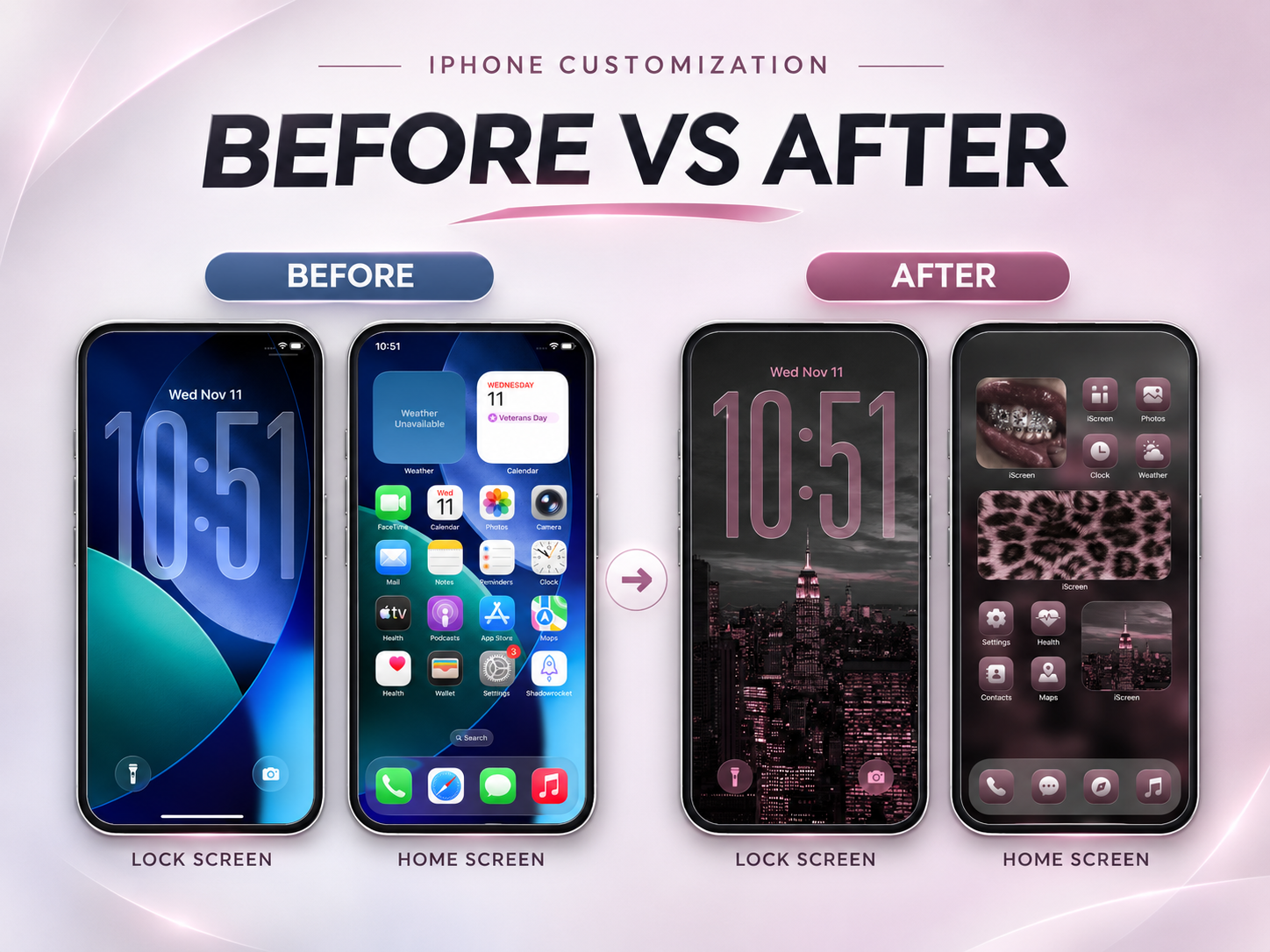
Kawaii iPhone Theme Guide: Cute App Icons, Pastel Widgets, and Home Screen Ideas
Kawaii iPhone Theme Ideas: Icons, Widgets & Wallpapers

A usable kawaii iPhone theme pairs kawaii pastel artwork with at least a 3:1 icon contrast ratio so everyday apps are quick to tap. Built-in iOS customization is free, while indie icon packs and theme apps expand your options for cute widgets and coordinated wallpapers.

Many viral setups make a phone cute in screenshots but slow down your daily tasks. When every phone icon has the same pale pink background, your eyes lose immediate color landmarks. In this tutorial, we’ll discuss readable palettes, setup trade-offs, and exact iPhone wallpaper pixel dimensions and provide clean reversal paths.

What Makes a Kawaii iPhone Theme Actually Usable Every Day?
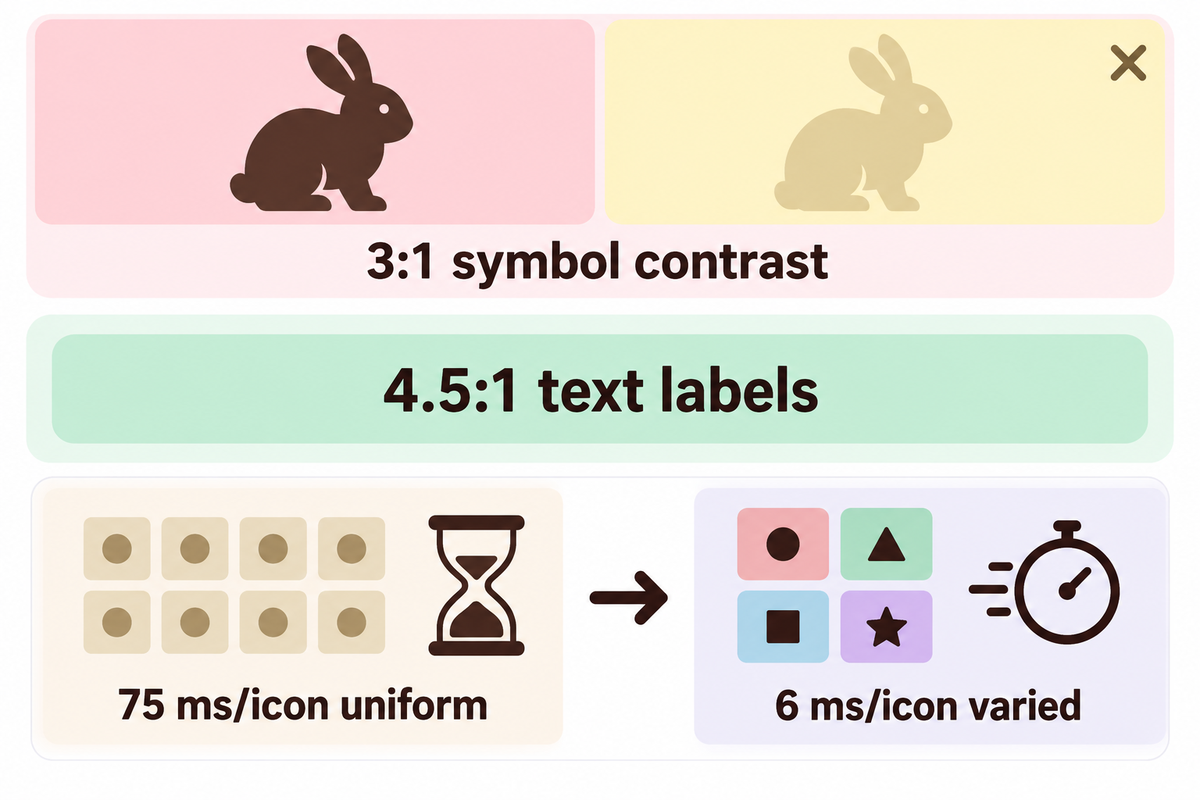
3-layer kawaii legibility: 3:1 icon contrast and 3 to 4 category hues cut scan slope from 75 to 6 ms/icon.

Every icon symbol needs at least 3:1 contrast against its pastel tile so everyday apps stay quick to tap. Pastel color variations throughout app categories maintain the theme. The icon silhouettes are easy to recognize and reduce search time when looking for apps. Keeping color groupings distinct cuts visual search time while keeping the cozy look of a coordinated iPhone home screen.

Think of your home screen like a pastel stationery box. Imagine all the pens, highlighters, and erasers wrapped in the same light cream paper. You would pause to look at each one every time you wanted to choose a tool. It’s faster to identify items separated in various pastel hues. So a soft pink, mint, butter yellow, or sky blue background is faster to scan and much cuter.

Accessibility standards provide a baseline. Under W3C WCAG 2.1 Technique G207 and Success Criterion 1.4.11, graphical symbols needed for recognition must have a minimum contrast ratio of 3:1 against adjacent colors. That threshold does not round up, so 2.999:1 falls short. Normal text labels and widget copy need 4.5:1 under Technique G18, while large display text needs 3:1.

“When choosing the colors for graphics, consider the color(s) adjacent to that graphic, and test that the contrast ratio is at least 3:1.”

Peer-reviewed ergonomics research shows why a monochrome app icon set slows down daily taps. In Study 1 by Trapp and Wienrich (2018) 18 mobile touch device users searched grids of 8, 16, and 24 icons. Search slopes were at 6 ms/icon and 13 ms/icon when the target icons were distinct by color. If all icons shared one color group, the slope jumped to 75 ms/icon, a 12.5x increase in time.

In Study 2 of Trapp and Wienrich (2018), 36 participants searched two swipeable 24-icon smartphone screens with visible app names. No participant appreciated adding an all-same color scheme to their smartphone. Out of 33 written comments, 24 called it confusing or exhausting. By contrast, 78% favored varied colors, and 65% of the 34 smartphone owners wanted icons color-coded by app category. Suppose you place 24 icons on page one using one uniform cream hue.

At a 75 ms/icon slope instead of 6 ms/icon, scanning an unfamiliar app adds 1.8 seconds of visual slope instead of 0.14 seconds. That comparison isolates visual search from muscle memory; pinned positions speed up familiar taps, yet occasional apps still trigger hesitation.

The 3-Layer Kawaii Legibility Rule

  1. Layer 1 (Symbol to Tile): Place crisp white or deep cocoa symbols against pastel tiles at a ratio of 3:1 or higher. Pale yellow (#FFF000) on white scores only 1.2:1 and washes out in daylight, per W3C SC 1.4.11 Figure 7.
  2. Layer 2 (Tile to Wallpaper): Test tile borders against the least contrasting area of a gradient or patterned background. Thin doodle strokes almost disappear against a screen due to anti-aliasing, so pick medium outlines.
  3. Layer 3 (Category Hue Coding): Assign 3 to 4 distinct pastel hues to functions such as messaging (pink), notes (mint), utilities (sky blue), and media (lavender).

If your icons look identical at arm’s length, switch monochrome tiles to category-coded pastels before adding widgets. Browse creative iPhone home screen ideas to compare balanced grids against crowded setups.

Can You Make a Kawaii iPhone Home Screen Without Hiding Every App Label?

You should keep your icon size set to Small in iOS Customize to have app names shown under pastel tiles. According to Apple Support, setting icon size to Large automatically removes app labels. Keeping Small icons gives you the cute app icons effect while enabling fast text scanning for utility, banking and travel apps.

Switch to Large label-free tiles only after you memorize every app position on page one. Hand-drawn or Chibi artwork can make two apps appear similar, making Small icons with visible text useful to avoid tapping the wrong app.

Original Kawaii iPhone Theme Palettes and Licensed-Safe Art Directions
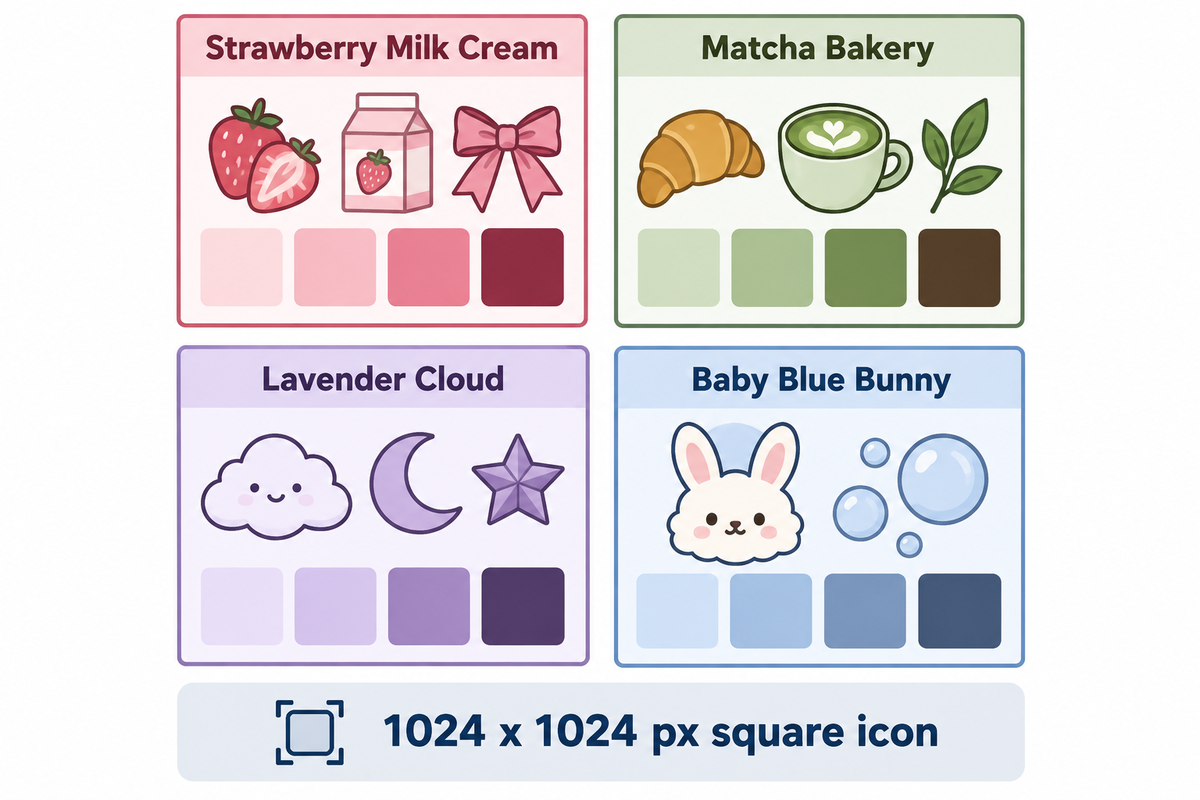
Four original non-IP pastel kawaii palettes built around strawberries, matcha, clouds, and bunnies at 1024 x 1024 px.

Choosing original pastel palettes built around bunnies, cats, clouds, strawberries, sakura petals, and bakery sweets creates a polished kawaii aesthetic without trademark takedowns. Matching two core colors, one darker accent for legibility (3:1), and one consistent illustration style prevents visual discord across your phone theme.

Unlicensed packs featuring protected cartoon characters often vanish from online shops without warning. Original kawaii icons stay available and let you style your smartphone with a cute aesthetic built from cherry blossom branches, woodland animals, or retro pixel trinket charms.

For crisp scaling on Retina displays, Apple Developer Human Interface Guidelines specify a 1024 x 1024 px square icon layout in sRGB or Display P3 color spaces. Skip pre-rounded PNG files with transparent corners. Because iOS applies its own rounded-rectangle mask, pre-masked borders can leave jagged edges around specular highlights.

Style Direction Original Motifs Tile & Symbol Palette Icon Art Style Best iOS Mode
Strawberry Milk Cream Strawberry slices, milk cartons, gingham ribbons Cute pink tiles with deep berry or cocoa ink Hand-drawn flat vector Light Default
Matcha Bakery Croissants, bakery cups, soft cream puffs Sage green and warm beige with espresso outlines Thick-stroke doodle Light Default
Lavender Cloud Smiling clouds, moons, paper stars Kawaii purple tiles with plum or navy symbols Soft 3D clay Auto or Light
Baby Blue Bunny Fluffy bunny faces, bows, soap bubbles Powder blue and ivory with slate-blue ink Rounded sticker art Light or Clear Light
Butter Yellow Cafe Toast, honey jars, sleepy kitty faces Warm cream-yellow with chestnut brown outlines Watercolor brush Light Default
Soft Berry Dark Mode Night clouds, glowing hearts, sleepy cats Charcoal-plum tiles with rose-pink glyphs Soft neon-pastel flat Dark or Tinted Dark
Sakura Ribbon Sakura blossoms, satin bows, tea cups Blush rose and white with burgundy linework Anime-inspired flat Light Default
Woodland Cottagecore Mushrooms, frogs, acorns, fern leaves Oatmeal beige and moss with forest-green ink Textured crayon Light Default
Retro Pixel Trinket Pixel hearts, mini consoles, cassette charms Mint, lilac, and peach with crisp dark borders 16-bit pixel art Light or Dark

Stick to one rendering family to keep your pink aesthetic iPhone theme clean and unified. Mixing glossy 3D clay widgets with thin black-and-white doodle icons breaks visual harmony even when colors match. Keeping an aesthetic kawaii look focused on one style holds every folder together.

For girly or pink phone layouts with warm pastel vibes and strong readability, pair blush tiles with symbols in deep cocoa or plum. Avoid white icons on pale yellow tiles. In W3C G207 Example 1, crisp orange (#E3660E) on white passes at 3.4:1, while pale yellow (#FFF000) on white fails at 1.2:1.

When you prefer pre-matched sets over piecing files together, you can find themes where widgets and icons are pre-matched to share identical line weights. Pair your palette with calm pastel iPhone wallpapers and background setups so icons stand out cleanly.

Shortcuts Icons vs. Native iOS Tinting vs. Configuration Profiles: Real Tradeoffs
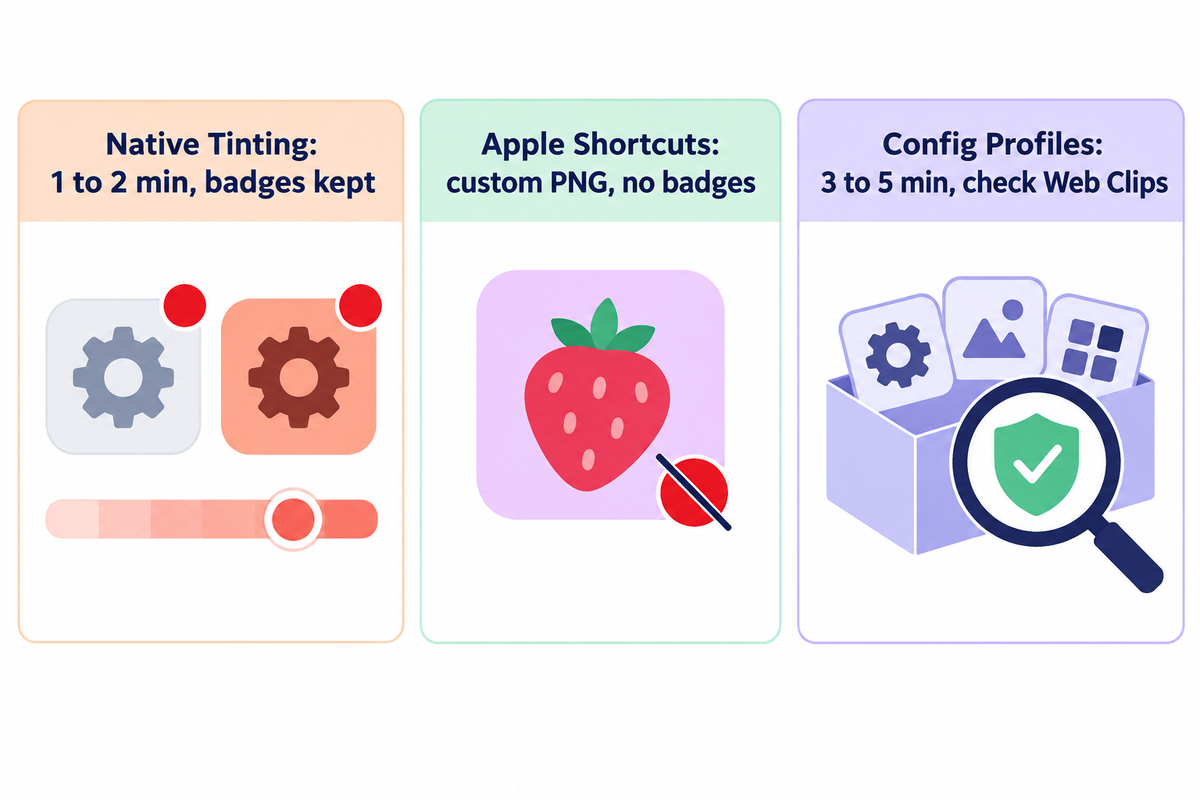
Compare Native Tinting (1 to 2 min, badges kept), Apple Shortcuts custom PNGs, and Web Clip config profiles.

Native iOS controls recolor real app icons inside SpringBoard in under two minutes while keeping unread red badges intact. Apple Shortcuts and configuration profiles add custom launcher bookmarks to your Home Screen instead of replacing real app binaries, while your original apps stay safely inside the App Library.

Each customization route uses a distinct mechanism underneath. Instead, they add launcher bookmarks to your Home Screen while your real apps stay stored inside the App Library.

Decision Factor Native iOS Tinting & Clear Apple Shortcuts Custom Icons Configuration Profile Packs
Artwork Freedom Recolors stock logos only Any custom PNG or photo Bundled pack images (Web Clips)
Unread Red Badges Preserved (native) Not supported Not supported
Launch Speed & Banners Instant native launch Brief 1-second banner unless automated Brief Web Clip handoff redirect
Setup Effort 1 to 2 minutes (tinting only) 30 to 60 minutes for 35+ icons 3 to 5 minutes batch install
Icon Spec Limit 1024 x 1024 px layered native Square PNG from Photos or Files 114 x 114 px iPhone / 144 x 144 px iPad (max 400 x 400 px, under 1 MB)
Security & Payload Risk Zero external risk Zero system risk (local action) Requires checking profile contents
Reversibility One tap back to Default Delete tiles one by one Delete profile in Settings once
iOS Update Resilience High (Apple maintained) High for Open App actions Medium (broken URL schemes can fail)
Direct Cost Free built-in Free built-in; optional indie pack purchase Free with In-App Purchases apps

Use this 3-Route iOS Theme Tradeoff Matrix to choose your workflow. Pick native iOS Tinting if unread badges on Mail, Messages, and work chat matter most. Pick Apple Shortcuts for 8 to 12 hero apps if you want illustrated bunny or kitty app icons without system profiles. Pick a configuration profile pack only from a verified App Store developer after reviewing its payload.

Profile Safety Check Before Installing Any Batch Icon Pack

Configuration profiles for corporate Wi-Fi, VPNs, email and certificates have been detailed by Apple Support and Check Point mobile security research. Before hitting the Install button in Settings > General > VPN & Device Management, open More Details and confirm the profile holds only Web Clips.

Reject any themes asking for root certificates, VPN configs or device management. As Apple’s Web Clips payload specification states, if a profile states that clips are non-removable, deleting the profile will also remove all Web Clips.

iOS customizers on Reddit’s r/iOSsetups community often ask whether profile icons can access private data. Checking More Details before installation should allay those fears. You can also take a look at curated custom iPhone app icons to see if there are any differences between the PNGs and the profile bundles.

Do Custom Kawaii App Icons Show Red Notification Badges on iPhone?

Custom kawaii app icons made by Apple Shortcuts or Web Clip config profiles won’t show red unread notification badges on iPhone. Because those tiles act as launcher bookmarks rather than native app bundles, iOS keeps unread counts attached to the original apps inside your App Library. Leaving Phone, Messages, Mail, and calendar alerts on native icons prevents missed updates while custom icons handle music, notes, and reading.

As reported by How-To Geek, Shortcuts tiles also briefly display a top banner. To prevent that, use automation.

How to Build a Pastel Kawaii iPhone Home Screen Step by Step
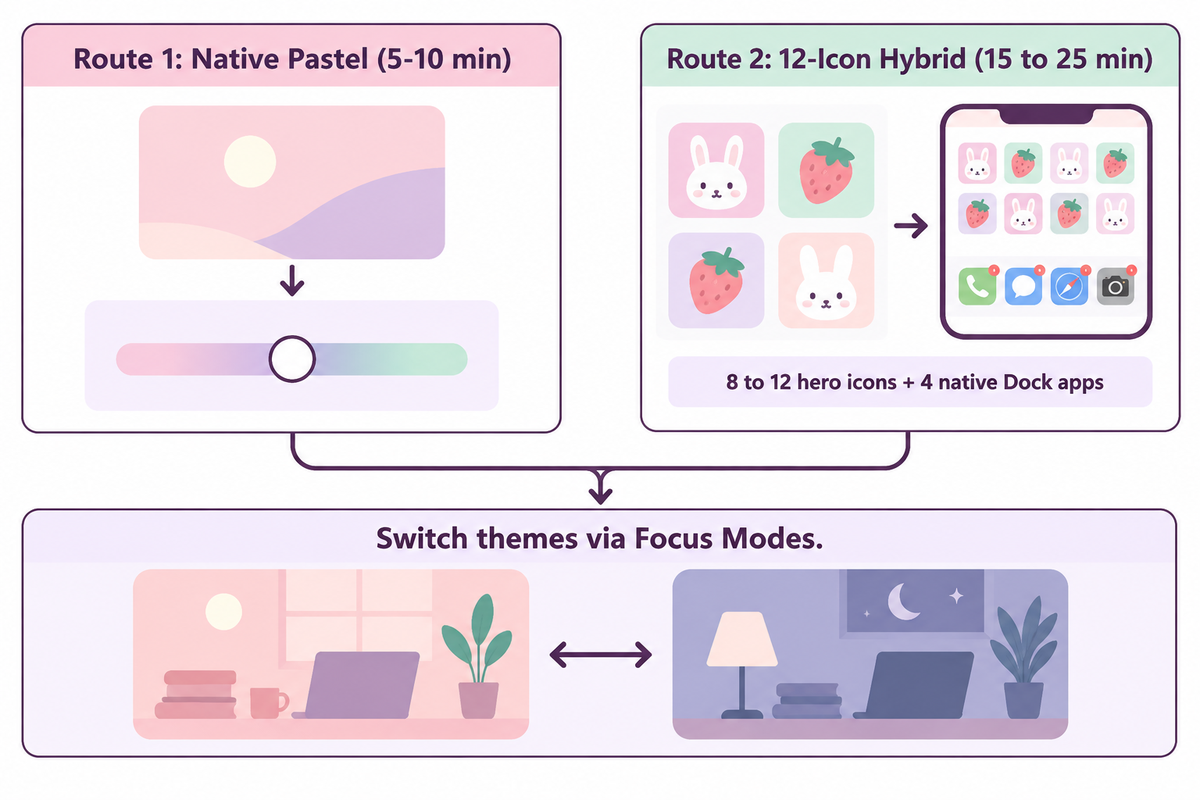
Two pastel setup paths: 5-10 minute native tinting vs 15-25 minute 12-Icon Hybrid with 4 native Dock apps.

Building a cute pastel iPhone home screen takes 5 to 10 minutes with native iOS styling and wallpaper pairing, or 15 to 25 minutes using the 12-Icon Hybrid Kawaii Layout. Keeping the main screen focused on 8 to 12 custom hero icons, with two to three matching widgets, prevents second-screen visual fatigue.

In Study 2 of Trapp and Wienrich (2018), the search slowdown from high icon similarity grew significantly worse on the second screen than on the first screen (t(35) = -6.49, p < 0.001). Putting your primary kawaii home screen on page one lets the App Library hold rarely used utilities and cuts repetitive setup time.

Route 1: Native Pastel Styling (Free, 5-10 Minutes)

  1. Save a calm pastel wallpaper to Photos, and apply it to the Lock and Home Screens.
  2. Hold an empty spot on the Home Screen to make icons jiggle.
  3. Tap Edit in the top-left corner, then tap Customize.
  4. Select Tinted (or Clear on iOS 26 and newer), then drag the sliders or tap the eyedropper to pull a soft pink, mint, or lavender tone from your wallpaper.
  5. Pick Small to keep app names visible or Large for an icon-only grid, then tap outside the panel to save.

Route 2: The 12-Icon Hybrid Kawaii Layout (15 to 25 Minutes)

  1. Save your selected kawaii app icon pack PNGs to a new album or folder on your device.
  2. Open the Shortcuts app and tap the + in the upper right corner.
  3. Tap Add Action, choose Open App, and select one hero app such as Spotify, Notes, Photos, or Safari.
  4. Select Add to Home Screen from the share or title menu, and tap your placeholder icon to select your PNG.
  5. Repeat for 8 to 12 hero apps, and then long press each of the original apps and select Remove App > Remove from Home Screen to keep the original apps in your App Library.
  6. Leave 4 badge-critical apps (Messages, Phone, Mail, and Calendar) native in your Dock to keep the red badges visible.

To silence Shortcuts launch banners on iOS 15.4 and later, open the Automation tab in Shortcuts and create a Personal Automation triggered by App > Is Opened. Finally, turn off both Ask Before Running and Notify When Run. This is documented by GadgetHacks.

Pro Tip: Use Focus Modes to Easily Switch Between Kawaii Themes

Create two themed Home Screen pages (e.g., Matcha Bakery for Study Hours and Lavender Cloud for Evening Time). Go to Settings > Focus, pick a Focus Mode, and tap Customize Screens to link a paired Lock Screen and kawaii page. Switching Focus Mode changes your theme.

For more icon screenshots and other tips, see our article on customizing app icons with Apple Shortcuts.

Do Kawaii iPhone Themes Work on iOS 18 and Newer Versions?

Kawaii themes work with iOS 18, iOS 26, and iOS 27, and with older iOS 17 setups using Shortcuts. Starting with iOS 18, Apple added free grid placement, Dark mode icons, Tinted color sliders, and Large label-free icons directly in the Customize menu, while iOS 26 and iOS 27 added and then refined Clear Liquid Glass appearances.

Older ios17 icon packs saved as square PNG files work just fine in Apple Shortcuts as is. Keep delicate thin-line icons at a 3:1 or higher contrast ratio against adjacent background colors so they stay legible under translucent Clear styling in newer releases.

Pairing Cute Widgets and Wallpapers for a Clean Kawaii Layout
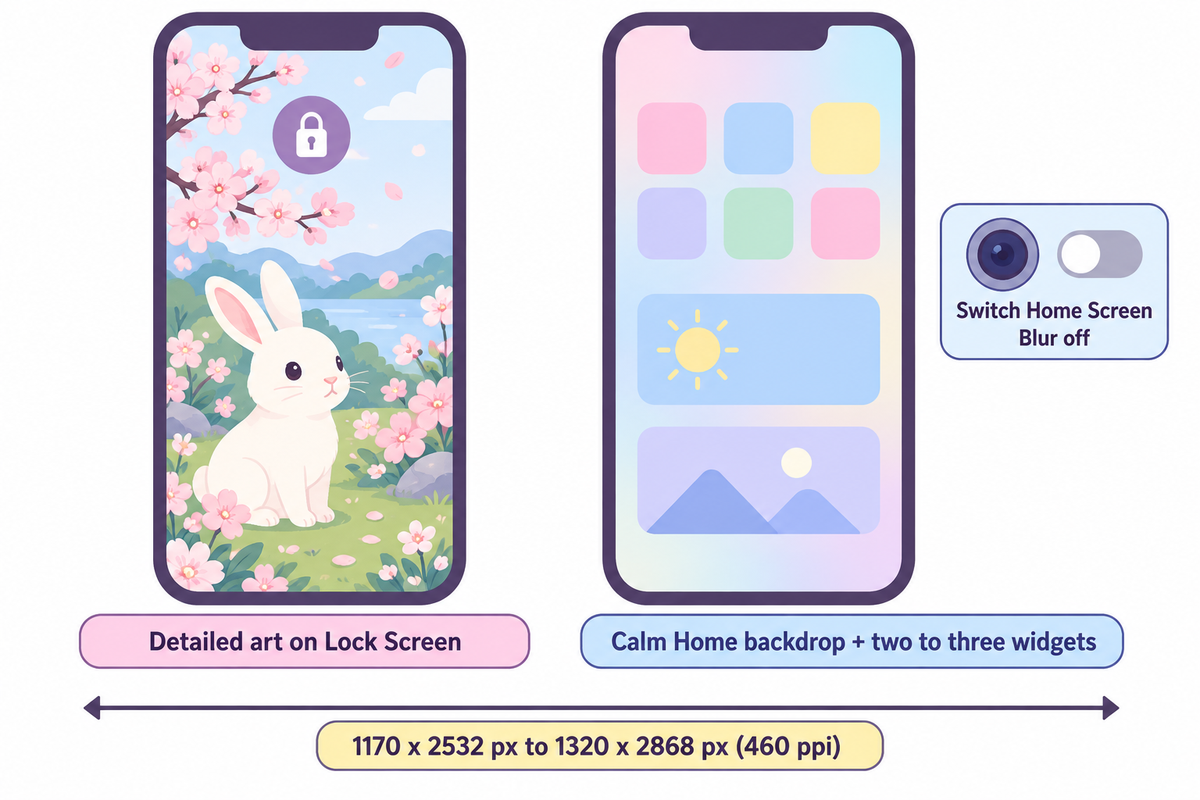
Pair 460 ppi portrait wallpapers (1170 x 2532 px to 1320 x 2868 px) with calm Home backdrops and Blur off.

Match your wallpaper’s portrait dimensions to your exact iPhone display, 1170 x 2532 px on iPhone 13 and 14 up to 1320 x 2868 px on iPhone 16 Pro Max, and place two to three purposeful pastel widgets per page. Putting detailed art on the Lock Screen and a calmer background behind icons keeps labels crisp.

Horizontal desktop images cause iOS to crop aggressively, softening the edges of cute art and hiding the focal characters behind the clock. Checking Apple’s 460 ppi portrait specifications eliminates the need to stretch the image and preserves a clean home screen aesthetic.

iPhone Model Group Portrait Wallpaper Size Pixel Density Panel Type
iPhone 16 Pro Max (6.9-inch) 1320 x 2868 px 460 ppi Super Retina XDR OLED
iPhone 16 Plus / 15 Pro Max / 14 Pro Max 1290 x 2796 px 460 ppi Super Retina XDR OLED
iPhone 16 / 15 / 15 Pro / 14 Pro 1179 x 2556 px 460 ppi Super Retina XDR OLED
iPhone 14 / 13 / 13 Pro 1170 x 2532 px 460 ppi Super Retina XDR OLED

Dimensions align with the official Apple iPhone Technical Specifications. The 6.9-inch Super Retina XDR OLED panel has 460 ppi sharpness, a typical contrast ratio of 2,000,000:1, and a max brightness of 1000 nits (2000 nits outdoor peak). To switch between sizes (small, medium, large), touch and hold any of the widgets. For a balanced aesthetic home screen, pair one medium calendar or weather widget with one small photo or battery widget.

Do: Clean Kawaii Spacing

  • Keep detailed cute illustrations on your lockscreen and use a soft gradient or calm pattern on your homescreen.
  • Leave one breathing row for wallpaper art to be visible between icon rows.
  • Pair one utility widget (weather or calendar) with one or two decorative photo widgets.

Avoid: Visual Overload

  • Never put busy white-background doodles directly behind white app icon labels.
  • Avoid stacking four live GPS or moving widgets on page one. They add clutter and background refreshes.
  • Don’t place square hard-bordered widgets next to transparent widgets on the same row.

Mix and match designs of soft pastels and iPhone widgets. Or try aesthetic wallpapers for iPhone. They’re tall and portrait oriented.

Why Does a Cute Kawaii Wallpaper Look Blurry Behind My App Icons?

Fuzziness in kawaii Home Screen wallpapers often comes from Apple’s Home Screen Blur toggle rather than a low-resolution file. Opening Customize Home Screen and switching Blur off brings back crisp artwork.

If you turn Home Screen Blur off and your wallpapers are still fuzzy, check the image dimensions. Often, files saved as compressed thumbnails from social media feeds measure under 700 px wide and will stretch noticeably to fit the 1179 px to 1320 px OLED screen.

How Much Does a Kawaii iPhone Theme Cost? Free DIY vs. Paid Packs
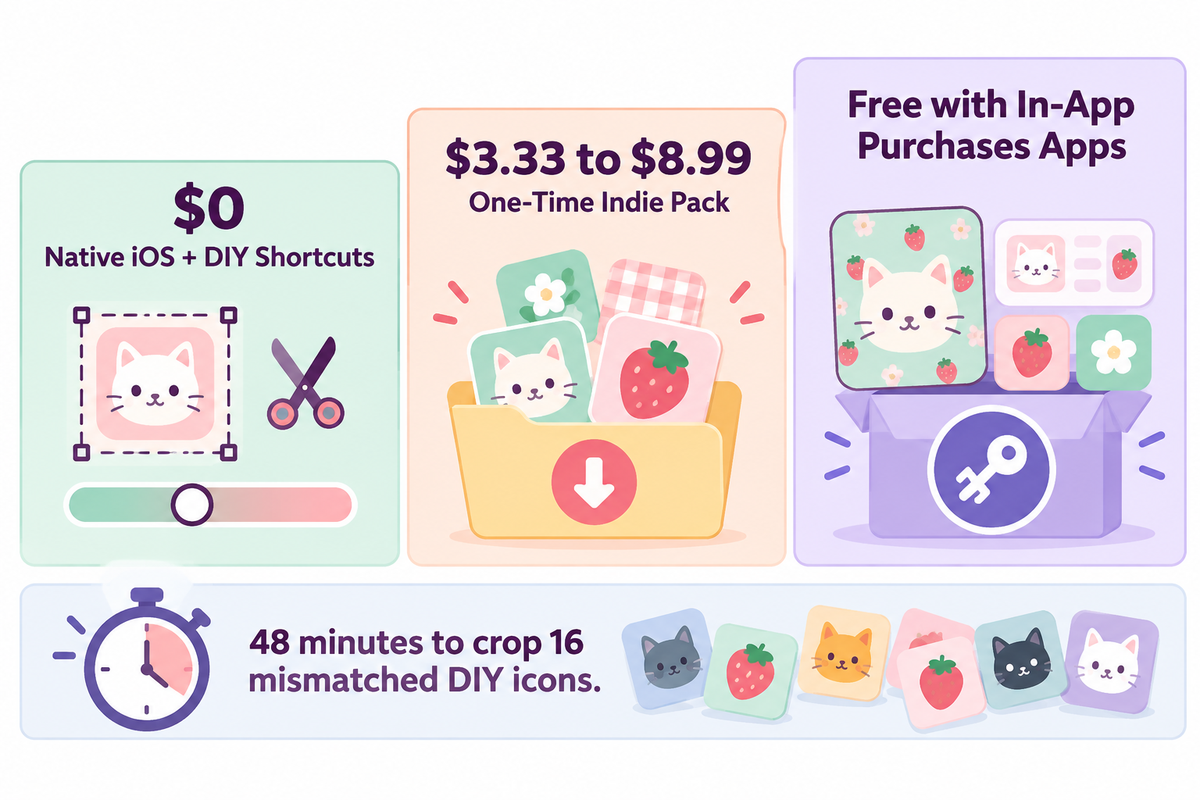
Kawaii iPhone theme cost tiers: $0 native DIY (48 min for 16 icons), $3.33 to $8.99 indie packs, or IAP apps.

A full kawaii iPhone theme costs $0 using built-in iOS customization, Apple Shortcuts, and free wallpapers. One-time indie digital download icon packs, observed on Etsy in November 2026, sold for $3.33 to $8.99, based on the pack size and seller’s sales, while App Store theme apps list as Free with In-App Purchases.

Users on r/iOSsetups frequently report downloading “free” icon apps only to hit unexpected weekly paywalls. Separating Apple’s built-in no-cost tools from one-time artist packs and App Store subscriptions helps keep your costs predictable before downloading anything.

Budget Tier Pricing Model What You Get Hidden Time or Tradeoff
Native iOS + DIY Shortcuts Free built-in Tinted or Clear icons, Focus pages, custom photo widgets, DIY PNG icons Hunting free icons on Pinterest often leaves missing utility apps and mismatched styles
One-Time Indie Pack (Etsy) One-time digital download (varies by seller) Coordinated PNG icon set, matching wallpapers, widget graphics Manual Shortcuts install; check live shop listing for icon count and updates
All-in-One Theme App Free with In-App Purchases One-tap bundles combining wallpapers and widgets plus matching icon themes Full theme libraries require optional paid tiers or subscriptions

Suppose you want to customize 16 daily apps using free images collected from Pinterest boards where users find and save ideas. If you assume it takes 3 minutes to download and crop each mismatched PNG icon, fixing 16 inconsistent icons takes 48 minutes. Even then, a few niche apps may still lack matching artwork. For a small cost, you can buy a kawaii app icon pack from an indie seller or use a curated theme suite to get consistent line weight and matching wallpapers.

When buying icons from an indie seller, check how many app icons are included and if the seller gives pastel tiles for apps where artwork isn’t easily accessible.

Are Kawaii iPhone Themes Free to Download and Use?

Free options using built-in Apple features, Shortcuts and original wallpapers let users build a cute kawaii iPhone theme for free. Many App Store theme apps also provide free downloads with limited starter themes, but full libraries of matching kawaii widgets and icon packs usually sit behind optional in-app purchases.

If you want a strictly no-cost setup, combine native pastel Tinted icons on your main grid with two free photo widgets displaying original bunny or bakery illustrations. That approach looks cohesive, preserves every unread badge, and requires zero subscriptions.

Choosing Kawaii Theme and Widget Apps With Original Artwork
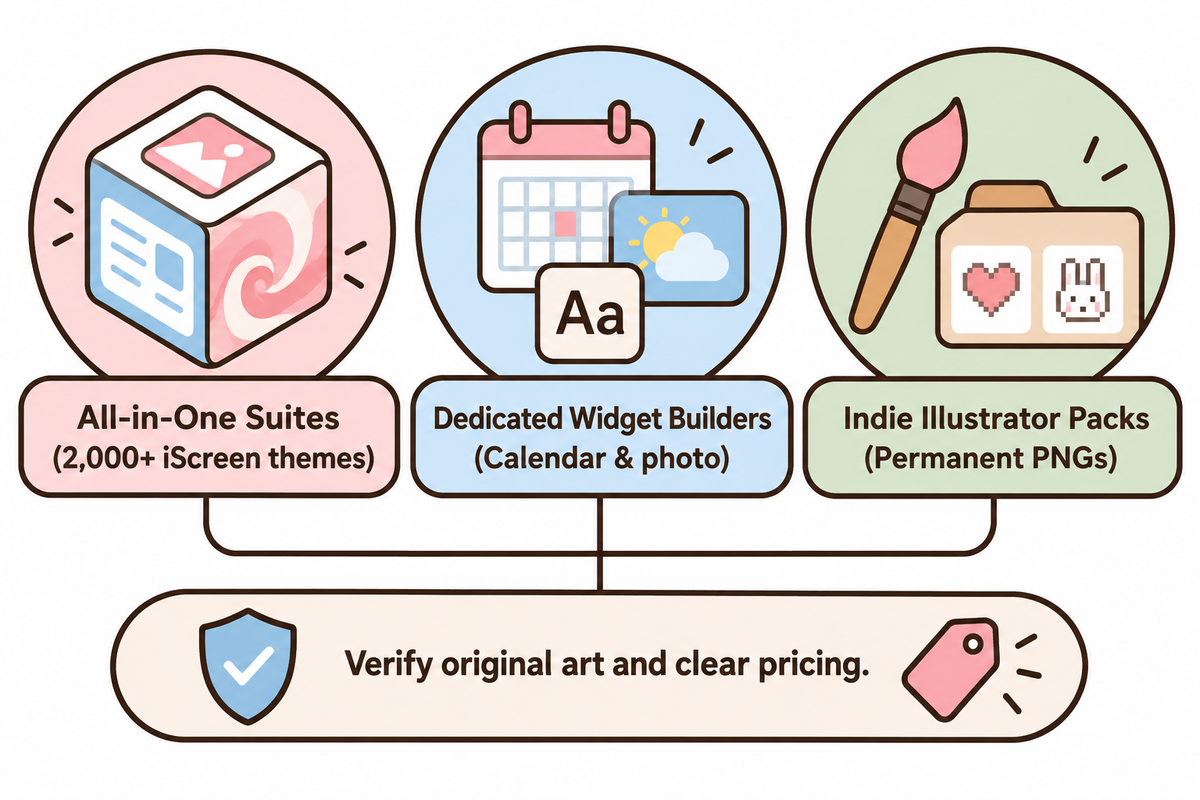
Compare all-in-one suites (2,000+ iScreen themes), dedicated widget builders, and credited indie illustrator PNGs.

When assessing a kawaii app or icon shop, look at four main factors: original and non-copyrighted art pieces, a clear and direct way of installing icons and widgets, functionally useful widgets, and clear pricing prior to checkout. Compare theme suites, dedicated widget builders, and independent illustrator shops to identify bundles that take no effort and recycle the same art pieces.

All-in-one theme suites bundle icons, widgets, and wallpapers inside one catalog so you never match hex shades manually. Dedicated widget builders focus on custom calendar, weather, and photo widgets. Indie shops on Etsy excel at niche hand-drawn or cottagecore art styles sold as permanent PNG folders.

Tool Category Notable Examples Best Strength Watch-Out Before Installing
All-in-One Theme Suites iScreen, Themify, WidgetClub, TopWidgets Coordinated icons, matching widgets, and wallpapers in one tap Confirm live IAP tiers and verify whether packs use Shortcuts or Web Clips
Dedicated Widget Builders Widgetsmith, Color Widgets Custom fonts, timed widgets, photo albums, granular color controls Icon curation is lighter; pair with native tinting or indie PNG sets
Indie Illustrator Packs Credited Etsy artists One-time ownership of original hand-drawn or pixel app icon packs Avoid uncredited trademarked character packs that risk removal

For readers comparing verified libraries, iScreen’s theme library offers 2,000+ aesthetic iPhone themes with matched wallpapers, widgets, and icons. It’s notable for offering original non-IP kawaii packs such as Felt Pink Fluff, Cute iBunny, Blueberry Cat, Soft Bunny, ParfaitKitty, and iOS26 Cute Liquid Glass Cat. WidgetClub is more suited for users looking for a massive community grid (listing 3,656+ kawaii icon sets and 1,714+ templates). Indie Etsy artists ($3.33 to $8.99 one-time) are suited for users wanting to own PNG files. Standalone widget app makers like Widgetsmith, Color Widgets, Themify, and TopWidgets are popular among iOS app users. Most iOS apps, including iScreen, use a Free with In-App Purchases model.

For a quick visual walkthrough of pairing widgets, icons and Lock Screen elements together, follow our step-by-step iPhone customization guide.

Fixing Common Kawaii iPhone Theme Problems and Reversing Changes
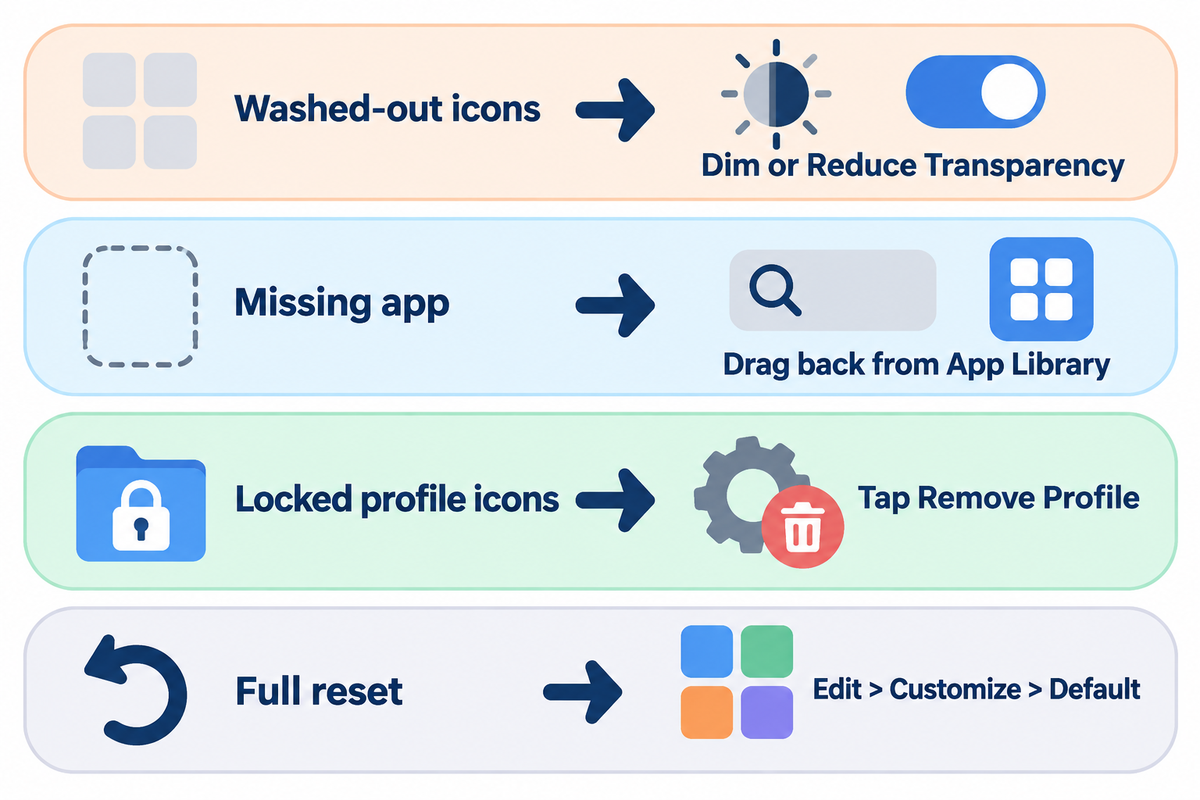
Fix kawaii iPhone themes: reduce transparency, restore apps from App Library, remove profiles, or reset Default.

Each of the home screens can be customized and reverted to the default state at any time. You can clear widgets, adjust display transparency to dim the background, reset app placements to the App Library, or uninstall configuration profiles.

Users upgrading to iOS 26 and iOS 27 on Apple Support Communities often report that their custom Shortcuts icons (tiles) appear glossy or faint over bright pastel wallpapers. Instead of using a new wallpaper, adjust display transparency to dim the background.

Common Symptom Root Cause Verified Fix
Clear or pastel icons look washed out iOS 26/27 Liquid Glass translucency over bright backgrounds Tap the sun icon in Edit > Customize to dim the wallpaper, or toggle Reduce Transparency and Increase Contrast under Settings > Accessibility > Display & Text Size.
Cute widget turns blank or freezes Memory cap, paused background refresh, or deleted source photo Open the host widget app once to force a refresh, check Background App Refresh, or remove and re-add the widget.
Original app seems missing Moved out of Home Screen during Shortcuts cleanup Swipe past your last page to the App Library, search the app name, and drag the icon back to your Home Screen.
Batch profile icons refuse to delete Profile Web Clips configured as non-removable Go to Settings > General > VPN & Device Management, open the theme profile, and tap Remove Profile.
Custom shortcut opens wrong app or fails Target app was offloaded or renamed after shortcut creation Re-download the target app from the App Store, open Shortcuts, and re-link the Open App action.

To fully revert to stock iOS icons, go to the Home Screen and tap Edit, then Customize, then Default. This will remove the tints. Next, delete any Shortcuts tiles that you no longer want, as removing shortcuts doesn’t delete the app. Finally, delete any Web Clip profiles, under VPN and Device Management. See Apple Support’s configuration profile guide for full removal steps.

How Native iOS Customization and Liquid Glass Are Reshaping Kawaii Themes
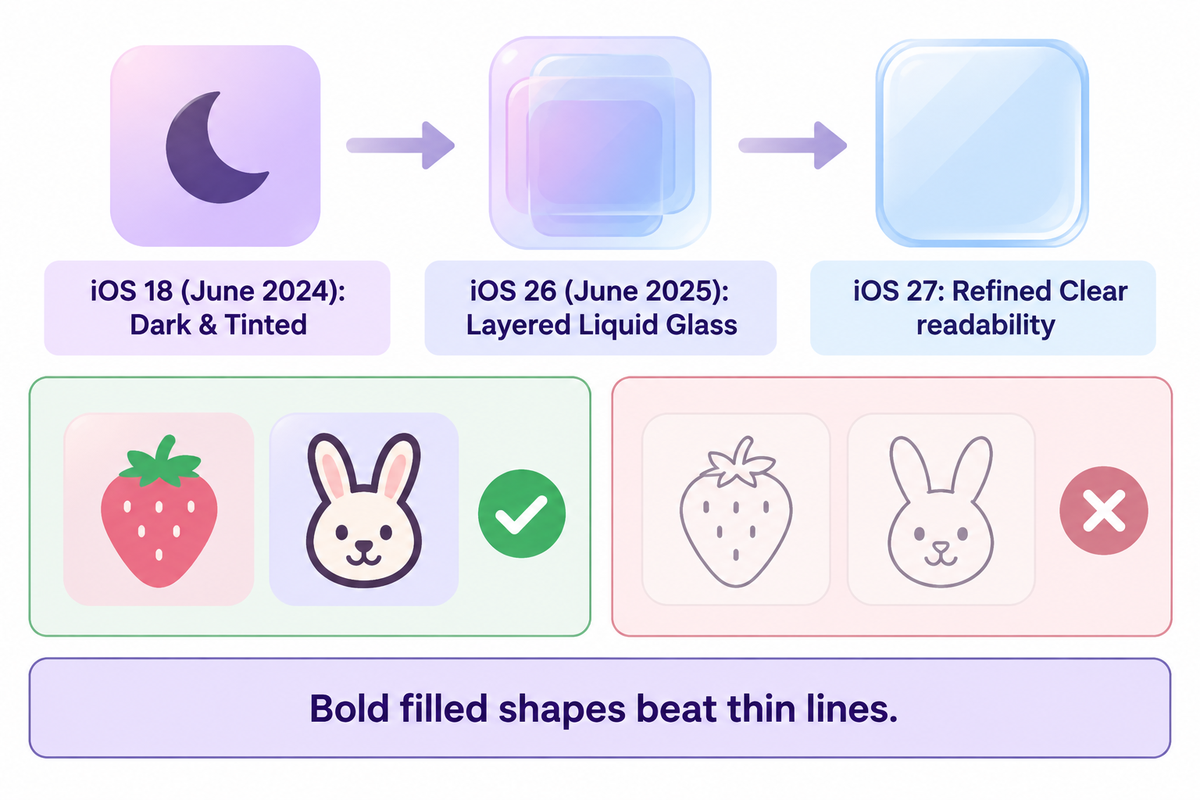
From iOS 18 Tinted to iOS 26 and iOS 27 Liquid Glass, bold filled pastel shapes stay sharper than thin lines.

Apple’s shift toward layered Liquid Glass icons, built-in Tinted and Clear appearances, and free grid placement is moving kawaii iPhone themes away from fragile 40-shortcut overhauls toward durable hybrid layouts. Modern iOS releases favor bold, filled pastel illustrations over ultra thin line drawings.

Apple updated its official App Icons Human Interface Guidelines four times between June 10, 2024 and October 28, 2026. First, Apple added Dark and Tinted modes for iOS 18 in June 2024. Next, Apple introduced layered Liquid Glass icons in June 2025 for iOS 26, refined readability in June 2026, and expanded icon format guidance in October 2026.

As reported by MacRumors in September 2026, iOS 26 added Clear app icons and widgets throughout the system. Apple then refined readability in iOS 27 after touch device users pushed back against faint glass icons. 9to5Mac also talked about iOS 26’s Tinted matching setting for calibrating icon hues with iPhone hardware or case finishes.

“When the system segments your icon, it applies Liquid Glass effects to foreground layers that feature large simple shapes. It doesn’t automatically apply Liquid Glass effects to smaller, more complex elements in an icon like text and thin lines.”

This is important when you pick or create cute icons and a home screen theme to maximize sharp edges. Fine-line pastel sketches packed with tiny text often look flat or fuzzy under automatic glass segmentation. Chunky filled illustrations, like thick-outline strawberries, solid bunny silhouettes, or soft 3D clay shapes, hold sharp edges across Light, Dark, Clear, and Tinted modes.

To future-proof your setup for 2026 and upcoming updates, build a hybrid grid instead of replacing every system app with static bookmarks. Pair native Tinted or Clear styling on your utility Dock with 8 to 12 bold-outline hero Shortcuts icons and two to three matching widgets so your kawaii theme survives every annual refresh.

Frequently Asked Questions

Q: How long does it take to set up a full kawaii iPhone theme?

Native iOS tinting with a pastel wallpaper and two widgets takes 5 to 10 minutes, while a 12-Icon Hybrid Kawaii Layout takes 15 to 25 minutes.

Setting up 35 to 40 icons manually with Apple Shortcuts takes 30 to 60 minutes if your wallpapers and PNG icons are already saved in the Photos app.

Q: Can you switch between multiple kawaii themes on one iPhone without starting over?

Yes, you can create multiple themed Home Screen pages and link each one to its own Focus mode and paired Lock Screen in iOS Settings.

Switching Focus modes automatically shows your matching pastel Home Screen page and wallpaper while hiding every other page, letting you change your study or seasonal setups with one tap.

Q: Does removing original apps from the Home Screen delete my app data?

No, tapping Remove from Home Screen on an app icon only moves the original icon into the App Library and keeps the installed app intact. The app, logins, and saved data aren’t deleted.

When hiding duplicate icons behind custom Shortcuts, you should always choose Remove from Home Screen rather than Delete App, and you can swipe over to drag apps back anytime. You can move the app back from the app library at any time.

Q: Do cute widgets and custom kawaii themes drain iPhone battery fast?

No, static pastel wallpapers, Shortcuts icons, and lightweight cute widgets add virtually zero battery drain.

Only live GPS weather or animated widgets draw extra power, so two static widgets keep battery steady. Static widgets don’t affect battery drain.

Q: Which kawaii iPhone theme motifs are safe to use without copyright headaches?

Original pastel artwork, such as smiling clouds, bunnies, cats, frogs, bakery sweets, strawberries, cherry blossoms, ribbons, and pixel hearts, avoids third-party character trademark takedowns completely.

When purchasing icon packs on Etsy or using other theme apps, look for packs created by independent illustrators, and avoid bundles that include protected cartoon characters. Make sure the packs have pastel blank tiles and essential icons for Wallet, Notes, Mail, Calendar, and Maps. This keeps the Home Screen and app set up clean and aligned.

Q: Can I use kawaii iPhone icon packs on an iPad or Android phone too?

Yes, icons work with Shortcuts on iPadOS and with Nova and/or Good Lock on Android.

Only iOS configuration profiles and widget templates stay Apple-only.

Q: How do you remove a custom kawaii theme and return to default iPhone icons?

To unstyle your Home Screen, go to Edit > Customize > Default and delete all custom Shortcuts tiles. Go to Settings > General > VPN & Device Management and delete any Web Clip Profiles.

Reversing a kawaii theme takes only a few minutes and never harms your installed apps, logins, or personal files. All real apps stay untouched in your App Library. Swipe right, search any app name, and drag the standard stock icon back onto page one whenever you want a fresh start.

Interested in Decorating your Home Screen with Original Pastel Art?

Instead of searching for random downloads, take a look at iScreen’s original aesthetic iPhone themes, from Cute iBunny and Blueberry Cat to Felt Pink Fluff and Soft Bunny, to give your iPhone a readable kawaii look in minutes.

References & Sources

  1. W3C Web Accessibility Initiative, Technique G207: Ensuring a contrast ratio of 3:1 is provided for icons (WCAG 2.1)
  2. W3C Web Accessibility Initiative, Understanding Success Criterion 1.4.11 Non-text Contrast (Level AA)
  3. Trapp, A. K., & Wienrich, C. (2018). App icon similarity and its impact on visual search efficiency on mobile touch devices. Cognitive Research: Principles and Implications, 3:39 (PMC6191407)
  4. Apple Support – Customize apps and widgets on the iPhone Home Screen (iOS 18/26/27)
  5. Apple Developer Documentation – Human Interface Guidelines: App icons (October 28, 2026)
  6. Apple Support – Install or remove configuration profiles on iPhone
  7. Apple Platform Deployment – Web Clips device management payload settings for Apple devices
  8. Apple Support — iPhone 16 Pro Max Technical Specifications
  9. MacRumors (September 16, 2026) – Get Clear App Icons on your iPhone Home Screen
  10. 9to5Mac (April 14, 2026) — iOS 26 has a new Home Screen setting for app icons
  11. Check Point Blog – Are Malicious Configuration Profiles iOS’ Achilles Heel?
  12. GadgetHacks — How to Stop Notification Banners from Popping Up for Custom App Icon Shortcuts on Your Home Screen

About This Guide: The kawaii iPhone theme guide was written by the iScreen team, based on official Apple documentation and supported by non-text W3C contrast standards, peer-reviewed icon usability studies, and pastel app icons and cute widgets catalog comparisons. It was reviewed for accuracy by the iScreen team, including the Home Screen workflows of iOS 18, 26, and 27, as well as original licensed-safe artwork.

最近の記事

Calendar Wallpaper for iPhone: Monthly Layouts You Can Read

Calendar Wallpaper for iPhone: Monthly Layouts You Can Read

2026/11/15 10:54
A calendar wallpaper places a calendar in your iPhone’s background. It helps to see which day of the week a date falls on, but to see appointments you’ll need to use a calendar app or widget. To start, make sure the month is named clearly. Save the image. Calendar wallpaper iPhone sets are most successful when the dates are readable in the final Lock Screen preview. Using a simple grid, check the month and year. Replace the picture when the month changes. Choose between a full month grid and upcoming events before selecting a design. Check the date numerals as well as the clock. A readable time display could hide an unreadable calendar. Choose the phone version as well as your preferred week start when saving monthly art. Apple’s photo wallpaper settings do not require a separate wallpaper-app purchase. Choose a monthly grid, event widget, or life calendar Choose a Monthly Grid to look up dates at a glance, a widget to see your next appointment, or a life calendar to see how much time has already elapsed. Display Useful for What changes it Monthly wallpaper calendar Seeing dates and weekdays together Replacing the saved picture Calendar widget Displaying the app’s supported event information The app and its widget update process Life calendar wallpaper Viewing life progress or elapsed weeks Its image generator and replacement workflow A design showing life in weeks can help you visualize your life over a longer span. A year calendar can also give an overview of dates across the year, but fitting more dates into the same space can make each numeral smaller. For a birthday reminder or changing task list, start with the appropriate app instead of adding more labels. How to display clock and calendar on iPhone Lock Screen? Set a monthly calendar picture as your Lock Screen wallpaper to show a date grid alongside the clock. Add a Calendar widget supported by Lock Screen customization to show upcoming events. Apple documents widgets for the Lock Screen with iOS 16 and later, and the available widget determines which information appears. The instructions for Apple’s widgets can be found on Apple’s site and explain the widget setup. When comparing other useful widgets, choose based on which information you need to see. Keep your private event titles or addresses out of a wallpaper visible to anyone nearby. Pick a layout that leaves the clock readable You can choose from three main layouts to start. One is a central grid on a plain background, one is a photo with a solid calendar panel, and one is a subtle grid paired with a quiet Home Screen. Position the date in the space available in the preview. Check each row after adjusting your clock or widgets. Plain background with a central grid There are many other design choices available. For a plain background, choose dark type on a light field or light type on a dark field. Increase the date size before adding decoration. For a harmonious palette, consider these color choices. Photo with a solid calendar panel Suppose you want your garden picture behind the month. Light petals and dark leaves create uneven contrast, so a date that may seem clear over one patch may disappear over another. Put the entire grid on a solid panel and remove the outline around the numbers. Keep the panel clear of the subject. Open the wallpaper preview. If the clock overlaps its title, then move or resize the picture and check the bottom row. View the dates at your normal reading distance. If you have to shrink the panel to the point where you can’t read it comfortably, use the picture on the Home Screen and a plain calendar on the Lock Screen. Understated grid with a coordinated Home Screen Keep the decoration around the grid sparse and carry over one background color to the other screen. Apple’s iOS 26 Feature Guide describes Adaptive Time that alters the clock around photo wallpaper and notifications. Therefore, a fixed rule like “always place dates directly below the clock” doesn’t always apply. Also see the iOS 26 option to move Lock Screen widgets at MacRumors. See the guide to choosing the image dimensions to specify the aspect ratio, then view the crop to ensure it’s correct. If the numerals still seem too small, prioritize accessibility with an adjustable calendar app or widget. Find a free monthly calendar wallpaper Download a phone image from the creator’s monthly page for the month, year, and week start you want. Social media previews may include older images or a desktop wallpaper. Check file options on the original page before saving to get the clearest image. For November 2026, Oh So Lovely Blog’s monthly collection advertises free phone and desktop choices with Sunday-start, Monday-start, and no-calendar versions. Haus of Planner’s November collection also provides week starts and a choice of font styles. Save the digital download instead of a screenshot. Look into the creator’s terms of use before altering or sharing their artwork. The download and purchase conditions for a design discovered through Instagram or Etsy may be different. When creating a design for a grid, select the background first, and add a verified grid in your preferred application, keeping an editable copy for next month. Check the dates before saving your design Use the First–Last Date Check: Confirm the month and year. Find the first and last weekdays. Compare all the intervening rows with a trusted calendar. Endpoints catch obvious template mistakes; they don’t catch all missing or duplicated numbers. Also, confirm the headings begin with Sunday or Monday. Suppose you’re making a calendar wallpaper for iPhone using a Sunday-start November 2026 template. Timeanddate’s month grid places November 1 on Sunday and November 30 on Monday, with 30 days in total. Read across each row: 1–7, 8–14, 15–21, 22–28, then 29–30. Now compare the template cell by cell. A correct final date wouldn’t reveal a duplicated 18 in the middle. If you switch to Monday-first headings, move the dates to their corresponding columns rather than relabeling the existing grid. Sunday remains Sunday even when it becomes the final column. Once you export the calendar, check it one last time. Regional holidays require their own calendar check; a decorative date highlight shouldn’t substitute for an appointment reminder. Checks before you keep a monthly wallpaper Check category Ready to use when If it fails Dates: month and year The title names your intended month Choose the correct monthly file Dates: weekday headings Headings follow your preferred week start Use the other week-start variant Dates: complete grid Every date matches the reference calendar Correct missing, duplicate, or misplaced cells Layout: crop The title and outer columns remain visible Give the grid more surrounding space Layout: contrast All numerals stand out from the background Add a solid panel or use a plain background Layout: reading size Dates are comfortable to read on the phone Enlarge the grid or choose an adjustable widget Screen: clock and widgets The date grid fits the available area Reposition the artwork in the preview Screen: app icons Home Screen icons have a clear background Set a separate Home Screen image Maintenance: next month You know how the replacement image will be selected Set a reminder to replace the picture Set the calendar picture on your iPhone Once you’ve checked everything, you can save the calendar to the Photos app. After that, you can change your Wallpaper by going to Settings > Wallpaper > Add New Wallpaper. You can apply the picture to both screens or choose a separate Home Screen background through Apple’s built-in controls. How do I add a calendar picture to my iPhone wallpaper? In Settings, find Wallpaper. Tap Add New Wallpaper, then Photos. Select your saved calendar photo. Arrange it so that all the dates are visible. Tap Add. For both your Home Screen and Lock Screen, select Set as Wallpaper Pair. To use a separate Home Screen background behind your app icons, select Customize Home Screen. Save the full-resolution image to Photos. Open the wallpaper controls and select that saved file. Check the month title, weekday headings, and outer columns in the preview. Inspect the clock, widgets, and bottom controls before keeping the crop. Return to the Home Screen to inspect the wallpaper behind your app icons. If your iPhone Lock Screen trims your calendar, go to your image layout and increase the surrounding space of the grid. Apple’s optional 3D photo effect works only with certain photos, but a flat grid doesn’t need that effect to be useful. Pair the Lock Screen with a quieter Home Screen For the Home Screen, choose a plain background and keep the month grid on the Lock Screen. With the Customize Home Screen option, you can create a separate Home Screen wallpaper. If you want the iPhone calendar info on your Home Screen, add a widget and leave enough visual space to read the dates. For a calendar pic with a cream background and dark green dates, you may want to use a solid cream background for the Home Screen and let the icons occupy that space. For future events or dates, put a calendar widget that supports the view you need on the Home Screen. If you mainly check dates before opening an app, you may prefer the Lock Screen grid without another calendar display. When you change the picture later, keep the background color the same if it still goes with your icons; customization doesn’t require rebuilding the whole arrangement each month. Refer to the guide to matching the Home Screen background; separately, iScreen’s gallery includes widget designs to explore, including Calendar and Blocks Calendar labels. Before you use the selected widget to display events or add it to your home screen widgets, examine the available options. Decide whether a paid app is useful An additional wallpaper-app purchase is unnecessary for Apple’s native photo wallpaper route. A paid asset, editing app, or subscription is your other option. Before you pay, make sure you verify what feature you’re missing, and ensure the developer provides it in the app for your device. For habit tracking or custom countdowns to an anniversary, compare dedicated app features rather than assuming a static month picture can update those values. Read the developer’s App Store description and renewal terms. If your only intent is to look up dates, you can do that with a clear, saved calendar picture. Keep the month current as your setup changes Replace a static calendar picture when the month changes. To change it automatically, a workflow must create or select the correct new image and set it to wallpaper. Keep a reminder until you know where the replacement image comes from and how it’s selected. The Apple Support, Change your iPhone wallpaper instructions list the Photo Shuffle options as follows: “Choose a shuffle frequency (On Tap, On Lock, Hourly, or Daily).” Those settings determine when photos change; the dates printed inside the file remain the same. If the wallpaper refreshes but still shows the wrong month, check the image selection before changing the schedule. Digitalminimalist’s life-calendar tutorial uses a shortcut that retrieves an image and sets the wallpaper. Apple separately documents automation triggers such as time of day. A source that generates life progress isn’t necessarily a source for monthly dates or appointments. For unexpected changes, start by checking the active shuffle or automation and investigating an unexpected background change. Keep a known good static image while adjusting the workflow. Frequently asked questions How do I put my calendar on my home screen on my iPhone? Touch and hold an empty area of the Home Screen, tap Edit, choose Add Widget, and find Calendar. Select an available size, tap Add Widget, and finish with Done. That adds application information rather than printing dates onto your background. If you only want a decorative month picture, set it as a photo wallpaper instead and check whether icons cover the grid. Does it work for iPhone 12 Pro? Yes, you can use a saved calendar picture as photo wallpaper on your iPhone 12 Pro. Apple says you can change the time display, add widgets, adjust wallpaper styles, and replace controls. The phone can show the same flat picture on both screens or use a different background behind your apps. For third-party widgets and shortcuts, check each product’s device and iOS requirements separately. How does the automatic wallpaper update work? An automatic calendar wallpaper needs something to create or select a new image and then replace the old background. A shortcut may do those jobs on a schedule, while a widget displays application data separately. Check the specific service’s setup, permissions, and update schedule before expecting it to stay current. Do I need to download an app? No. You can save a calendar picture and use Apple’s built-in wallpaper settings. A separate design app is optional if you want to create the image yourself. Are calendar wallpapers accurate? Yes, if the printed dates match the intended month and year and appear under the correct weekday headings. Compare the first date, last date, and every intervening row with your Calendar app. A reused image can look correct while placing dates under the wrong weekdays. Public holiday accuracy depends on the selected country or region, so compare calendars using the same location. Use a calendar application or widget for appointments you edit. Build around a readable month Choose the date layout first, then find a background that leaves it clear. Browse iScreen’s backgrounds for a custom monthly design for a starting image. Add your checked calendar grid in your preferred editor and keep the editable file, so next month’s update starts with the layout you already like. Related guides Wallpaper image sizing Aesthetic wallpaper ideas Home Screen background choices Widgets for everyday information References & Sources How to add and edit widgets on your iPhone, Apple Support. New features available with iOS 26, Apple. Lock Screen widget placement in iOS 26, MacRumors. November 2026 calendar, Timeanddate. Change your iPhone wallpaper, Apple Support. Life calendar wallpaper tutorial, Digitalminimalist. Intro to automation shortcuts, Apple Shortcuts User Guide.
2026/11/15 10:54
How to Turn a Video into a Live Photo on iPhone

How to Turn a Video into a Live Photo on iPhone

2026/11/13 19:12
To turn video into a Live Photo on iPhone, import a video clip into a Live Photo converter, trim the moment you want, and save it to Photos. Open the saved picture, then press and hold to play it. If you want to keep the original sound quality, listen to the result before removing the video or sharing it. For a moving Lock Screen, choose a converter’s wallpaper export route. IntoLive has a dedicated Live Wallpaper option, and Apple provides a different wallpaper route. Saving a moving picture and setting an animated background are different things. Video to Live Photo conversion turns a selected video moment into a photo with motion. Save the result to Photos first. For wallpaper, use a wallpaper export and enable the play control when setting your Lock Screen. Start with the original video and keep it until you’ve checked the saved result. Choose an output that preserves sound if you want to keep a spoken moment. Use the converter’s wallpaper option when your goal is Lock Screen animation. Compare the saving step and payment terms before editing a long clip. This tutorial follows Apple’s instructions and the developers’ own guides. The conversion routes haven’t been tested on a physical iPhone for this article. Turn your video into a Live Photo Can I make a live picture from a video? Yes. A video to Live Photo converter can transform a selected moment into a picture with motion. To convert video to Live Photo format, start with the original recording. Pick a video from your library. Trim the part you want, choose a still frame where the tool allows it, and export to photos. Play that saved item before moving on to wallpaper setup or sharing. V2LP’s developer explains how to use an app to create Live Photos by choosing a video, trimming it, selecting a cover photo and saving it to Photos. Editing controls include an audio toggle. Leave the sound on if you want to keep the voice or background audio of your favorite video moments. For wallpaper, follow intoLive’s creation guide: Open intoLive and tap Live Wallpaper. Import your media and trim the section you want. Finish the edit, then tap the Share icon. Choose the option to save as a Live Photo. Next, launch Photos. The Apple Live Photos instructions state that saved Live Photos appear in the Collections > Media Types > Live Photos section. Open the item and press and hold the screen to preview its cover image and motion. Inspect the cover and playback, then listen if sound is required. A thumbnail in the camera roll alone doesn’t say much about the moving part. Keep the original in your library. It’s a good starting point if your crop takes off too much, if the moment captured is too short, or if you want to make another version of the video. When using apps like these, make sure to use the same original video so that changes are easier to spot in the output. Before comparing apps, identify the type of result you need: Result type What you have What to do next Camera Live Photo Captured directly with the iPhone camera. Play it in Photos; this is not a conversion of an older movie. Converted Live Photo A moment selected from an existing video. Check both the chosen still image and the motion. Silent Live Photo Motion saved without the original audio. Suitable when sound is unimportant; keep the video for speech. Live wallpaper export A converter’s output intended for the Lock Screen. Apply it in Wallpaper settings and check playback on wake. GIF input An animated source accepted by some converters. Import it through the tool before saving a Live Photo. Standalone video A movie that can be shared separately. Keep the original video for the full scene. To export a Live Photo as a short movie, use Apple’s Save as Video command. Still image A photo without playable motion. Use it as a static background; it is not a moving export. Download package Files bundled for a provider-specific import. Follow that provider’s import instructions before checking Photos. Choose a clip that works as wallpaper For Live Photo wallpapers, select short clips with smooth motion, a clear subject and not too many scene changes. intoLive recommends minimal movement and transitions for its wallpaper exports. A person turning and facing the camera would be a better starting point than a montage of different unrelated scenes. In its duration guide, intoLive says that wallpaper exports should be between 1-2 seconds. Consider that if you need to pick a segment of action for the background. The Clip-to-Lock-Screen Check below will allow you to pinpoint the stage of the unwanted change. For browser conversions, do the paired import and then check the saved item. Complete the other checks provided below. Work through the relevant checks below; app users can disregard the browser import row. Stage What to inspect What to change first Original action The selected moment contains the action you want. Move the trim points before editing the cover. Original framing The subject stays inside the crop. Choose a wider source or adjust the crop. Saved cover The still image shows the expression you chose. Change the cover or key photo where available. Saved motion Pressing and holding plays the saved item in Photos. Return to the converter if only a still image was saved. Saved sound Speech remains when you need it. Check the mute option; choose another route for silent-only output. Browser import Both parts are saved by the provider’s paired import route. Repeat Save 2 Items for LivePhotoNow rather than saving only the picture. Wallpaper preview The subject fits around the clock and the play control is available. Review the wallpaper export route, framing and play setting. Lock Screen wake The selected wallpaper animates when the phone wakes. Inspect the play control and developer troubleshooting guidance. A high-quality still frame matters too. Pause on a frame of the video with your preferred expression and composition before making any cropping adjustments. For the surrounding layout, the iPhone wallpaper Size Guide can assist you in planning a portrait composition before you crop away part of your subject. Set the Live Photo as your Lock Screen wallpaper Can you add video as wallpaper on an iPhone? You can use a converted Live Photo as an animated Lock Screen wallpaper via Apple’s wallpaper controls. Use a saved Live Photo rather than a raw movie for the wallpaper. Apple details this method on iOS 17 or later, where the animation is played when the device is woken. Follow Apple’s Lock Screen setup instructions once you’ve saved your conversion: Open Settings → Wallpaper → Add New Wallpaper. Tap Photos, then Live Photo. Select your saved image. Customize the preview. Tap Add, then choose Set as Wallpaper Pair or Customize Home Screen. Apple describes the animation as playing “whenever you wake up your device.” Apple, Set a Live Photo as your Lock Screen wallpaper on your iPhone, 2025. Lock and wake the phone to test the result. Pressing and holding a Live Photo in Photos tests its playback in the library. Choose Customize Home Screen if you want a different static background image behind your app icons. For more on Lock Screen customization, see this guide. Convert without installing another app Yes, a browser converter can offer a route that doesn’t require installing another app. LivePhotoNow describes importing an MP4, MOV or WebM clip, selecting the moment, and using Save to Photos → Save 2 Items on iPhone. Follow that paired saving step, rather than saving only the still picture. The service states its conversion runs in the browser and its output is silent. It pairs a still image with a motion file using matching metadata. So the audio choice is to use a different route when the person’s voice is the reason you’re saving the clip. Other online tools use different imports. LivePhotoTools, for example, describes a package and an iPhone import route involving a Live Photo app. Downloading a package isn’t the same step as creating a recognized item in Photos. Before using a private video, read the service’s upload and handling information. Don’t use a shortcut tutorial that promises a native Photos conversion button without showing its actual saving route. Check free export before paying for an app V2LP’s developer lists basic conversion, trimming, cover selection and saving as free, with advertisements. Removing advertisements and gaining editing tools is available via an in-app purchase. Route Saving step Decision before editing V2LP Save the edited result to Photos. Basic saving is listed as free with ads; Pro is optional. intoLive wallpaper route Live Wallpaper → edit → Share → save as Live Photo. Use the dedicated wallpaper route and inspect the current purchase screen. LivePhotoNow browser route Save to Photos → Save 2 Items. The developer describes free, silent output and browser processing. LivePhotoTools browser route Download its package, then follow its import instructions. Its iPhone instructions involve another application. V2LP lists no watermark, no subscription and an optional one-time Pro purchase. When comparing apps, distinguish an optional in-app purchase from a renewing subscription or trial. On the App Store, read App Privacy. A developer can describe conversion that’s done locally while the listing can separately disclose tracking, as V2LP does. Local processing and the app’s broader data collection are different questions. Fix motion that is not supported as wallpaper If the saved item moves in Photos but stays still as wallpaper, check the wallpaper export and play control first. intoLive’s troubleshooting guide states that both converted Live Photos and Live Photos captured using the camera may not work perfectly as wallpaper. For this Lock Screen feature, Apple states iOS 17 or higher. Buying another converter isn’t the first check. No moving item in Photos: return to the export step. Make sure you saved a Live Photo rather than a GIF, video or still image. intoLive wallpaper fails: create the final export through Live Wallpaper. Its guide distinguishes that route from New Project. Motion control is missing: intoLive recommends turning off Low Power Mode and checking again. A busy clip is rejected: choose a simpler moment with less movement and fewer transitions, following the developer’s advice. There’s an exception to the New Project distinction: intoLive describes using the video acceleration feature to increase a video’s speed, saving that edit, and then importing it again using the Live Wallpaper. Therefore, you don’t need to discard a useful pre-edit just because it was done in a different part of the application. In an Apple Support Community discussion, a user said that system-suggested pictures worked. However, when using manually selected pictures, it didn’t work. Another user said he/she got different results. Don’t reset your whole phone just because one user in a forum said to do it. After altering the export settings, save a new version and apply that version in Wallpaper settings. Otherwise, you may be looking at a previously saved background while evaluating a newer conversion. The guide to iPhone wallpaper changing by itself addresses a different situation where the image changes unexpectedly. Keep the still image useful between animations Cover pictures work best when they leave space for notifications and the clock. You can evaluate video details by checking whether individual faces are recognizable. Use the preview to check for blur at the edge of your crop. The animation can end on a calm screen with a readable subject. A tight crop that cuts off a face will still be distracting when nothing moves. Select a coordinated Home Screen and Lock Screen from Apple’s settings, and then check the wallpaper preview. If you want a better static composition, return to the converter. Design ideas can be found in iScreen wallpapers or in the iPhone wallpaper Aesthetic Guide. Choose the background design after the conversion works so that you can judge the saved still image alongside the motion. Frequently asked questions What is a Live Photo? A Live Photo is a photo with a short moving moment that you can play in Photos. Apple’s camera records what happens 1.5 seconds before and after the shutter. You can choose a key photo, apply a Photos effect, and share the result. That camera timing describes capture on the device. A converter starts from an existing movie and applies its own trimming and export settings; for example, intoLive’s wallpaper guide describes a 1–2-second result. Can I convert a long video into a Live Photo? Yes, by selecting a shorter moment from the original video. Trim to the part you want before saving. For intoLive’s wallpaper route, its developer describes a 1–2-second result, so choose the action that fits that output rather than expecting the entire recording to play. Keep the original movie for the full scene, longer audio or a later edit. A Live Photo is useful for a selected moment, not as the only copy of a long recording. How do you loop a Live Photo? Open it in Photos, tap the Live Photo control near the top, and select Loop. Apple also lists Bounce and Long Exposure in that menu. Choose the effect you want for viewing the photo in your library. Loop replays the action, while Bounce reverses it back and forth. Preview the effect on the actual subject: a wave can read differently from a person walking out of frame. Keep an original copy before experimenting with an additional editor, since Apple warns that third-party editing can remove applied effects. How do I turn a Live Photo into a video on iPhone? Open the Live Photo, tap More, and choose Save as Video. Apple’s reverse-conversion instructions say the new video appears in Recently Saved and the original remains in Live Photos. Use this shareable video copy when you want to send a standalone movie. Why does my Live Photo stay still on another phone? The sharing method may have sent a still image, or the receiving application may show only the photo. Apple says Mail sends a Live Photo as a still image. If the recipient needs motion, save a video copy and send that instead. Keep the original Live Photo as well; the video copy is a separate output for sharing. Can a GIF be used instead of a video? Yes, when the converter supports GIF input. Choose a GIF or video that contains the moment you want to keep. V2LP and LivePhotoNow both describe that option. Import the GIF through the selected tool and save the result into Photos, then use the same playback and wallpaper checks as for a video conversion. Live Photo vs video: what is the difference? A Live Photo opens as a picture with motion available to play; a video is a standalone moving recording. Choose a Live Photo for a selected still image and its brief action. Keep a video when you need the full scene or a movie to send. For a personal moment with speech, include sound retention in the decision: some conversion routes save motion without the original audio. References & Sources Take and edit Live Photos, Apple Support. Set a Live Photo as your Lock Screen wallpaper on your iPhone, Apple Support. How to turn a Live Photo into a video on your iPhone, Apple Support. Related articles Animated wallpaper on iPhone iPhone Home Screen wallpaper ideas iPhone wallpaper size and framing Customize your iPhone Lock Screen
2026/11/13 19:12
How to Customize Your iPhone Home Screen with Widgets and App Icons

How to Customize Your iPhone Home Screen with Widgets and App Icons

2026/11/13 17:20
Your iPhone Home Screen is more than just a place to launch apps — it’s a reflection of your personal style. With custom widgets, app icons, and wallpapers, you can turn a standard Home Screen into a look that feels uniquely yours. Whether you prefer a clean minimalist layout, a soft pastel look, or a bold retro theme, iScreen makes it easy to create a Home Screen you love. Here’s how to do it with iScreen.   1. Why Customize Your iPhone Home Screen? There are several reasons to give your iPhone Home Screen a makeover. Express Your Personal Style: Choose colors, icons, and wallpapers that reflect your personality and favorite aesthetic. Make Your Phone More Functional: Widgets let you check useful information, such as the weather, calendar events, and battery levels, without opening individual apps. Create a More Organized Look: Matching app icons and carefully arranged widgets can make your Home Screen look cleaner and more visually appealing. A well-designed Home Screen combines both style and functionality, making your everyday iPhone experience more enjoyable.   2. How to Customize Your iPhone Home Screen Before exploring third-party customization apps, you can start with the built-in features on your iPhone. Here are two simple ways to personalize your Home Screen. 2.1 Add Widgets to Your iPhone Home Screen Widgets display useful information directly on your Home Screen while adding a personal touch to your layout. Follow these steps to add a widget: Touch and hold an empty area of your Home Screen until the apps start to jiggle. Tap the Edit button or the + button, depending on your iOS version. Browse the available widgets and select the one you want. Choose your preferred widget size. Tap Add Widget, then drag it to your desired position. Tap Done to save your layout. You can experiment with different widget sizes and arrangements to create a layout that works for you.   2.2 How to Change App Icons on Your iPhone Custom app icons are another great way to transform your iPhone’s appearance. You can use the Shortcuts app to replace the standard app icons with your own images. Here’s how: Open the Shortcuts app on your iPhone. Tap the + button to create a new shortcut. Select Add Action, search for Open App, and choose it. Tap App and select the app you want to customize. Open the shortcut’s details menu and choose Add to Home Screen. Tap the icon preview and select Choose Photo to upload your custom icon. Enter a name and tap Add. Repeat these steps for other apps to create a consistent icon style across your Home Screen.   3. How to Customize Your iPhone Home Screen with iScreen Want more creative options beyond the built-in iPhone settings? iScreen makes it easier to explore different widget designs, custom app icons, and wallpapers in one place. 3.1 Explore More Widget Styles With iScreen, you can discover a variety of aesthetic iPhone widgets to match your personal style. From minimalist calendars and photo widgets to cute interactive designs, there’s something for different tastes. You can also personalize available widget options, such as colors, backgrounds, and photos, to create a look that fits your Home Screen. Mix different widget styles and sizes to build a layout that’s both attractive and practical. 3.2 Explore Ready-to-Use Theme Setups For a more cohesive Home Screen design, iScreen offers a curated collection of ready-made theme setups, bringing together matching widgets, app icons, and wallpapers in a unified aesthetic. Explore a range of styles, from playful and colorful designs to minimalist, retro, and dark themes. Each collection features coordinated visual elements, making it easy to create a polished iPhone Home Screen with a consistent look and feel. With thoughtfully paired designs, iScreen helps transform individual customization elements into a complete, visually harmonious setup.   3.3 Bring Everything Together Now it’s time to combine your favorite widgets, custom app icons, and wallpapers into one personalized setup. Try a minimalist theme for a clean look, a pastel theme for a softer aesthetic, or a retro-inspired design for a nostalgic vibe. Don’t be afraid to experiment with different colors and layouts until you find your favorite combination.   Final Thoughts Customizing your iPhone Home Screen doesn’t have to be complicated. With the right combination of widgets, app icons, and wallpapers, you can create a phone setup that reflects your personality while keeping everything easy to access. Ready to give your iPhone a fresh new look? Explore more customization possibilities with iScreen and create a Home Screen that’s truly yours! Media Contact iScreen Official Team Email: iscreenofficial@gmail.com Official Website:iScreen – Phone Style, iScreen it! iOS Download Link:‎‎iScreen – Widgets & Wallpaper Android Download Link:‎‎iScreen – Widgets & Wallpaper
2026/11/13 17:20
トップに戻る