Aesthetic Clock Widgets for iPhone: Best Designs & How to Set Up

Updated July 2026 · Current iPhone, iOS 26, and iOS 18 guidance

Aesthetic clock widgets for iPhone are visual time displays designed to coordinate with a wallpaper, icon set, and placement surface. They look best when the typeface, color, and amount of information match the wallpaper, not when the clock is simply the most decorative option in the gallery. Start with a minimalist digital clock for a busy background, a flip or pixel clock for a quiet retro layout, or an analog face for a classic screen. Then check that the design is actually available for the Home Screen, Lock Screen, or StandBy surface where you want to use it.

Quick Picks

Best clean layout Minimalist digital clock with medium-weight numerals
Best retro look Flip clock or pixel clock on a plain gradient
Best classic look Round analog clock with a simple face
Best cute look Pastel clock paired with a low-detail wallpaper
Best transparent effect Glass-style clock tested in both light and dark appearance
Best information-rich option Time-and-date dashboard with one extra datum, not a crowded mini control panel

What Makes a Clock Widget Aesthetic and Easy to Read?
What Makes a Clock Widget Aesthetic and Easy to Read? — iScreen

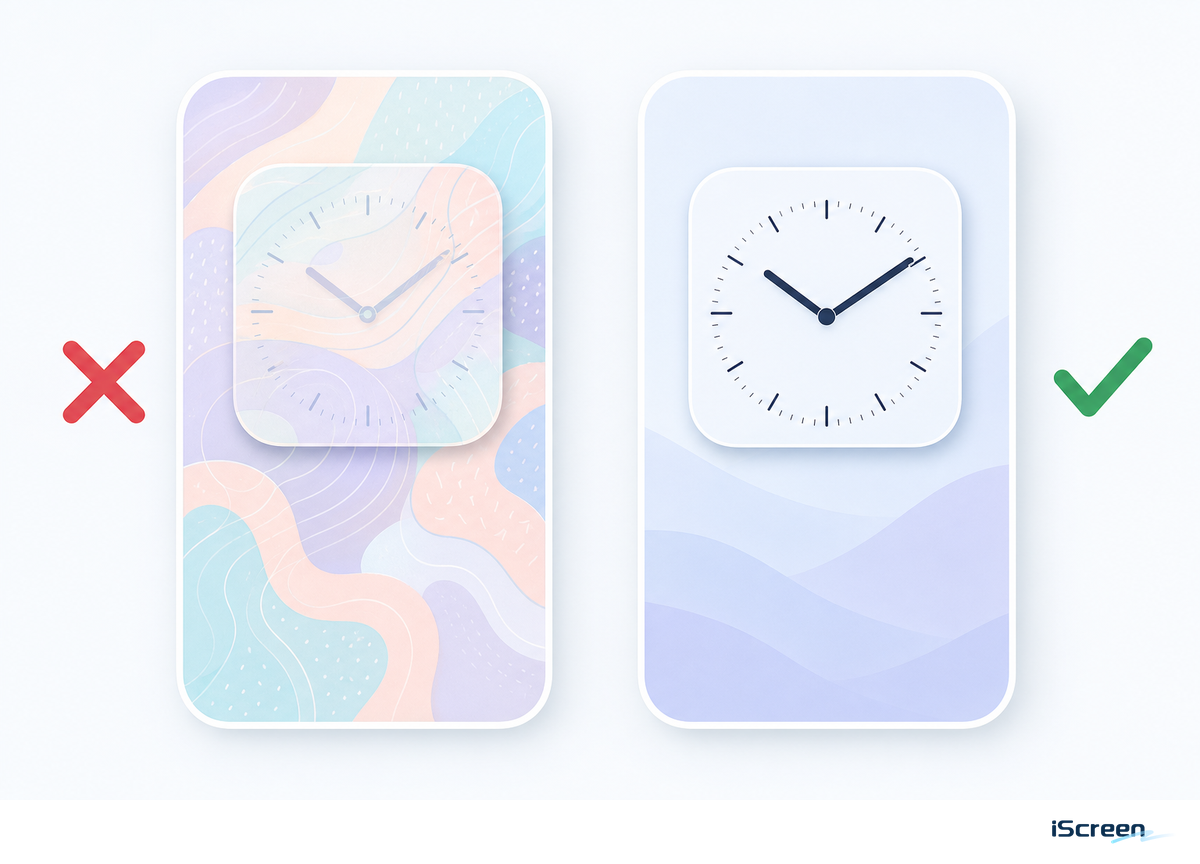
An attractive clock needs four things working together: a numeral shape that suits the mood, enough weight to survive the wallpaper, clear separation between foreground and background, and a sensible amount of information. Thin serif numerals can look elegant in a preview and then vanish over clouds, faces, or bright highlights. Heavy digital numerals stay readable, but they can dominate a soft layout if the widget is too large.

Use the wallpaper’s focal point as your boundary. When the subject sits in the upper half, move the clock lower or choose a compact size. For an already detailed background, use fewer colors and less ornament. Apple provides display controls such as Increase Contrast and Reduce Transparency because appearance and readability don’t always move in the same direction. Apple’s display and text guide is worth checking if a pale, glass, or low-contrast design looks different on your phone than it did in the preview.

Practical rule: a clock should either improve at-a-distance readability, add useful time-and-date context, or deliberately anchor the composition. Without one of those roles, the status-bar time may be the cleaner choice.

Best Aesthetic Clock Widget Designs for iPhone
Best Aesthetic Clock Widget Designs for iPhone — iScreen

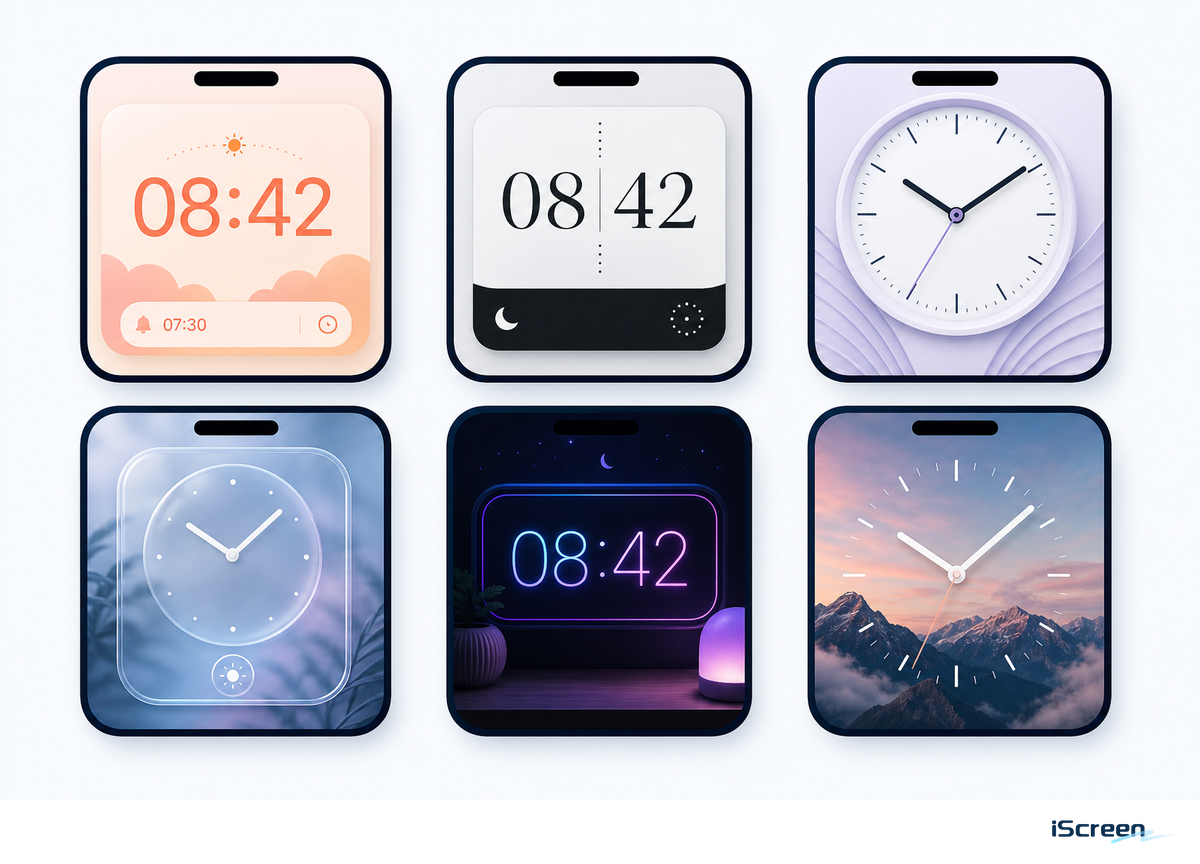
There’s no universal winner. This table treats each clock as part of a full screen, not an isolated product thumbnail. iScreen’s current widget library includes digital and Lock Screen clock options, while the App Store listing shows the wider customization scope, ratings and reviews, version history, in-app purchases, and app privacy information in one place. Review the privacy policy and App Store privacy label for any widget app before you decide that visual style is the only tradeoff.

Before downloading apps like these, check three details: whether the design is completely free or part of an in-app purchase, whether the “What’s New” notes show recent bug fixes, and whether the supported devices match yours. Reviews describing the exact clock and iOS version are more useful than a generic “great app” comment. App Store distribution also doesn’t mean every marketing statement is verified by Apple. This guide focuses on iPhone; some WidgetKit families also work on iPad, but a design shown for iPhone and iPad still may not support every iPhone surface.

Nine clock types compared by wallpaper, placement, size, and limitation
Clock type Best wallpaper match Best surface Useful size Watch for
Minimalist digital Photos, gradients, or quiet textures Home Screen Small or medium Ultra-thin numerals can disappear
Retro flip clock Solid, film-grain, or muted gradient Home Screen or StandBy Medium or full screen The panels become noisy over busy photos; some listings spell the style “FlipClock”
Classic analog clock Neutral, architectural, or editorial Home Screen Small or medium Tiny hands are harder to read at a glance
Transparent or Liquid Glass Low-detail wallpaper with a stable color field Home Screen Medium Tint, clear mode, and accessibility settings can change the effect
Pixel clock Game, cyber, or monochrome retro art Home Screen Small Mixed icon styles break the illusion quickly
Pastel or cute clock Soft illustration or plain pastel Home Screen or Lock Screen slot Small Low contrast can turn cute into hard to read
Information dashboard Plain dark or light background Home Screen or StandBy Medium A countdown can help you keep track of time, but too many fields compete with the main display
World clock Plain map, travel, or neutral background Home Screen or StandBy Medium Extra zones need clear city labels
Timer clock Minimal work or study layout Home Screen Small or medium A task timer is not the same as a continuously updating wall clock

Our July 2026 US DataForSEO Google Ads batch recorded 1,600 estimated monthly searches for both “iPhone clock widget” and “clock widget for iPhone,” compared with 30 for “analog clock widget iPhone”; the same batch put “add widgets to iPhone” at 5,400. These are directional search estimates from one current batch, not traffic forecasts. They don’t make analog clocks unattractive; they explain why a digital clock widget is the most useful default and analog appears as a deliberate style choice. For a broader list of screen widgets beyond clocks, see our best widgets for iPhone guide.

A first-party 90-day review of 939 query-by-page rows found established visibility for generic widget, Home Screen, and Lock Screen pages, but no strong clock-specific owner. That is why this guide connects clock design and setup to those broader resources instead of duplicating them.

The 4-Input Clock Style Fit Matrix
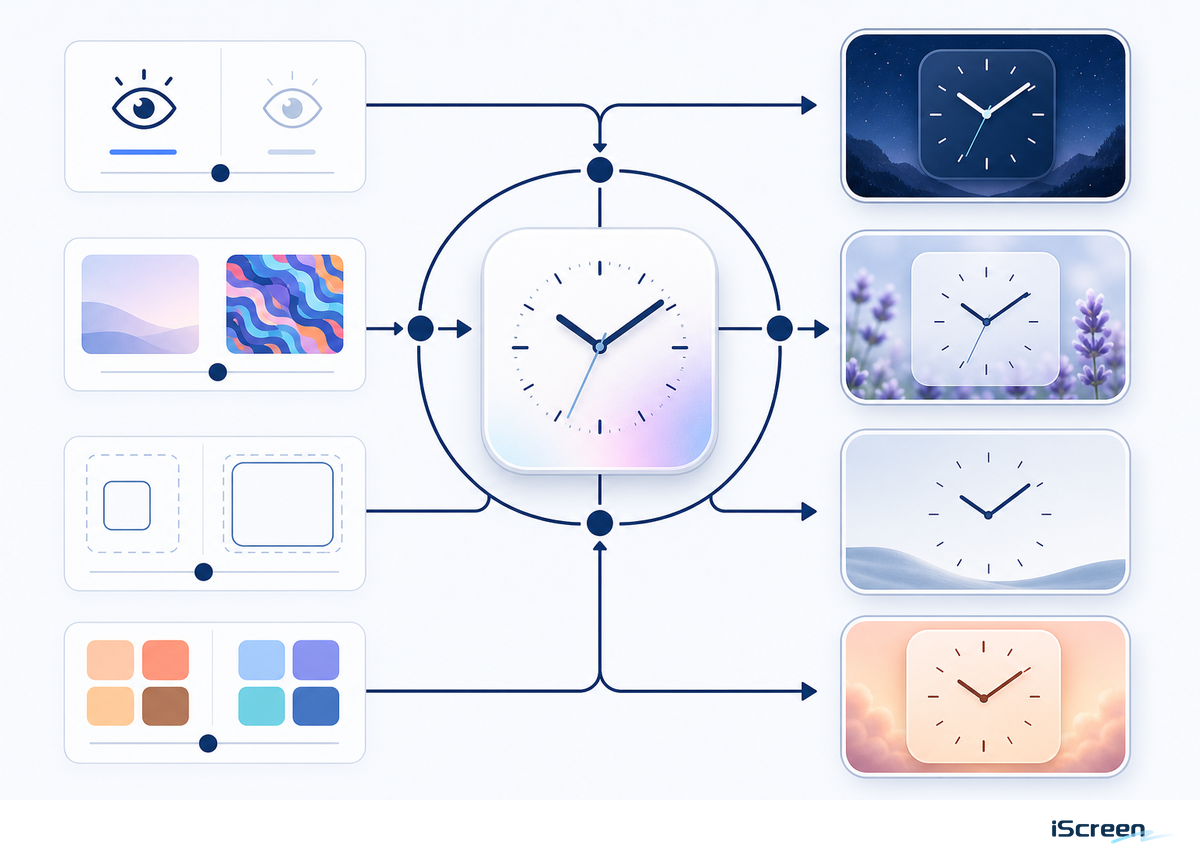
The 4-Input Clock Style Fit Matrix — iScreen

The 4-Input Clock Style Fit Matrix starts with what’s already on the screen: wallpaper complexity, visual goal, information density, and placement surface. It doesn’t guarantee that one custom clock widget is offered in every location: Apple’s WidgetKit guidance distinguishes system widgets from accessory widgets, and the UI rendering can change by context. Apple’s widget-background guidance also explains that the system can remove or alter a widget background in contexts such as StandBy and accessory placements. Choose the desired surface first, then confirm that iScreen offers that design and widget family there. Community user tips can suggest a look, but the availability check belongs inside the app.

The Clock Style Fit Matrix, choose by wallpaper, goal, information density, and surface
Your screen Recommended Avoid first Availability check
Busy photo + time only + Home Screen Bold minimalist digital Transparent glass or detailed analog face Small or medium system widget
Quiet gradient + decorative goal + Home Screen Flip, pixel, or analog Dense information dashboard Matching saved size in iScreen
Portrait wallpaper + compact Lock Screen area Simple accessory clock or date A design intended only for a medium Home Screen tile Lock Screen accessory family
Nightstand + at-a-distance viewing + StandBy Large digital or restrained flip clock Fine analog hands or multi-panel dashboard StandBy-compatible clock or small widget

For a cute layout, apply the same logic before choosing illustrations. Our cute aesthetic widgets guide covers full theme pairing; here, the clock-specific rule is simpler: one clear time display, one visual motif, and no competing decorative panel beside it.

The One-Glance Contrast Test
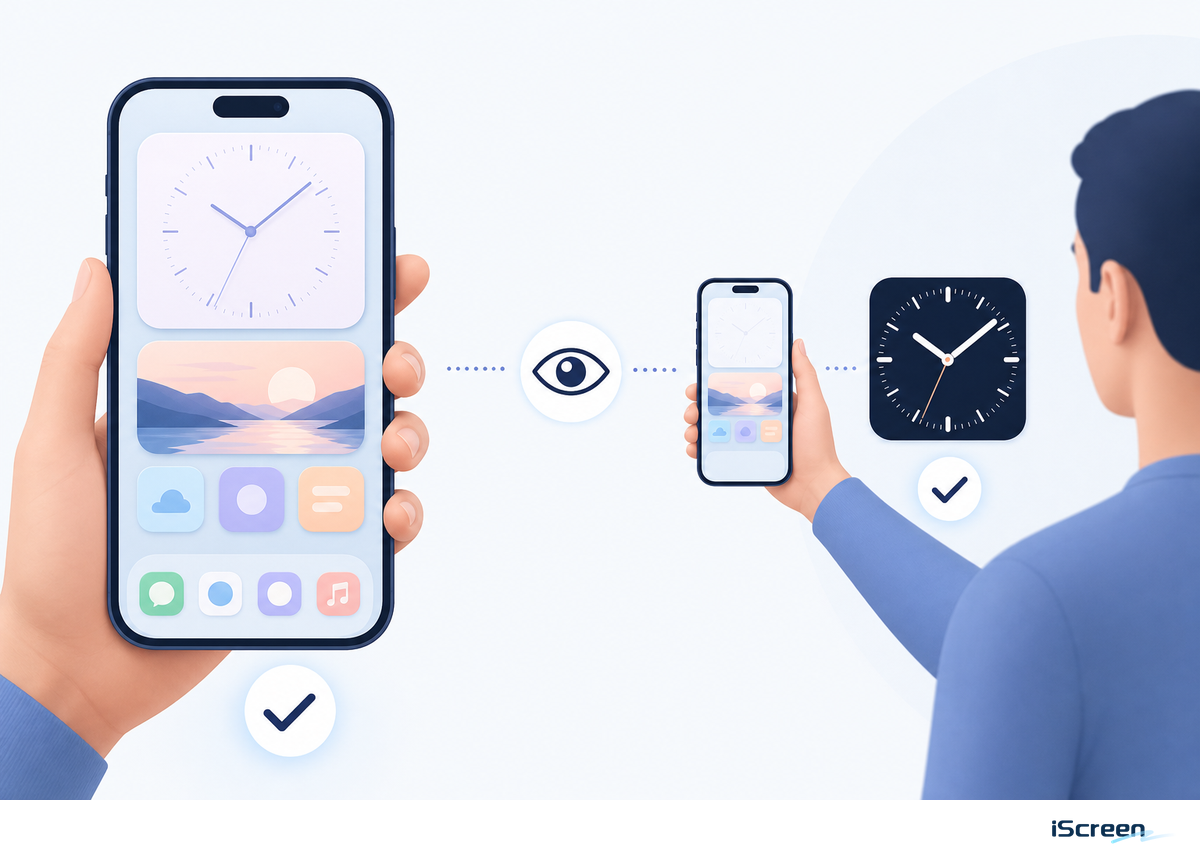
The One-Glance Contrast Test — iScreen

The One-Glance Contrast Test takes less than a minute after you place the widget:

  1. Hold the phone at arm’s length. Needing longer than a glance to read the time means the numerals are too light, too small, or too close to the wallpaper color.
  2. Move the widget across the wallpaper’s brightest area. Any design that only works in one dark corner is fragile; decide whether moving it harms the composition.
  3. Check both light and dark appearance. Also check tint or clear mode and any enabled Increase Contrast, Reduce Transparency, Color Filters, Bold Text, or Display Zoom setting; Apple documents these controls in its display and text settings guide.

Adjust in this order: move the position, change the widget size, add a quiet backdrop, then switch the numeral weight or style. This preserves the chosen aesthetic before replacing it. Transparent clock backgrounds can look integrated in one appearance and mismatched in another, so test the placed widget, not just its in-app preview.

Do not force a large clock into every layout

If the status-bar time is already enough and the clock adds no useful date, time zones, or distance readability, leave the space open. Negative space can make the rest of the Home Screen feel more intentional.

How to Add an iScreen Clock Widget to the Home Screen
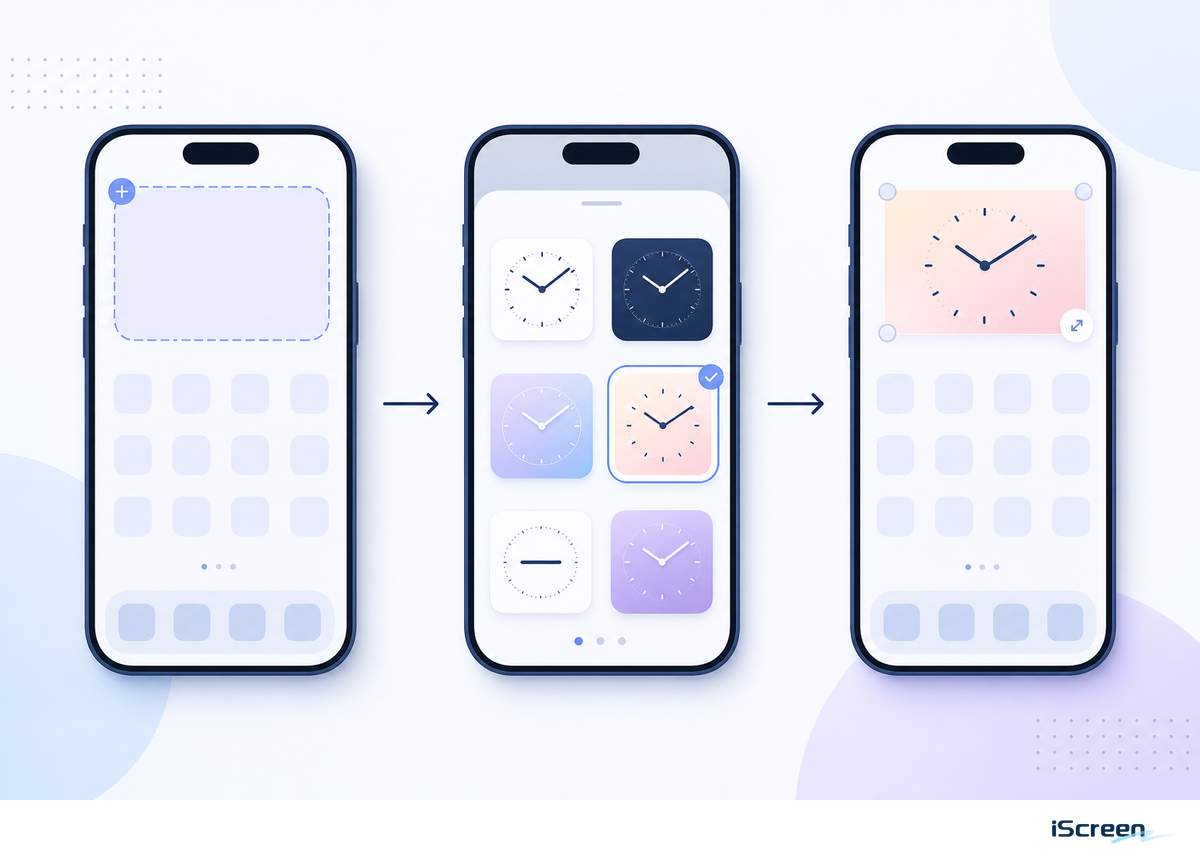
How to Add an iScreen Clock Widget to the Home Screen — iScreen

First, open iScreen, browse or search for the clock you want, customize its color or content, and save it to My Widgets. Then follow Apple’s current Home Screen widget flow.

  1. Touch and hold the Home Screen background until the items begin to move.
  2. Tap Edit, then Add Widget.
  3. Search for iScreen and open it.
  4. Choose the same size as the clock you saved, then tap Add Widget.
  5. Move the tile into position and tap Done.
  6. If the wrong saved design appears, touch and hold it, choose Edit Widget, and select the current widget.

iScreen shows the exact assignment step in the full customization guide. When you’re adding several home screen widgets, the broader iPhone widget roundup can help you decide what earns the second slot.

The Three-Zone Clock Layout

Divide the screen into a time zone, an app zone, and breathing room. Put the clock in the quietest zone, keep one supporting widget at most, and let the wallpaper remain visible somewhere.

If the clock needs to stay visible, don’t place it inside a Smart Stack: iOS can rotate the visible widget based on time, location, and activity. Today View is another supported location, but access from a locked phone depends on your Allow Access When Locked settings, so avoid exposing sensitive calendar or location data there.

How to Add or Style a Clock on the Lock Screen
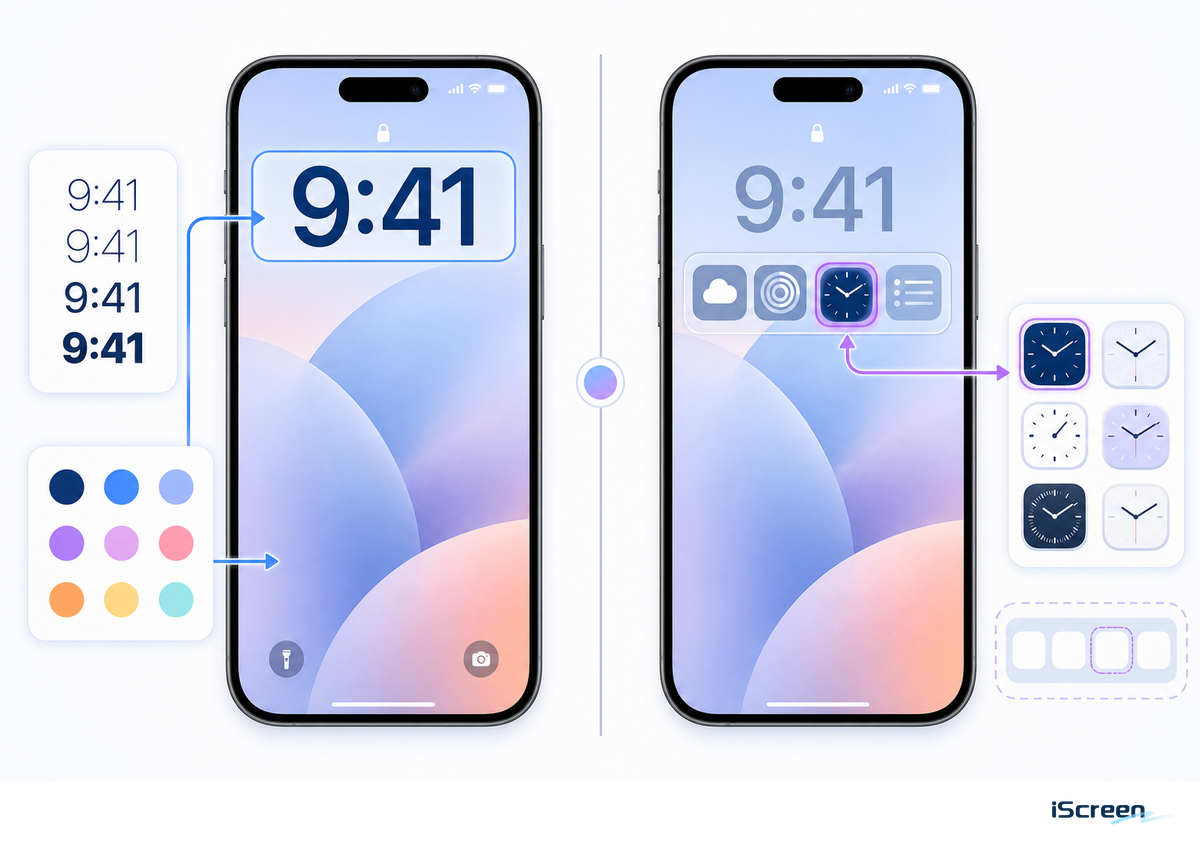
How to Add or Style a Clock on the Lock Screen — iScreen

There are two different clocks here. The large built-in Lock Screen clock is part of Apple’s system editor; a third-party Lock Screen widget occupies an available widget area and does not replace that large system clock. That distinction prevents the most common expectation mismatch.

Style Apple’s main clock

  1. Touch and hold the Lock Screen, then unlock the iPhone if asked.
  2. Tap Customize, choose the Lock Screen, and tap the clock.
  3. Adjust the available font, size, color, or transparency controls, then tap Done.

Add an iScreen accessory widget

Save a compatible design in iScreen first. In the Lock Screen editor, tap Add Widgets or the widget area, choose iScreen, then add a supported accessory size. That same Home Screen design may not exist in this smaller format, and iOS can render Lock Screen widgets with a different vibrant treatment. Some listings use “Lockscreen” as one word, but the platform distinction is the same. For more placement options, use our dedicated Lock Screen widgets guide; its cute widget combinations also offer theme ideas.

Use StandBy for a Full-Screen Aesthetic Clock
Use StandBy for a Full-Screen Aesthetic Clock — iScreen

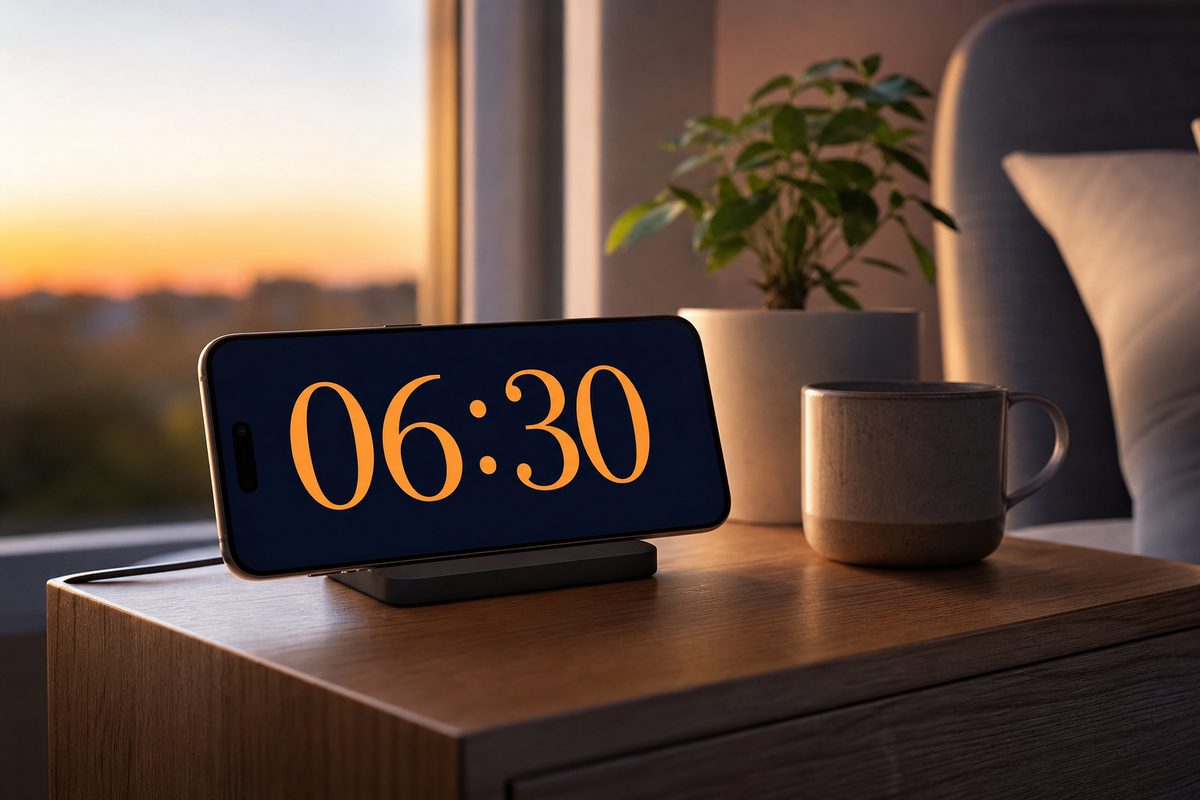
StandBy mode, introduced in iOS 17 and refined since, is the best fit when the clock needs to work as a nightstand display, desk clock, or full-screen screensaver-style view. It’s a system surface, not simply a large copy of every Home Screen clock. Designs advertised for “Home Screen and StandBy” still need the app’s supported-family check.

  1. Open Settings > StandBy and turn it on.
  2. Connect the iPhone to a charger, place it on its side, and keep it stationary.
  3. Press the side button if needed, then swipe between widgets, photos, and clocks.
  4. Choose a restrained clock for distance viewing and test Night Mode in the room where you’ll use it.

Apple’s current StandBy guide notes that supported Always-On models can keep the view visible. On other iPhones, StandBy can sleep and require a tap, a nudge to the surface, or Siri to wake it, so don’t judge a clock app as broken just because the full-screen view doesn’t remain on. Our complete iPhone StandBy guide covers the deeper settings.

Fix a Clock Widget That Is Missing, Blank, or Not Updating
Fix a Clock Widget That Is Missing, Blank, or Not Updating — iScreen

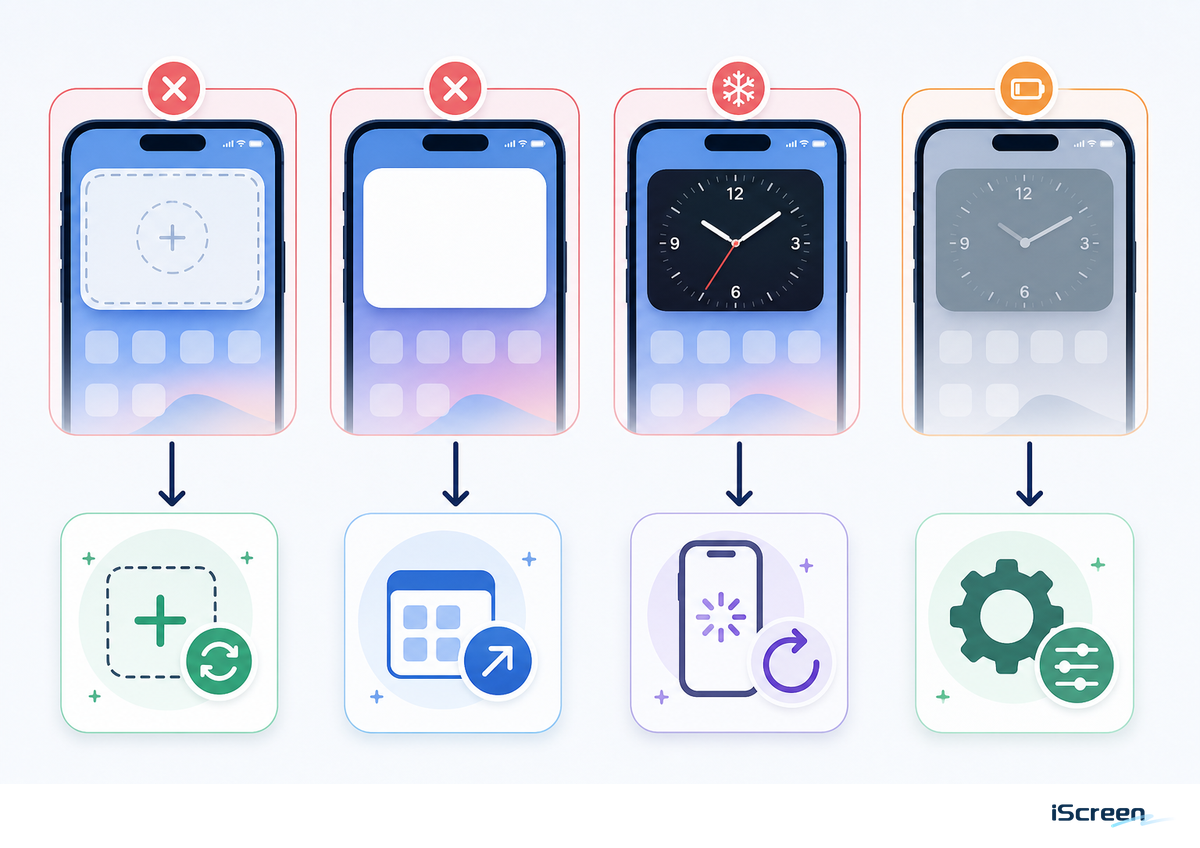
Start with the symptom. Stale time can come from the saved-widget assignment, the widget family’s supported context, iOS scheduling, or an app-specific bug. Apple Developer documentation also shows that supported dynamic date and time views can continue updating while visible even when the widget extension isn’t running, so “iOS refresh delay” isn’t a complete diagnosis.

Symptom-to-fix guide for iPhone clock widgets
Symptom Check first Next fix
iScreen is missing from the gallery Open iScreen once and confirm the widget was saved Search again, then restart the iPhone if it remains missing
The wrong clock appears Confirm the placed size matches the saved size Touch and hold > Edit Widget > choose the saved clock
The clock is blank Open iScreen and verify the design still loads in-app Remove and re-add the widget; check version history for recent bug fixes
The time looks stale Open the app and check whether that design supports a dynamic time display on this surface Reassign or re-add it; update iOS and the app before treating it as a defect
A transparent clock no longer matches Check light/dark, tint/clear, and accessibility display settings Recreate the background or switch to a solid/outlined clock

The iScreen setup and troubleshooting page covers opening the app to refresh, re-adding a widget, and restarting when an item is missing. No third-party developer should promise that every widget behaves like the Clock app or updates second by second in every context.

Frequently Asked Questions

How do you get aesthetic widgets on iPhone?

Install a widget app, save a design that matches your wallpaper, then add its matching size from the Home Screen editor and place it in a quiet area.
With iScreen, choose and customize a clock, save it to My Widgets, touch and hold the Home Screen, and select Edit > Add Widget > iScreen. Pick the matching size, place it, and use Edit Widget if the wrong saved design appears. Coordination comes from matching the clock’s visual weight to the wallpaper, icons, and any second widget, not from adding lots of options at once.

Can you customize the clock widget on an iPhone?

Yes. Customize Apple’s main clock in the Lock Screen editor, or configure a third-party clock in its app before adding a supported widget size to the screen.
Apple’s main Lock Screen clock is customized in the Lock Screen editor. Configure a customisable or customizable third-party clock in its source app, then add it as a Home Screen or supported Lock Screen widget. That face may not be available in every size or surface, so customise the saved design only after choosing where it will live.

How do you add a cute clock widget?

Choose a pastel or illustrated clock, save it in the widget app, add the matching size, and place it over a quiet part of the wallpaper.
In iScreen, save the pastel or playful design to My Widgets. Enter Home Screen edit mode, choose Add Widget, select iScreen, and add the matching size. When the wrong design appears, use Edit Widget to select the saved clock. Keep the numerals darker than the lightest wallpaper area, especially with cute illustrated backgrounds.

Do clock widgets drain battery?

Normal clock widgets use iOS-scheduled updates rather than running continuously, but the specific widget, update behavior, and time the display remains on can still affect battery use.
WidgetKit uses timelines and system-controlled updates, while supported dynamic date views can update onscreen without continually running the extension. More often, the relevant battery consideration is how long the display remains active, especially with StandBy or Always-On, not the clock artwork alone. When battery use changes sharply, compare the app and display battery entries instead of assuming every clock widget has the same cost.

How do you display different clocks on iPhone?

Save a different design for each placed widget.
Assign each saved clock through Edit Widget, or use one world clock for multiple time zones. Test every screen after unlocking.

Choose the surface before the style

A clock is easiest to live with when it solves the job of its surface: quick glance on the Home Screen, compact context on the Lock Screen, or distance viewing in StandBy. That functional fit decides whether an elaborate design is worth paying for. Use the Fit Matrix, run the One-Glance Test, and then browse iScreen’s clock and widget designs for an option available in the size you need. Dynamic Island is a separate iPhone surface and isn’t a substitute for a clock widget.

For a complete setup walkthrough, continue with how to customize iPhone widgets. When the Lock Screen is your priority, the Lock Screen widget guide goes deeper; for a bedside or desk setup, use the StandBy mode tutorial.

References & Sources

  1. Add, edit, and remove widgets on iPhone Apple iPhone User Guide.
  2. Personalize your iPhone Lock Screen Apple iPhone User Guide.
  3. Use StandBy on iPhone Apple iPhone User Guide.
  4. Displaying dynamic dates in widgets Apple Developer Documentation.
  5. Developing a WidgetKit strategy Apple Developer Documentation.
  6. Displaying the right widget background Apple Developer Documentation.
  7. Keeping a widget up to date Apple Developer Documentation.
  8. How to install iScreen desktop widgets iScreen Support.

最近の記事

How to Turn a Video into a Live Photo on iPhone

How to Turn a Video into a Live Photo on iPhone

2026/11/13 19:12
To turn video into a Live Photo on iPhone, import a video clip into a Live Photo converter, trim the moment you want, and save it to Photos. Open the saved picture, then press and hold to play it. If you want to keep the original sound quality, listen to the result before removing the video or sharing it. For a moving Lock Screen, choose a converter’s wallpaper export route. IntoLive has a dedicated Live Wallpaper option, and Apple provides a different wallpaper route. Saving a moving picture and setting an animated background are different things. Video to Live Photo conversion turns a selected video moment into a photo with motion. Save the result to Photos first. For wallpaper, use a wallpaper export and enable the play control when setting your Lock Screen. Start with the original video and keep it until you’ve checked the saved result. Choose an output that preserves sound if you want to keep a spoken moment. Use the converter’s wallpaper option when your goal is Lock Screen animation. Compare the saving step and payment terms before editing a long clip. This tutorial follows Apple’s instructions and the developers’ own guides. The conversion routes haven’t been tested on a physical iPhone for this article. Turn your video into a Live Photo Can I make a live picture from a video? Yes. A video to Live Photo converter can transform a selected moment into a picture with motion. To convert video to Live Photo format, start with the original recording. Pick a video from your library. Trim the part you want, choose a still frame where the tool allows it, and export to photos. Play that saved item before moving on to wallpaper setup or sharing. V2LP’s developer explains how to use an app to create Live Photos by choosing a video, trimming it, selecting a cover photo and saving it to Photos. Editing controls include an audio toggle. Leave the sound on if you want to keep the voice or background audio of your favorite video moments. For wallpaper, follow intoLive’s creation guide: Open intoLive and tap Live Wallpaper. Import your media and trim the section you want. Finish the edit, then tap the Share icon. Choose the option to save as a Live Photo. Next, launch Photos. The Apple Live Photos instructions state that saved Live Photos appear in the Collections > Media Types > Live Photos section. Open the item and press and hold the screen to preview its cover image and motion. Inspect the cover and playback, then listen if sound is required. A thumbnail in the camera roll alone doesn’t say much about the moving part. Keep the original in your library. It’s a good starting point if your crop takes off too much, if the moment captured is too short, or if you want to make another version of the video. When using apps like these, make sure to use the same original video so that changes are easier to spot in the output. Before comparing apps, identify the type of result you need: Result type What you have What to do next Camera Live Photo Captured directly with the iPhone camera. Play it in Photos; this is not a conversion of an older movie. Converted Live Photo A moment selected from an existing video. Check both the chosen still image and the motion. Silent Live Photo Motion saved without the original audio. Suitable when sound is unimportant; keep the video for speech. Live wallpaper export A converter’s output intended for the Lock Screen. Apply it in Wallpaper settings and check playback on wake. GIF input An animated source accepted by some converters. Import it through the tool before saving a Live Photo. Standalone video A movie that can be shared separately. Keep the original video for the full scene. To export a Live Photo as a short movie, use Apple’s Save as Video command. Still image A photo without playable motion. Use it as a static background; it is not a moving export. Download package Files bundled for a provider-specific import. Follow that provider’s import instructions before checking Photos. Choose a clip that works as wallpaper For Live Photo wallpapers, select short clips with smooth motion, a clear subject and not too many scene changes. intoLive recommends minimal movement and transitions for its wallpaper exports. A person turning and facing the camera would be a better starting point than a montage of different unrelated scenes. In its duration guide, intoLive says that wallpaper exports should be between 1-2 seconds. Consider that if you need to pick a segment of action for the background. The Clip-to-Lock-Screen Check below will allow you to pinpoint the stage of the unwanted change. For browser conversions, do the paired import and then check the saved item. Complete the other checks provided below. Work through the relevant checks below; app users can disregard the browser import row. Stage What to inspect What to change first Original action The selected moment contains the action you want. Move the trim points before editing the cover. Original framing The subject stays inside the crop. Choose a wider source or adjust the crop. Saved cover The still image shows the expression you chose. Change the cover or key photo where available. Saved motion Pressing and holding plays the saved item in Photos. Return to the converter if only a still image was saved. Saved sound Speech remains when you need it. Check the mute option; choose another route for silent-only output. Browser import Both parts are saved by the provider’s paired import route. Repeat Save 2 Items for LivePhotoNow rather than saving only the picture. Wallpaper preview The subject fits around the clock and the play control is available. Review the wallpaper export route, framing and play setting. Lock Screen wake The selected wallpaper animates when the phone wakes. Inspect the play control and developer troubleshooting guidance. A high-quality still frame matters too. Pause on a frame of the video with your preferred expression and composition before making any cropping adjustments. For the surrounding layout, the iPhone wallpaper Size Guide can assist you in planning a portrait composition before you crop away part of your subject. Set the Live Photo as your Lock Screen wallpaper Can you add video as wallpaper on an iPhone? You can use a converted Live Photo as an animated Lock Screen wallpaper via Apple’s wallpaper controls. Use a saved Live Photo rather than a raw movie for the wallpaper. Apple details this method on iOS 17 or later, where the animation is played when the device is woken. Follow Apple’s Lock Screen setup instructions once you’ve saved your conversion: Open Settings → Wallpaper → Add New Wallpaper. Tap Photos, then Live Photo. Select your saved image. Customize the preview. Tap Add, then choose Set as Wallpaper Pair or Customize Home Screen. Apple describes the animation as playing “whenever you wake up your device.” Apple, Set a Live Photo as your Lock Screen wallpaper on your iPhone, 2025. Lock and wake the phone to test the result. Pressing and holding a Live Photo in Photos tests its playback in the library. Choose Customize Home Screen if you want a different static background image behind your app icons. For more on Lock Screen customization, see this guide. Convert without installing another app Yes, a browser converter can offer a route that doesn’t require installing another app. LivePhotoNow describes importing an MP4, MOV or WebM clip, selecting the moment, and using Save to Photos → Save 2 Items on iPhone. Follow that paired saving step, rather than saving only the still picture. The service states its conversion runs in the browser and its output is silent. It pairs a still image with a motion file using matching metadata. So the audio choice is to use a different route when the person’s voice is the reason you’re saving the clip. Other online tools use different imports. LivePhotoTools, for example, describes a package and an iPhone import route involving a Live Photo app. Downloading a package isn’t the same step as creating a recognized item in Photos. Before using a private video, read the service’s upload and handling information. Don’t use a shortcut tutorial that promises a native Photos conversion button without showing its actual saving route. Check free export before paying for an app V2LP’s developer lists basic conversion, trimming, cover selection and saving as free, with advertisements. Removing advertisements and gaining editing tools is available via an in-app purchase. Route Saving step Decision before editing V2LP Save the edited result to Photos. Basic saving is listed as free with ads; Pro is optional. intoLive wallpaper route Live Wallpaper → edit → Share → save as Live Photo. Use the dedicated wallpaper route and inspect the current purchase screen. LivePhotoNow browser route Save to Photos → Save 2 Items. The developer describes free, silent output and browser processing. LivePhotoTools browser route Download its package, then follow its import instructions. Its iPhone instructions involve another application. V2LP lists no watermark, no subscription and an optional one-time Pro purchase. When comparing apps, distinguish an optional in-app purchase from a renewing subscription or trial. On the App Store, read App Privacy. A developer can describe conversion that’s done locally while the listing can separately disclose tracking, as V2LP does. Local processing and the app’s broader data collection are different questions. Fix motion that is not supported as wallpaper If the saved item moves in Photos but stays still as wallpaper, check the wallpaper export and play control first. intoLive’s troubleshooting guide states that both converted Live Photos and Live Photos captured using the camera may not work perfectly as wallpaper. For this Lock Screen feature, Apple states iOS 17 or higher. Buying another converter isn’t the first check. No moving item in Photos: return to the export step. Make sure you saved a Live Photo rather than a GIF, video or still image. intoLive wallpaper fails: create the final export through Live Wallpaper. Its guide distinguishes that route from New Project. Motion control is missing: intoLive recommends turning off Low Power Mode and checking again. A busy clip is rejected: choose a simpler moment with less movement and fewer transitions, following the developer’s advice. There’s an exception to the New Project distinction: intoLive describes using the video acceleration feature to increase a video’s speed, saving that edit, and then importing it again using the Live Wallpaper. Therefore, you don’t need to discard a useful pre-edit just because it was done in a different part of the application. In an Apple Support Community discussion, a user said that system-suggested pictures worked. However, when using manually selected pictures, it didn’t work. Another user said he/she got different results. Don’t reset your whole phone just because one user in a forum said to do it. After altering the export settings, save a new version and apply that version in Wallpaper settings. Otherwise, you may be looking at a previously saved background while evaluating a newer conversion. The guide to iPhone wallpaper changing by itself addresses a different situation where the image changes unexpectedly. Keep the still image useful between animations Cover pictures work best when they leave space for notifications and the clock. You can evaluate video details by checking whether individual faces are recognizable. Use the preview to check for blur at the edge of your crop. The animation can end on a calm screen with a readable subject. A tight crop that cuts off a face will still be distracting when nothing moves. Select a coordinated Home Screen and Lock Screen from Apple’s settings, and then check the wallpaper preview. If you want a better static composition, return to the converter. Design ideas can be found in iScreen wallpapers or in the iPhone wallpaper Aesthetic Guide. Choose the background design after the conversion works so that you can judge the saved still image alongside the motion. Frequently asked questions What is a Live Photo? A Live Photo is a photo with a short moving moment that you can play in Photos. Apple’s camera records what happens 1.5 seconds before and after the shutter. You can choose a key photo, apply a Photos effect, and share the result. That camera timing describes capture on the device. A converter starts from an existing movie and applies its own trimming and export settings; for example, intoLive’s wallpaper guide describes a 1–2-second result. Can I convert a long video into a Live Photo? Yes, by selecting a shorter moment from the original video. Trim to the part you want before saving. For intoLive’s wallpaper route, its developer describes a 1–2-second result, so choose the action that fits that output rather than expecting the entire recording to play. Keep the original movie for the full scene, longer audio or a later edit. A Live Photo is useful for a selected moment, not as the only copy of a long recording. How do you loop a Live Photo? Open it in Photos, tap the Live Photo control near the top, and select Loop. Apple also lists Bounce and Long Exposure in that menu. Choose the effect you want for viewing the photo in your library. Loop replays the action, while Bounce reverses it back and forth. Preview the effect on the actual subject: a wave can read differently from a person walking out of frame. Keep an original copy before experimenting with an additional editor, since Apple warns that third-party editing can remove applied effects. How do I turn a Live Photo into a video on iPhone? Open the Live Photo, tap More, and choose Save as Video. Apple’s reverse-conversion instructions say the new video appears in Recently Saved and the original remains in Live Photos. Use this shareable video copy when you want to send a standalone movie. Why does my Live Photo stay still on another phone? The sharing method may have sent a still image, or the receiving application may show only the photo. Apple says Mail sends a Live Photo as a still image. If the recipient needs motion, save a video copy and send that instead. Keep the original Live Photo as well; the video copy is a separate output for sharing. Can a GIF be used instead of a video? Yes, when the converter supports GIF input. Choose a GIF or video that contains the moment you want to keep. V2LP and LivePhotoNow both describe that option. Import the GIF through the selected tool and save the result into Photos, then use the same playback and wallpaper checks as for a video conversion. Live Photo vs video: what is the difference? A Live Photo opens as a picture with motion available to play; a video is a standalone moving recording. Choose a Live Photo for a selected still image and its brief action. Keep a video when you need the full scene or a movie to send. For a personal moment with speech, include sound retention in the decision: some conversion routes save motion without the original audio. References & Sources Take and edit Live Photos, Apple Support. Set a Live Photo as your Lock Screen wallpaper on your iPhone, Apple Support. How to turn a Live Photo into a video on your iPhone, Apple Support. Related articles Animated wallpaper on iPhone iPhone Home Screen wallpaper ideas iPhone wallpaper size and framing Customize your iPhone Lock Screen
2026/11/13 19:12
How to Customize Your iPhone Home Screen with Widgets and App Icons

How to Customize Your iPhone Home Screen with Widgets and App Icons

2026/11/13 17:20
Your iPhone Home Screen is more than just a place to launch apps — it’s a reflection of your personal style. With custom widgets, app icons, and wallpapers, you can turn a standard Home Screen into a look that feels uniquely yours. Whether you prefer a clean minimalist layout, a soft pastel look, or a bold retro theme, iScreen makes it easy to create a Home Screen you love. Here’s how to do it with iScreen.   1. Why Customize Your iPhone Home Screen? There are several reasons to give your iPhone Home Screen a makeover. Express Your Personal Style: Choose colors, icons, and wallpapers that reflect your personality and favorite aesthetic. Make Your Phone More Functional: Widgets let you check useful information, such as the weather, calendar events, and battery levels, without opening individual apps. Create a More Organized Look: Matching app icons and carefully arranged widgets can make your Home Screen look cleaner and more visually appealing. A well-designed Home Screen combines both style and functionality, making your everyday iPhone experience more enjoyable.   2. How to Customize Your iPhone Home Screen Before exploring third-party customization apps, you can start with the built-in features on your iPhone. Here are two simple ways to personalize your Home Screen. 2.1 Add Widgets to Your iPhone Home Screen Widgets display useful information directly on your Home Screen while adding a personal touch to your layout. Follow these steps to add a widget: Touch and hold an empty area of your Home Screen until the apps start to jiggle. Tap the Edit button or the + button, depending on your iOS version. Browse the available widgets and select the one you want. Choose your preferred widget size. Tap Add Widget, then drag it to your desired position. Tap Done to save your layout. You can experiment with different widget sizes and arrangements to create a layout that works for you.   2.2 How to Change App Icons on Your iPhone Custom app icons are another great way to transform your iPhone’s appearance. You can use the Shortcuts app to replace the standard app icons with your own images. Here’s how: Open the Shortcuts app on your iPhone. Tap the + button to create a new shortcut. Select Add Action, search for Open App, and choose it. Tap App and select the app you want to customize. Open the shortcut’s details menu and choose Add to Home Screen. Tap the icon preview and select Choose Photo to upload your custom icon. Enter a name and tap Add. Repeat these steps for other apps to create a consistent icon style across your Home Screen.   3. How to Customize Your iPhone Home Screen with iScreen Want more creative options beyond the built-in iPhone settings? iScreen makes it easier to explore different widget designs, custom app icons, and wallpapers in one place. 3.1 Explore More Widget Styles With iScreen, you can discover a variety of aesthetic iPhone widgets to match your personal style. From minimalist calendars and photo widgets to cute interactive designs, there’s something for different tastes. You can also personalize available widget options, such as colors, backgrounds, and photos, to create a look that fits your Home Screen. Mix different widget styles and sizes to build a layout that’s both attractive and practical. 3.2 Explore Ready-to-Use Theme Setups For a more cohesive Home Screen design, iScreen offers a curated collection of ready-made theme setups, bringing together matching widgets, app icons, and wallpapers in a unified aesthetic. Explore a range of styles, from playful and colorful designs to minimalist, retro, and dark themes. Each collection features coordinated visual elements, making it easy to create a polished iPhone Home Screen with a consistent look and feel. With thoughtfully paired designs, iScreen helps transform individual customization elements into a complete, visually harmonious setup.   3.3 Bring Everything Together Now it’s time to combine your favorite widgets, custom app icons, and wallpapers into one personalized setup. Try a minimalist theme for a clean look, a pastel theme for a softer aesthetic, or a retro-inspired design for a nostalgic vibe. Don’t be afraid to experiment with different colors and layouts until you find your favorite combination.   Final Thoughts Customizing your iPhone Home Screen doesn’t have to be complicated. With the right combination of widgets, app icons, and wallpapers, you can create a phone setup that reflects your personality while keeping everything easy to access. Ready to give your iPhone a fresh new look? Explore more customization possibilities with iScreen and create a Home Screen that’s truly yours! Media Contact iScreen Official Team Email: iscreenofficial@gmail.com Official Website:iScreen – Phone Style, iScreen it! iOS Download Link:‎‎iScreen – Widgets & Wallpaper Android Download Link:‎‎iScreen – Widgets & Wallpaper
2026/11/13 17:20
OLED Wallpapers for iPhone: Black Backgrounds That Work

OLED Wallpapers for iPhone: Black Backgrounds That Work

2026/11/13 14:36
/* Article-only alignment with the confirmed iScreen Home Screen guide. */ #iscreen-oled-article{font-family:Arial,sans-serif;font-size:inherit;line-height:1.75;color:#242735;} #iscreen-oled-article h2{margin:0 0 8px;padding:0;border:0;} #iscreen-oled-article figure{margin:12px 0!important;} #iscreen-oled-article .faq-item{margin:0 0 24px!important;padding:0!important;border:0!important;border-radius:0!important;} #iscreen-oled-article table{width:100%;border-collapse:collapse;margin:24px 0;font-size:15px;line-height:1.6;letter-spacing:normal;border:1px solid #e0e0e0;color:#2d2d2d;font-variant-numeric:tabular-nums;} #iscreen-oled-article table tr{border:none!important;} #iscreen-oled-article table th{background:#2d2d2d!important;color:#fff!important;font-weight:600;text-align:left;padding:12px 16px!important;border:none!important;vertical-align:top;} #iscreen-oled-article table td{padding:11px 16px!important;border:none!important;border-top:1px solid #e0e0e0!important;background:#fff;vertical-align:top;text-align:left;} #iscreen-oled-article table tbody tr:nth-child(even) td{background:#f5f5f5;} #iscreen-oled-article table tbody td:first-child{font-weight:600;} #iscreen-oled-article caption{caption-side:top;text-align:left;} @media(max-width:767px){#iscreen-oled-article table{font-size:14px;}#iscreen-oled-article table th,#iscreen-oled-article table td{padding:10px 12px!important;}} Updated November 2026 Choose an OLED wallpaper iPhone users can read at a glance: a black background with a small subject clear of the clock. Pure black has the quietest look; a thin moon or a dark gradient adds interest. Use the picture you like, and check its fit. Your screen type changes the battery advantage. An iPhone 13 uses OLED, while the standard iPhone 11 uses an LCD. Both can display the same dark image, but only the OLED panel lights its pixels individually. Browse iScreen wallpapers and backgrounds for designs, and use the checks below to choose a usable file. Six OLED wallpaper styles for your iPhone Pure black, a small moon, a thin outline, and a monochrome silhouette are a few starting points. A lower edge glow and a few scattered stars are a couple more. For a busy Home Screen, a pure black background is a good choice. For the Lock Screen, a small, bright subject is good. Choose a style for the screen you use Style Best starting place What to watch Pure black Home Screen with many apps No picture detail; the icons become the main color Small moon Lock Screen with empty upper space Keep the moon away from the time Thin outline Minimal abstract setup A line through a letter can distract Monochrome silhouette Lock Screen with a recognizable subject Fine edges can disappear in a tight crop Lower-edge glow Lock Screen with a dark upper half The glow is colored light, not pure black Sparse stars Night-sky theme Bright dots behind text can make it busy A calmer mobile layout has the favorite artwork on the Lock Screen and simpler backgrounds behind apps. Apple’s wallpaper instructions allow for these choices. A small touch of color often gives an inky black design enough character without filling the display. The iPhone wallpaper aesthetic guide has broader choices if you prefer. True black versus dark gray: check the image True black in an RGB image is #000000, or red 0, green 0, blue 0. For a wallpaper, those background pixels should also be opaque. Dark gray contains nonzero color values. Both can look dark on OLED screens, and darker gray can use less display power than a lighter image. How do I know whether a wallpaper is truly black? Open the original file in an image editor and use the color sampler to check colors in several background areas. Look for full opacity and an RGB value of (0, 0, 0). The W3C PNG specification differentiates transparency from color: a transparent pixel can reveal the background beneath it. A dark thumbnail is a poor test. Black-Pixel Evidence Ladder The Black-Pixel Evidence Ladder separates what a file contains, how a wallpaper looks after it’s installed, and how a phone uses power. Match the question to the check Check type What to inspect Next action File: original Full image rather than a thumbnail or phone mockup Open the individual download File: black values RGB at several empty background points Look for red 0, green 0, blue 0 File: opacity Transparency at those same points Use an opaque background for predictable black Appearance: crop Portrait preview and the subject’s edges Reposition without cutting off important detail Appearance: clock Bright shapes immediately behind the time Move the subject away from the digits Appearance: apps Stars or lines crossing app labels Choose a simpler Home Screen image Energy: display type Exact model’s OLED or LCD specification Use the model table below Energy: visible content Time spent on wallpaper versus app screens Consider app Dark Mode separately Energy: measured saving Same device, brightness and comparable use Only attach a percentage to an actual measurement Apple also describes slight changes in color or blur when scrolling next to black at reduced brightness as normal OLED behavior. A color sampler measures the file; it doesn’t diagnose the display. Check your iPhone screen before expecting savings OLED wallpapers for iPhone X work as images on LCD phones as well. With OLED iPhone wallpapers, the display technology changes how black is produced, not whether the picture can be installed. Check the specific model of a series using Apple’s specs: the standard iPhone 11 and iPhone SE examples below are different from the iPhone 11 Pro and 13. Screen-type decision table: verified model examples Apple device Display Reason to choose black iPhone X, iPhone XS and XS Max OLED Deep black appearance and darker-content power benefit iPhone 11 6.1-inch LCD Appearance and a quieter background iPhone 11 Pro models OLED Individually lit pixels, unlike standard 11 iPhone SE, third generation 4.7-inch LCD Simple composition behind apps iPhone 13 6.1-inch OLED Dark-content display-power advantage Apple lists the iPhone 11 LCD, SE third-generation display and iPhone 13 OLED specifications separately. The technology behind Super Retina explains the differences: “And with no backlight, OLED emits light through each pixel, allowing for a thinner display.” Apple, About the Super Retina display, 2026 How much battery can a black wallpaper save? A black wallpaper can reduce OLED display power compared to a brighter image. The daily battery saving with a black wallpaper varies with screen brightness and how long the wallpaper remains visible. When an opaque app fills the screen, the app’s displayed content becomes the relevant color choice. Apple’s 2022 power consumption presentation mentions that darker content uses less power on OLED panels. Therefore, system and app Dark Mode impact more than just the wallpaper. A black Home Screen doesn’t turn a bright webpage black. Consider the scope of Purdue’s 2021 dark-mode study. Purdue found that switching from light mode to dark mode at 100% brightness saved an average of 39%-47% battery power on the tested OLED smartphones. Researchers examined six Android apps, including Google Maps and YouTube, using 60-second activities on Pixel 2, Moto Z3, Pixel 4 and Pixel 5 phones. They altered the app’s appearance, considered screen brightness, and evaluated battery usage. Changing an iPhone background is a different adjustment. The wallpaper appears on the Home or Lock Screen, and the rest of your day consists of app interfaces, video and other workloads. No physical iPhone battery test was done for this post; therefore no daily savings percentage is assigned to your wallpaper. Download a sharp wallpaper from the original file Save the original HD or 4K portrait, rather than a gallery thumbnail or a screenshot of a phone mockup. Image quality starts with the original file. Its aspect ratio and the final crop determine how the subject is positioned. What is the correct way to download an iPhone wallpaper? Open the individual design from the black wallpaper collection, use its available download option, and keep the original file in Photos. Preview it in Wallpaper settings before committing. If the design has a border, pay attention to every edge while you adjust the crop. For example, suppose you are choosing a portrait image for an iPhone 13. Apple lists its display at 2532 by 1170 pixels, so the corresponding portrait orientation is 1170 pixels wide by 2532 pixels tall. A wide desktop composition places its subject differently even when the file has plenty of pixels. Choose a portrait version with open space near the clock first, then adjust the preview without cropping the subject. Increasing the dimensions of an image can’t restore details missing from the original. The iPhone wallpaper size guide covers model-specific sizing when you want a different fit. Set the Lock Screen and Home Screen separately Use Customize Home Screen to keep an illustration on the Lock Screen and a quieter image behind your apps. The built-in iOS Wallpaper controls handle this without a separate wallpaper app. Save your chosen image first, then follow the native sequence and choose whether you want a pair or two different backgrounds. Open Wallpaper. Go to Settings, then Wallpaper. Add your image. Tap Add New Wallpaper, then Photos, and select the saved picture. Adjust the composition. Preview the subject alongside the clock and any widgets, then tap Add. Choose the Home Screen. Tap Customize Home Screen for a separate look, or Set as Wallpaper Pair to use your selection on both. The Apple wallpaper guide also offers a color, another photo or Blur for the Home Screen. Keep blur off if you want to preserve background details. For a background with no subject, see the solid-color wallpaper guide. On supported models, Always-On has a separate Show Wallpaper toggle under Settings, Display & Brightness, Always On Display. For information on Always-On display, see Apple’s Always-On display guide. Keep bright details clear of your clock and apps Please keep the brightest detail away from the clock and the app labels you read most. In general, contrast right behind each letter is better than darkness. A mostly black image can still be difficult to read when a white star, outline or moon crosses the text. W3C’s background-image contrast examples show why local placement matters: black lines crossing black lettering can make one letter resemble another, and dark gray behind black text can make it unreadable. Apply that principle to your wallpaper preview. For a light clock, move a bright moon away from the digits or choose a darker patch behind them. If stars overlap several app labels, use a plain Home Screen instead of shrinking everything until the image loses its character. The picture doesn’t have to match on both screens. More layout ideas can be found in our Home Screen wallpaper guide. As an alternative to using a completely black background, consider a softer iPhone gradient wallpaper. Choose the black background you will keep Pure black works well behind a busy app layout, as does a small moon or outline if you want a subject that’s noticeably in the foreground. Keep the original download, preview both screens, and retain the version that makes your clock and apps easy to read. The simplest image is a useful starting point, but is by no means a requirement. Before you replace it Keep the uncropped original in Photos so you can readjust the framing when your clock or widget layout changes. Take a look at the iScreen collection above and save your favorite wallpapers. Also, as Apple suggests, use a shorter Auto-Lock time if you don’t need the display to stay on. Frequently asked questions Is OLED wallpaper a special file type? No. OLED wallpaper describes an image’s intended look on an OLED screen, not a separate image format. A PNG or JPEG can contain a black background, a gray gradient or a bright subject. An OLED-optimized label usually points to the design. For pure black, examine the original background values and opacity. Choose the file for its composition and dimensions rather than expecting the label to change how your screen works. Does a black wallpaper work on an iPhone 11? Yes. A black wallpaper works on the standard iPhone 11, although its LCD doesn’t use the same individually lit pixels as an OLED display. The image can still give your phone a minimal appearance and leave a quiet background behind apps. Choose it for those visual reasons. Keep the model distinction clear when reading recommendations: iPhone 11 Pro models use OLED, while the standard iPhone 11 uses LCD. Do I need to pay for an OLED wallpaper app? No. Setting an image you already have uses the iPhone’s built-in Wallpaper controls. Image access is a separate choice. A creator can offer a free download or sell a collection, while an app can charge for additional designs or features. Check the terms attached to the particular file you want. Once the image is saved, use Photos in Add New Wallpaper to select it. Is a dark gradient the same as true black? No. A gradient contains changing color values. It can include pure-black areas, but the colored glow remains part of the image. Choose it when that extra depth suits your design. Can one image look good on both screens? Yes, especially when the image has a small subject and plenty of empty space. Preview the clock and your app layout separately. A composition that frames one can overlap the other. References & Sources Apple: Change your iPhone wallpaper W3C: PNG Specification, Third Edition, 2025 Apple: iPhone 11 technical specifications Apple: iPhone SE, third generation, technical specifications Apple: iPhone 13 technical specifications Apple: Super Retina and Super Retina XDR displays Apple Developer: Power down, improve battery consumption, 2022 Purdue University: Dark mode and phone battery life, 2021 Apple: Change the wallpaper on iPhone Apple: Keep the iPhone display on longer W3C: Background-image contrast failure F83
2026/11/13 14:36
トップに戻る